


Any other time of year you might take umbrage at being told to go fly a kite. But at the end of September it's good advice. Annual winds rush up the Taiwan Strait past the Pescadores and across the northern tip of Taiwan, causing a bit of a hullabaloo in Shihmen township, which this weekend hosts its fifth annual international kite festival.
Taiwan has more festivals than there are weekends in the year and most are centered around something for which the host area is known: Yingge has its pottery festivals, Yunlin has its coffee festival, Pingtung hosts the popular black tuna festival and there are enough tea festivals around the island to cause your heart to palpitate.
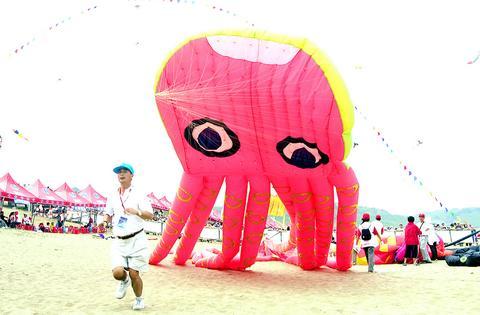
PHOTO: GEORGE TSORNG, TAIPEI TIMES
The deceit of the Shihmen kite festival is that there was never any tradition of kite-flying among the residents of this depopulated fishing village. Kite-flying was a popular activity during the Ching dynasty but the Japanese prohibited it during their occupation of the island for fear that locals might use kites to send signals. It hasn't become popular since because the area, once a thriving fishing community, has become depressed economically.
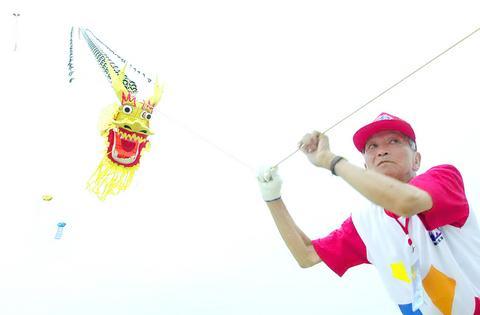
Then along came Hsu Chu-kuan (許主冠) of the Council for Cultural Affairs' Integrated Community Development Project. An avid kite-flyer himself, Hsu would spend weekends near the Huachung Bridge, one of the only places in the city to fly a kite. He conceived of the festival as a chance for local enthusiasts to meet their counterparts from the rest of Taiwan and abroad, and as a means of putting the wind back in the sails of Shihmen's economy by boosting tourism.
Residents there were taught how to make basic kite kits that could be sold for around NT$200 and assembled in just a few minutes. While this hasn't become a steady source of income for locals, it has provided an annual boost come festival-time.
Much of the reason for this is the attention the festival has attracted from overseas kite-flying enthusiasts. Japan, South Korea, Thailand and Malaysia each have kite festivals and many of these enthusiasts trace a line from one festival to the next, skipping Taiwan.
In the first year of the Shihmen Kite Festival, kite-flyers came from 16 different countries and brought with them huge, colorful and wildly imaginative kites. Ace flyers from the US Scott Hampton and Archie Stewart were also in attendance that year. Some 100,000 first-time flyers and spectators came as well and the festival has grown steadily since.
In the past few years, locals have taken a much more active role and have begun building their own extravagant kites. The kite kits they sell have become more extravagant, too, with jar-shaped kites, crab and box kites now on offer. But the truly impressive kites still come from overseas.
And speaking of crab, like every other festival in Taiwan, Shihmen's kite festival will have plenty of seafood being served up. All the more reason to go fly a kite.
To get to the Shihmen International Kite Festival by car from Taipei, take Highway 2 north past Danshui, Paishawan and Sanchih to Shihmen in the North Coast Scenic Area, then look for the kites hovering above the beach. Call (02) 2636 1580 or (02) 2636 4503 for more information.

Taiwan’s English education system is being pulled apart by three opposing forces. Bilingual Nation 2030 pulls students toward English and global communication. Artificial Intelligence (AI) readiness pulls them toward digital judgment, verification and AI-mediated work. But Taiwan’s old exam culture pulls them back toward memorization, grammar drills, timed reading and correct answers. If the education system keeps using old exams to define success, it risks producing graduates who are neither genuinely bilingual nor genuinely AI-ready, but trained for tasks machines can already perform. The first force is Bilingual Nation 2030. Launched in 2018, the policy aimed to “help Taiwan’s workforce connect

It seems every few days one bumps into one of those “real man” comments in which Taiwan is urged to “face reality” or similar, and “make a deal,” with the speaker implying that soon it will be too late. “Deal” advocates always present themselves as having a superior grip on reality, and the manly ability to make the “hard choice.” Their testosterone-laden language often echoes that of Taiwan sellout advocates. Note that such commentary always specifies a process (“make a deal, work with, make progress”), never the end state of what occupation by a violent authoritarian colonialist state will entail. In
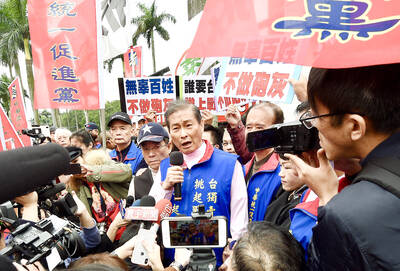
There are shadowy cabals plotting to sell out Taiwan to be annexed by China, by invasion if necessary. Fortunately, they are buffoons. In 2019, former Bamboo Union gangster and founder of the China Unification Promotion Party (CUPP), Chang An-le (張安樂, colorfully known as “White Wolf”), led a protest at the Legislative Yuan against comments made by then-premier Su Tseng-chang (蘇貞昌) that in the event of an attack by China, he would never surrender, but would protect the nation by fighting to the end, even if he only had a broom. Chang had party members bring a wooden casket that they
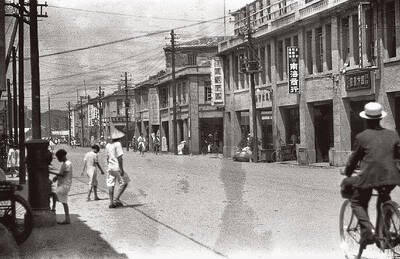
June 1 to June 7 "If all Taiwanese were as afraid of dying as you, then what would happen?” Physician Shih Chiang-nan (施江南) reportedly said this to his wife Chen Chiao-tung (陳焦桐) after she urged him to stop intervening on behalf of Taiwanese soldiers stranded overseas after serving in the Japanese Army during World War II. Shih had clashed with high-ranking officials over the issue, engaged in several heated arguments with Taiwan governor-general Chen Yi (陳儀) and allegedly shouted at general Ko Yuan-fen (柯遠芬), chief of staff of the Taiwan Garrison Command, over


 RSS
RSS