


Six Taiwanese films have been selected to go to the 9th Pusan International Film Festival (PIFF) in South Korea, which will be held from Oct. 7 through Oct. 15. The festival will screen 266 films from 63 countries: the greatest number of films from the highest number of countries in the history of PIFF.
Out of 266 films, 39 films are world premieres, which reflects the increasing significance of the event.
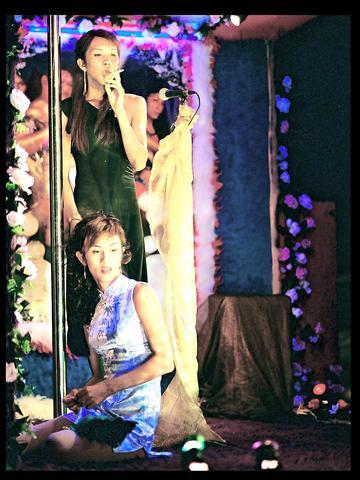
PHOTO COURTESY OF ZERO AND HOHO FILM
The opening film is Wong Kar Wai's (王家衛) new version of 2046, which has been re-filmed and re-edited since its screening at Cannes this year. Supposedly a sequel to the critically acclaimed In the Mood for Love (花樣年華, 2000), the film is expected to captivate the audience with Wong's signature style of sensual images.
The closing film is Daniel Byun's The Scarlet Letter. Followed by his feature directorial debut Interview in 2000, the film is expected to win favor from both the public and the critics due to its delicate camera work, mature performances from the actors and a well-refined plot.
Formula 17 (
Splendid Float tells of a Taiwanese man who works as a Taoist priest during the day and a drag queen in cabarets during the night.
Bear Hug is a drama about the need to care for children of divorced parents. A group of school kids scheme an abduction in order to raise the attention of their adult relatives.
As for Hou Hsiao-hsien's Cafe Lumiere, it's a Japan-Taiwan co-production about a love story between the owner of an antique bookstore in Tokyo and a woman who decides to become a single mom after an accidental pregnancy. The film is made as a tribute to Japanese film master Ozu Yasujiro.
At PIFF this year, Hou will also be receiving the award of Asian Filmmaker of the Year for his contribution to the development of Asian film industry.
Documentary Ocean Fever (海洋熱) by Chen Lung-nan (陳龍男), has been selected for the "Wide Angle" section, which showcases outstanding documentary and short films from Asia. In the film, Chen documented the process of young rock devotees struggling to compete in the Gong-liao Ho-Hai-Yan Rock Festival (貢寮海洋音樂祭).
Butterfly Lovers: Leon and Jo, (
"New Currents," the only competitive section of the festival, through which the future leaders of Asian cinema are discovered, selected 12 films for competition.
The section recognizes the works of first-time filmmakers from Asia and the winner will be given the New Currents Award at the closing ceremony. The Taiwanese entry this year is Hsu Fu-chun (徐輔軍) with his debut feature Holiday Dreaming (夢遊夏威夷), starring Tony Yang (楊佑寧), the young actor from Formula 17.
Last year's winner of the New Currents Award was Taiwanese filmmaker Lee Kang-sheng (

Taiwan’s English education system is being pulled apart by three opposing forces. Bilingual Nation 2030 pulls students toward English and global communication. Artificial Intelligence (AI) readiness pulls them toward digital judgment, verification and AI-mediated work. But Taiwan’s old exam culture pulls them back toward memorization, grammar drills, timed reading and correct answers. If the education system keeps using old exams to define success, it risks producing graduates who are neither genuinely bilingual nor genuinely AI-ready, but trained for tasks machines can already perform. The first force is Bilingual Nation 2030. Launched in 2018, the policy aimed to “help Taiwan’s workforce connect
It seems every few days one bumps into one of those “real man” comments in which Taiwan is urged to “face reality” or similar, and “make a deal,” with the speaker implying that soon it will be too late. “Deal” advocates always present themselves as having a superior grip on reality, and the manly ability to make the “hard choice.” Their testosterone-laden language often echoes that of Taiwan sellout advocates. Note that such commentary always specifies a process (“make a deal, work with, make progress”), never the end state of what occupation by a violent authoritarian colonialist state will entail. In

June 1 to June 7 "If all Taiwanese were as afraid of dying as you, then what would happen?” Physician Shih Chiang-nan (施江南) reportedly said this to his wife Chen Chiao-tung (陳焦桐) after she urged him to stop intervening on behalf of Taiwanese soldiers stranded overseas after serving in the Japanese Army during World War II. Shih had clashed with high-ranking officials over the issue, engaged in several heated arguments with Taiwan governor-general Chen Yi (陳儀) and allegedly shouted at general Ko Yuan-fen (柯遠芬), chief of staff of the Taiwan Garrison Command, over

“Taiwan’s Opposition Leader Comes to US With a Message Straight Out of Beijing” read a May 31 headline in the Wall Street Journal. Top US administration officials and members of Congress almost certainly read the WSJ, and if there was a bullet point takeaway that people in Washington should absorb ahead of Chinese Nationalist Party (KMT) Chair Cheng Li-wun’s (鄭麗文) arrival in DC on June 9, that headline is it. The last few columns have discussed this very topic, and the timing is not coincidental. While those top officials likely do not read the Taipei Times, judging by the number


 RSS
RSS