


Following The Last Great Wilderness, the curious thriller with which he made his directorial debut, David Mackenzie has adapted Young Adam, the bleak novel that Scottish beat author Alexander Trocchi wrote in 1954.
The film is a kind of psychological thriller set in and around Glasgow in the early 1950s, a time of high employment and low wages. From the opening shots that give the landscape a cold, blue-tinged look and the plaintive David Byrne music that accompanies them, Young Adam catches the sad, desperate feeling of the times.
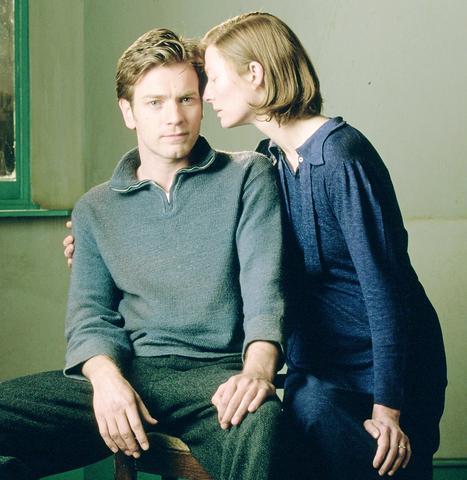
PHOTO COURTESY OF STAR BOULEVARD
It begins with the body of a young woman floating in the murky waters of the Clyde and fished out by two bargees, Les (Peter Mullan) and Joe (Ewan McGregor). Les is middle-aged, married to the resentful Ella and living with their seven-year-old son on a barge she owns called Atlantic Eve. Joe -- handsome, taciturn, in his late 20s -- lives with them, assisting Les in loading and unloading the cargoes they carry along the canals.
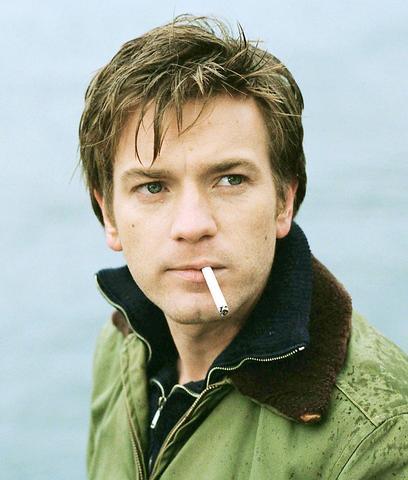
Theirs is an unromantic life of hard work and tedium, relieved by bouts of drinking. The dissatisfied Ella becomes Joe's passionate lover. In fact, without over-exerting himself, he also becomes the lover of another married woman and a widow, though he brings little in the way of affection or tenderness to his couplings. It almost seems that the women are punishing themselves for their carnality by having sex under the most miserable and dangerous conditions.
The newspapers record the story of the drowned girl; she's identified as Cathie (Emily Mortimer), a Glasgow office worker, and the police believe she is a murder victim. Headlines announce the arrest of her married boyfriend, a matter that becomes an obsessive subject in the pubs and streets of Clydeside.

Gradually, we learn by observing Joe's reactions and through a series of memories he has that Cathie was his lover and that he feels responsible for her accidental death. His finding her was coincidence certainly, but also destiny.
Trocchi's novel and this film have been compared with Camus' L'Etranger and Joe has been seen as some existential antihero, an ambitious would-be writer drifting around, angry and ineffectual after pitching his typewriter into the Clyde in a moment of despair.
The proper comparisons, it seems to me, are with the novels of Emile Zola, the French cinema of the 1930s and American movies of the postwar years. In Young Adam, we find Zola's sense of doom, the way his characters are trapped by fate, family and a malevolent society. The barge setting brings to mind the more lyrical L'Atalante of Jean Vigo and there are close resemblances to Renoir's 1938 version of Zola's La Bete Humaine and Fritz Lang's Hollywood adaptation of the same novel, Human Desire.
Young Adam is a cleverly constructed film that holds the attention throughout its economical 95 minutes. The naturalistic acting has considerable power, with Tilda Swinton giving a characteristically un-self-regarding performance and Ewan McGregor steering clear of easy charm. But it is a depressing film exuding hopelessness and inviting us to pity the characters rather than share in their tragic condition.

Taiwan’s English education system is being pulled apart by three opposing forces. Bilingual Nation 2030 pulls students toward English and global communication. Artificial Intelligence (AI) readiness pulls them toward digital judgment, verification and AI-mediated work. But Taiwan’s old exam culture pulls them back toward memorization, grammar drills, timed reading and correct answers. If the education system keeps using old exams to define success, it risks producing graduates who are neither genuinely bilingual nor genuinely AI-ready, but trained for tasks machines can already perform. The first force is Bilingual Nation 2030. Launched in 2018, the policy aimed to “help Taiwan’s workforce connect

It seems every few days one bumps into one of those “real man” comments in which Taiwan is urged to “face reality” or similar, and “make a deal,” with the speaker implying that soon it will be too late. “Deal” advocates always present themselves as having a superior grip on reality, and the manly ability to make the “hard choice.” Their testosterone-laden language often echoes that of Taiwan sellout advocates. Note that such commentary always specifies a process (“make a deal, work with, make progress”), never the end state of what occupation by a violent authoritarian colonialist state will entail. In
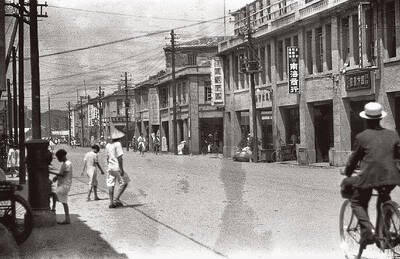
June 1 to June 7 "If all Taiwanese were as afraid of dying as you, then what would happen?” Physician Shih Chiang-nan (施江南) reportedly said this to his wife Chen Chiao-tung (陳焦桐) after she urged him to stop intervening on behalf of Taiwanese soldiers stranded overseas after serving in the Japanese Army during World War II. Shih had clashed with high-ranking officials over the issue, engaged in several heated arguments with Taiwan governor-general Chen Yi (陳儀) and allegedly shouted at general Ko Yuan-fen (柯遠芬), chief of staff of the Taiwan Garrison Command, over

“Taiwan’s Opposition Leader Comes to US With a Message Straight Out of Beijing” read a May 31 headline in the Wall Street Journal. Top US administration officials and members of Congress almost certainly read the WSJ, and if there was a bullet point takeaway that people in Washington should absorb ahead of Chinese Nationalist Party (KMT) Chair Cheng Li-wun’s (鄭麗文) arrival in DC on June 9, that headline is it. The last few columns have discussed this very topic, and the timing is not coincidental. While those top officials likely do not read the Taipei Times, judging by the number


 RSS
RSS