


Norfolk Island's view of itself as a South Pacific paradise free from crime, road rage, vice, gambling, drugs, fast food restaurants and even the mobile phone and AIDS was upset on a rainy Sunday afternoon two years ago when the body of Janelle Patton was found wrapped in black plastic at a picnic spot.
Patton, a newcomer among the 1,800 islanders who trace their ancestry back to the British sailors who overpowered Captain Fletcher Christian and took over the HMS Bounty in 1789, had sustained 64 separate injuries in an attack so frenzied it shocked coroner Ron Cahill.
"It's one of the worst cases I've seen in excess of 30 years in the criminal justice system," Cahill told an inquest three weeks ago.
It was the first murder on the island since 1855 when Norfolk ceased to be a penal colony and began its modern history as a self-governing Australian territory 1,400 kilometers east of Brisbane.
The 20km2 speck was settled by the descendants of the Bounty mutineers in 1856. They arrived there from Pitcairn Island with their Tahitian wives and an independent streak that is still reflected in the requirement that visitors from Australia need to bring their passports along.
Despite fingerprinting and DNA testing, a bevy of Canberra detectives and a media scrum, the killer of 29-year-old Patton has yet to be found and the coroner's inquest concluded with an open verdict. Now, the Canberra detectives are back on Norfolk Island investigating another murder.
The victim of the shooting this week is 60-year-old Ivens "Toon" Buffett, a Bounty descendant and one of the four ministers who ran Norfolk Island. Police say he was shot dead in his office by his son, 25-year-old Leith Buffett, who has been charged with his murder.
There is no obvious link with Patton's death in March 2002 but the father of the Sydney-born restaurant manager hopes that a second killing will help solve the riddle of the first.
"We feel that maybe some information could come from the island as a result of this that would be a result of people realizing that these things can happen, that Janelle's murder wasn't just maybe a one-off, they happen in all communities around the world," said Ron Patton, Janelle's father.
The Pattons, who were on the island the day their daughter was murdered in their first visit since honeymooning there in 1968, have voiced exasperation at the level of cooperation the locals have offered the police.
"We don't know who it was, and we are not going to judge people," Ron Patton said. "We're going to leave that to police."
The police, too, have been disappointed at the lack of cooperation. They had expected an easy case.
Every adult on the island at the time of the murder has filled in a questionnaire and detective Brendan Lindsay was optimistic of wrapping up the investigation quickly.
"We've got an isolated population and we can identify every individual that was on the island that day," he said at the start of the enquiry. "It's a matter of just narrowing things down."
Linday's optimism was misplaced.
Local newspaper editor Tom Lloyd, who earlier this year described Norfolk Island -- which relies on tourism, fishing and avocado growing -- as "an oasis of peace in a troubled world," has spoken of a stark change since the murders in people's perception of the place they call home.
"The mood is one of abject depression," Lloyd told Australia's ABC Radio. "To think that it's taken us a long, long time to get over Janelle Patton's murder."
Patton's bloody end revived a past that locals thought the passage of time had erased.
Discovered by Captain Cook in 1774, Norfolk Island was picked by the British as an ideal dumping ground for the very worst of its criminals because escape to the mainland was nearly impossible. It became a byword for institutionalized brutality.
The island was described by historian Robert Hughes in his seminal work The Fatal Shore as "the worst place in the English-speaking world" during its time as a repository for the dregs of the Empire.
It was a place once known as the Isle of Despair, Devil's Island or Ocean Hell.
Hughes records that one prisoner, Joseph Mansbury, was flogged with a knotted leather whip known as a jack-o'-nine-tails no less than 2,000 times in 36 months. His skinned shoulder blades, a jailer recorded, poked out "like two polished horns."
Norfolk Island was considered such a hell-hole that some prisoners killed others in order to escape their misery on the gallows through their own death.

Taiwan’s English education system is being pulled apart by three opposing forces. Bilingual Nation 2030 pulls students toward English and global communication. Artificial Intelligence (AI) readiness pulls them toward digital judgment, verification and AI-mediated work. But Taiwan’s old exam culture pulls them back toward memorization, grammar drills, timed reading and correct answers. If the education system keeps using old exams to define success, it risks producing graduates who are neither genuinely bilingual nor genuinely AI-ready, but trained for tasks machines can already perform. The first force is Bilingual Nation 2030. Launched in 2018, the policy aimed to “help Taiwan’s workforce connect

It seems every few days one bumps into one of those “real man” comments in which Taiwan is urged to “face reality” or similar, and “make a deal,” with the speaker implying that soon it will be too late. “Deal” advocates always present themselves as having a superior grip on reality, and the manly ability to make the “hard choice.” Their testosterone-laden language often echoes that of Taiwan sellout advocates. Note that such commentary always specifies a process (“make a deal, work with, make progress”), never the end state of what occupation by a violent authoritarian colonialist state will entail. In

There are shadowy cabals plotting to sell out Taiwan to be annexed by China, by invasion if necessary. Fortunately, they are buffoons. In 2019, former Bamboo Union gangster and founder of the China Unification Promotion Party (CUPP), Chang An-le (張安樂, colorfully known as “White Wolf”), led a protest at the Legislative Yuan against comments made by then-premier Su Tseng-chang (蘇貞昌) that in the event of an attack by China, he would never surrender, but would protect the nation by fighting to the end, even if he only had a broom. Chang had party members bring a wooden casket that they
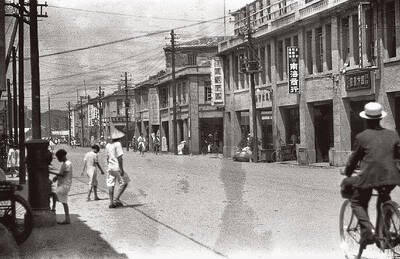
June 1 to June 7 "If all Taiwanese were as afraid of dying as you, then what would happen?” Physician Shih Chiang-nan (施江南) reportedly said this to his wife Chen Chiao-tung (陳焦桐) after she urged him to stop intervening on behalf of Taiwanese soldiers stranded overseas after serving in the Japanese Army during World War II. Shih had clashed with high-ranking officials over the issue, engaged in several heated arguments with Taiwan governor-general Chen Yi (陳儀) and allegedly shouted at general Ko Yuan-fen (柯遠芬), chief of staff of the Taiwan Garrison Command, over


 RSS
RSS