


Mexico this week marks the 50th anniversary of Frida Kahlo's death with a series of retrospectives but also with the launching of a line of products bearing the name of the iconic, communist painter.
A feminist icon and a close friend of Russian communist leader Leon Trotsky during her lifetime, Kahlo, who died on July 13, 1954, has now fallen prey to what critics decry as crass commercialism.
To mark the anniversary, her niece Isolda Pinedo Kahlo will launch this week the "Frida Kahlo" line, that includes shawls, jewelry and sunglasses.
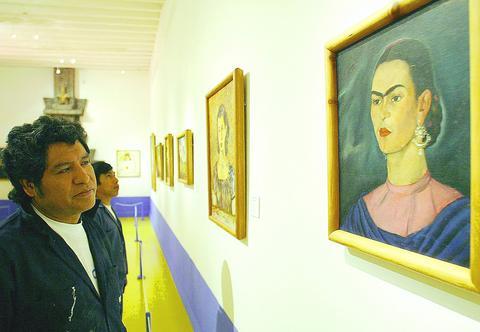
PHOTO: REUTERS
Prices start at US$100. The most Frida ever got for a painting was US$300.
The Kahlo family, which did not inherit the artist's works, has registered the name and signature of the painter as a trademark.
"The family has the right to use the name commercially," said Alejandro Trad, who is Pinedo Kahlo's business representative.
But Pinedo Kahlo has no rights to the paintings, which Frida's husband, muralist Diego Rivera, had donated to a foundation.
Further stirring controversy Pinedo Kahlo, 75, is set to publish a book that suggests Rivera helped Frida die.
"We reveal a great family secret," says Maria de Anda, the artist's great niece who compiled the book Frida Intima -- Spanish for "intimate Frida."
An anguished painter who suffered intense physical pain after being stricken by polio and severely wounded in a bus crash, Frida spent the last hours of her life in a semi-comatose state caused by pain-killers, according to art critic and biographer Raquel Tibol.
Her physical pain and her inability to have children were common themes in her paintings, many of which were shocking, bloody self-portraits.
After her death, Frida became "first a legend, then a myth, and now a cult figure," Hayden Herrera wrote in a 1992 biography of the Mexican artist.
The commercialization of Frida, whose images adorn calenders and greeting cards and whose tragic and turbulent life was recounted in a 2002 Hollywood movie, has outraged some members of her family.
"It is surprising to see her transformed into a commercial trademark," said photographer Cristina Kahlo, a niece of Frida, who describes the artist as "a fierce communist."
"In more than 20 years of being involved in culture, I have never seen an artist becoming a trademark," she said.
Tibol also expressed outrage over the commercial use of the rebellious artist's name.
"Anything that falls into Isolda's hands become a question of money, of great vulgarity," Tibol said.
Rivera's grandson Juan Coronel said it was a good thing the Frida family did not inherit the artist's works.
"Had it not been for Diego, the Frida paintings that are in Mexico would have been sold abroad," said Coronel, who will curate one of several anniversary exhibitions that opens this week in Mexico City.
In all, five exhibitions, several conferences, movie screenings and at least four new books will mark the half-century since Frida died of pneumonia just a few days after her 47th birthday.
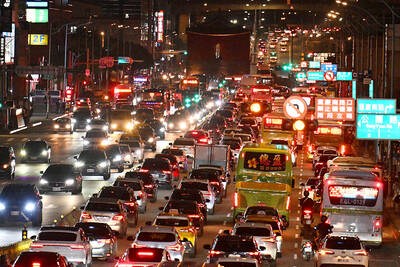
By global standards, the traffic congestion that afflicts Taiwan’s urban areas isn’t horrific. But nor is it something the country can be proud of. According to TomTom, a Dutch developer of location and navigation technologies, last year Taiwan was the sixth most congested country in Asia. Of the 492 towns and cities included in its rankings last year, Taipei was the 74th most congested. Taoyuan ranked 105th, while Hsinchu County (121st), Taichung (142nd), Tainan (173rd), New Taipei City (227th), Kaohsiung (241st) and Keelung (302nd) also featured on the list. Four Japanese cities have slower traffic than Taipei. (Seoul, which has some

In our discussions of tourism in Taiwan we often criticize the government’s addiction to promoting food and shopping, while ignoring Taiwan’s underdeveloped trekking and adventure travel opportunities. This discussion, however, is decidedly land-focused. When was the last time a port entered into it? Last week I encountered journalist and travel writer Cameron Dueck, who had sailed to Taiwan in 2023-24, and was full of tales. Like everyone who visits, he and his partner Fiona Ching loved our island nation and had nothing but wonderful experiences on land. But he had little positive to say about the way Taiwan has organized its

Michael slides a sequin glove over the pop star’s tarnished legacy, shrouding Michael Jackson’s complications with a conventional biopic that, if you cover your ears, sounds great. Antoine Fuqua’s movie is sanctioned by Jackson’s estate and its producers include the estate’s executors. So it is, by its nature, a narrow, authorized perspective on Jackson. The film ends before the flood of allegations of sexual abuse of children, or Jackson’s own acknowledgment of sleeping alongside kids. Jackson and his estate have long maintained his innocence. In his only criminal trial, in 2005, Jackson was acquitted. Michael doesn’t even subtly nod to these facts.
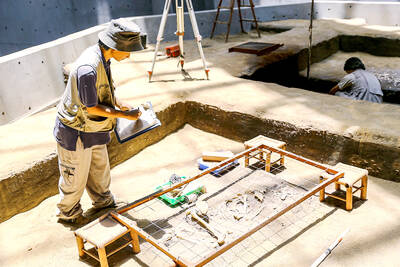
Writing of the finds at the ancient iron-working site of Shihsanhang (十 三行) in New Taipei City’s Bali District (八里), archaeologist Tsang Cheng-hwa (臧振華) of the Academia Sinica’s Institute of History and Philology observes: “One bronze bowl gilded with gold, together with copper coins and fragments of Tang and Song ceramics, were also found. These provide evidence for early contact between Taiwan aborigines and Chinese.” The Shihsanhang Web site from the Ministry of Culture says of the finds: “They were evidence that the residents of the area had a close trading relation with Chinese civilians, as the coins can be


 RSS
RSS