


Visitors to Checkpoint Charlie, Berlin's Cold War border crossing, have been startled to find it manned by menacing East German border guards bellowing orders through loudspeakers and offering to search cars.
Strutting up and down the street with visa stamps at the ready, they could be mistaken for unemployed Communist coppers pining for the Berlin Wall and determined to relive the past.
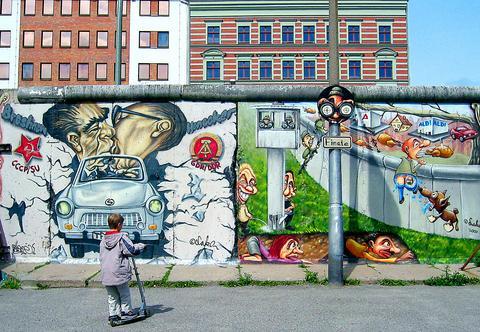
PHOTO: REUTERS
In fact they're actors in original uniforms charging one euro to pose in photographs -- a new tourist attraction in a city where traces of the Cold War are fast disappearing, to the dismay of tourists.
"Sometimes we board tour buses and go up the aisle demanding to stamp documents," said Tom Luszeit, 30, clad in a green uniform of the Volkspolizei, East
Germany's police force.
"We have had cars pull over thinking we really want to search them. Some people come up to us asking in fake East German accents to be searched."
Others offer them bananas, once a rare delicacy in the command economy of the Communist German Democratic Republic.
Luszeit came up with the idea and got permission from the Berlin city authorities after two years of trying. He has been operating the Checkpoint at weekends for several months with a troupe of 10 fellow actors. Three go on patrol at a time.
Checkpoint Charlie divided the US and Soviet sectors of Berlin and was one of the most famous symbols of the Cold War. It was a crossing point for foreigners such as Allied diplomats, soldiers and western tourists.
Luszeit and his comrades, one dressed as an East German army major, were a hit with passing tourists as they handed out Communist era soldiers' caps and posed with them for souvenir photos in front of a replica Allied guardhouse and US flag.
Their position on the US side of the former border is historically inaccurate, but they did not get permission to station themselves further down the street on the eastern side.
"History is being forgotten so we thought we'd do something about it," said Luszeit, who also works as a stripper when not not on patrol.
"We tell people about the Wall. More of it should have been left intact as a reminder. They should also have left the watchtower and the barriers here."
"People don't know their East from their West anymore. When you ask them to point out which was which, many take a look at the grotty buildings in the west and say that was East Berlin."
Most of the 156km Wall has been removed since its legendary breach in 1989 brought down the Iron Curtain that had divided Europe for 40 years.
New office buildings and stores have filled what used to be the brooding, gray center of East Berlin, and it's the west of the city that is starting to look worse for wear.
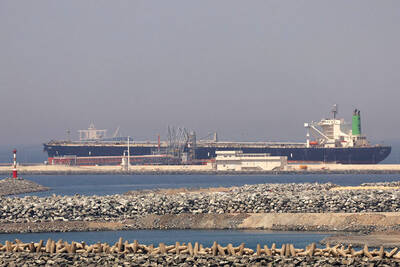
The breakwater stretches out to sea from the sprawling Kaohsiung port in southern Taiwan. Normally, it’s crowded with massive tankers ferrying liquefied natural gas from Qatar to be stored in the bulbous white tanks that dot the shoreline. These are not normal times, though, and not a single shipment from Qatar has docked at the Yongan terminal since early March after the Strait of Hormuz was shuttered. The suspension has provided a realistic preview of a potential Chinese blockade, a move that would throttle an economy anchored by the world’s most advanced and power-hungry semiconductor industry. It is a stark reminder of
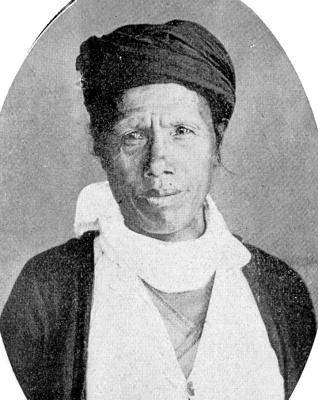
May 11 to May 17 Traversing the southern slopes of the Yushan Range in 1931, Japanese naturalist Tadao Kano knew he was approaching the last swath of Taiwan still beyond colonial control. The “vast, unknown territory,” protected by the “fierce” Bunun headman Dahu Ali, was “filled with an utterly endless jungle that choked the mountains and valleys,” Kano wrote. He noted how the group had “refused to submit to the measures of our authorities and entrenched themselves deep in these mountains … living a free existence spent chasing deer in the morning and seeking serow in the evening,” even describing them as
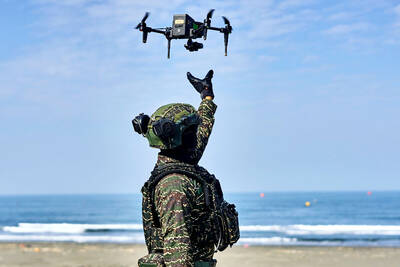
The last couple of weeks spectators in Taiwan and abroad have been treated to a remarkable display of infighting in the Chinese Nationalist Party (KMT) over the supplementary defense budget. The party has split into two camps, one supporting an NT$800 billion special defense budget and one supporting an NT$380 billion budget with additional funding contingent on receiving letters of acceptance (LOA) from the US. Recent media reports have said that the Taiwan People’s Party (TPP) is leaning toward the latter position. President William Lai (賴清德) has proposed NT$1.25 trillion for purchases of US arms and for development of domestic weapons
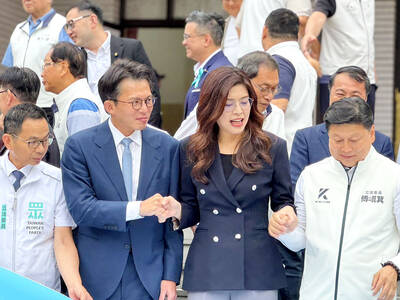
As a different column was being written, the big news dropped that Chinese Nationalist Party (KMT) caucus whip Fu Kun-chi (傅?萁) announced that negotiations within his caucus, with legislative speaker Han Kuo-yu (韓國瑜) of the KMT, party Chair Cheng Li-wun (鄭麗文), Taichung Mayor Lu Shiow-yen (盧秀燕) and Taiwan People’s Party (TPP) Chair Huang Kuo-chang (黃國昌) had produced a compromise special military budget proposal. On Thursday morning, prior to meeting with Cheng over a lunch of beef noodles, Lu reiterated her support for a budget of NT$800 or NT$900 billion — but refused to comment after the meeting. Right after Fu’s


 RSS
RSS