


When the artist who calls himself Abugy (
It was one of those moments when children shock adults with their immediate and spot-on insight, because the ring in a bull's nose is an image used in the practice of Zen meditation, of which Abugy is a devoted student. His paintings are a reflection of his ongoing inner search, and the fact that his son happened coincidentally upon a Zen image reinforced his belief that enlightenment entails achieving the totally free consciousness of a child. Along with meditation and studying, painting is one way in which he aims to get to that point.
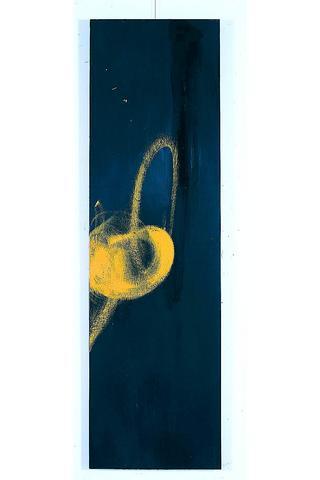
Ring on the Bull's Nose features over 20 oil paintings, almost all of then completed this year and which earned Abugy -- whose name is a Mandarin phoneticization of a Japanese term for fat boy -- the Liao Chi-chun Oil Painting Award for outstanding young artists (Abugy is 39).
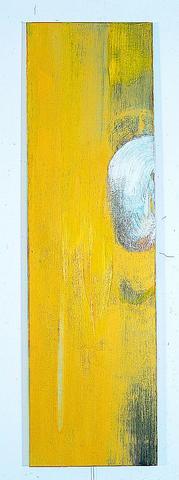
It's difficult to discern if the paintings are tools for meditation or the results of it. No matter which they are, the meditative aspect in each image comes though in the blur of colors that Abugy says tries to break down the time-space continuum. And there is unquestionably a force in many of the canvases that draws the viewer in so that several minutes could slip by in what seems like a mere second.
Viewing the paintings, according to Abugy, should be an experience similar to his own in making them -- they need a clear and peaceful mind. For him, working in this way has become a lifestyle, which he describes as pure and simple and basically the antithesis of the hip, urban artist, whom he views with thinly veiled scorn. Too many people involved in art, he said, are seeking some form of self-aggrandizement, or at the very least, desire the public's applause. One could say that he's more interested in the sound of one hand clapping and the impenetrable logic puzzles that his images raise.
Abugy is hardly the first to use oil on canvas for conceptual pieces that delve explicitly into Buddhist philosophies, but his use of color and form achieves a rare kind of grace that begs for a longer look, even though he says they don't require any more time than a split second.

For many people, Bilingual Nation 2030 begins and ends in the classroom. Since the policy was launched in 2018, the debate has centered on students, teachers and the pressure placed on schools. Yet the policy was never solely about English education. The government’s official plan also calls for bilingualization in Taiwan’s government services, laws and regulations, and living environment. The goal is to make Taiwan more inclusive and accessible to international enterprises and talent and better prepared for global economic and trade conditions. After eight years, that grand vision is due for a pulse check. RULES THAT CAN BE READ For Harper Chen (陳虹宇), an adviser
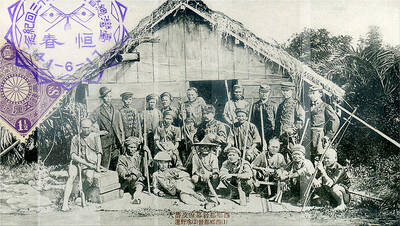
Traditionally, indigenous people in Taiwan’s mountains practice swidden cultivation, or “slash and burn” agriculture, a practice common in human history. According to a 2016 research article in the International Journal of Environmental Sustainability, among the Atayal people, this began with a search for suitable forested slopeland. The trees are burnt for fertilizer and the land cleared of stones. The stones and wood are then piled up to make fences, while both dead and standing trees are retained on the plot. The fences are used to grow climbing crops like squash and beans. The plot itself supports farming for three years.

President William Lai (賴清德) on Nov. 25 last year announced in a Washington Post op-ed that “my government will introduce a historic US$40 billion supplementary defense budget, an investment that underscores our commitment to defending Taiwan’s democracy.” Lai promised “significant new arms acquisitions from the United States” and to “invest in cutting-edge technologies and expand Taiwan’s defense industrial base,” to “bolster deterrence by inserting greater costs and uncertainties into Beijing’s decision-making on the use of force.” Announcing it in the Washington Post was a strategic gamble, both geopolitically and domestically, with Taiwan’s international credibility at stake. But Lai’s message was exactly

May 4 to May 10 It was once said that if you hadn’t performed at the Sapphire Grand Cabaret (藍寶石大歌廳), you couldn’t truly be considered a star. Taking the stage at the legendary Kaohsiung club was more than just a concert. Performers were expected to entertain in every sense, wearing outlandish or revealing costumes and staying quick on their feet as sharp-tongued, over-the-top hosts asked questions and delivered jokes that would be seen as vulgar, even offensive, by today’s standards. Opening in May 1967 during a period of strict political and social control, Sapphire offered a rare outlet for audiences in


 RSS
RSS