


Ten years ago in Tungshan township (東山鄉), a small town in Tainan County, drinking a cup of coffee was a luxurious treat for foreigners. Four generations of farmers in the town drank tea daily, like most Taiwanese, but now making, sipping and talking about coffee has become a daily routine for most residents.
They visit each other, exchange ideas about growing coffee trees and roasting methods and compare harvests with each other. As a result, this small town has gained a reputation for coffee that has attracted TV crews, writers and broadcasters alike.

Taiwan is well known for growing rice, tea and tropical fruit, but it also has a history of growing coffee for more than two centuries. Taiwan is in a subtropical zone -- similar weather to most coffee-growing countries -- and has mountainous areas in which coffee does well, thriving on the fluctuations of temperature found at high altitudes. Tungshan is a mountainous area 800m to 1200m above sea level and is one of four coffee-growing areas in Taiwan.
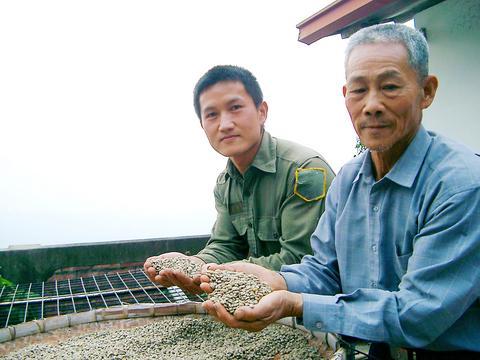
Kuo Ya-tsong (
business.
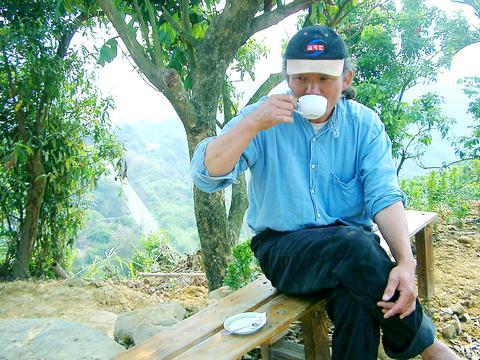
"Each coffee tree was grown by my hands," said Kuo Ya-tsong. His coffee farm and garden is called Ta Chu Hua Chien (
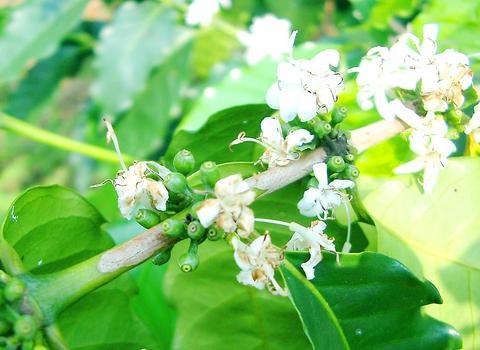
PHOTO: YU SEN-LUN, TAIPEI TIMES
The other three coffee-growing areas in Taiwan are: the Huisun Forest Farm (
Three areas all grow the Caffea Arabica plant. The are two stories regarding the origin of Taiwan's coffee growing. One says that 19th century British merchants brought some coffee plantlets from Manila and began growing coffee in northern Taiwan. Another story says the Japanese brought coffee to Taiwan in the early 20th century. The marketing of coffee was stopped because of World War II, when Taiwanese coffee farmers went back to rice-growing.
Now, because of Taiwan's fast-developing coffee drinking tendencies, coffee growing is back in business. "Tungshan is an interesting place because people who grow coffee don't usually have the habit of drinking coffee. But we do," said Shi Ling-lan, adding she and her husband are the "new immigrants within the island."
The couple used to work in the publishing business in Taipei. In 1991 they gave it up and went to the countryside looking for a new and rural life. The coffee in Ta Chu Hua Chien is not only organic, it is also roasted with innovative and precise roasting methods. Kuo's experienced hands have crafted a very smooth blend. Beside the coffee farm, the couple has also set up an "ecology classroom" which offers tourists a short walk around the mountain and aims to impart knowledge about local plants, snakes, eagles and pangolins. Shi occasionally offers classes to create handicrafts out of coffee.
The path around Kuo's garden is lined by cotton trees. The air is thick with the scents of coffee trees (similar to Jasmine) and lemon grass, which they grow beside the path. There are simply designed stones and wooden benches in the garden, with a nice view. Sitting down, sipping a cup of coffee, one can view the line of hills and the fishing harbor in Chiayi.
Originally Tungshan was better known for producing oranges and longans, but now dozens of households are growing the bean.
Tseng Ching-chiang (
As more farmers emerged in Tungshan, the Tseng's restarted their coffee farming. Their new coffee house has a distinctive Taiwanese style. The coffee beans are dried in a Chinese-style bamboo tray, one used to dry tea leaves. "We roast the coffee beans with woks," said Tseng Chien-nan.
He said his grandfather used to grind coffee with a Chinese mortar and pestle, the kind used for Chinese medicine. There is also an item on the menu called "coffee chicken." Tseng said it was a brick-kiln roasted chicken, but marinated in coffee dregs.
According to statistics from the Taiwan Coffee Association, Taiwan's coffee consumption is growing at a rate of 120 percent annually. There are roughly 10,000 cafes in Taiwan. As for the coffee chains, the biggest chain store, Starbucks has opened 110 branches and net profits of Starbucks in Taiwan is likely to reach NT$200 million this year.
"The younger generation are coffee drinkers and they have exceeded the tea-drinking people now," said Travis Lee, owner of Yeats Cafe in Taipei. He has been running his cafe for eight years and is increasingly facing tight competition, with six other cafes in just a small lane on Siping street.
Currently, according to the Agriculture Bureau of Tainan County Government, coffee farms in Tungshan township comprise an area of about 35 hectares, with 15 households growing coffee. The production amount is still too small (less than 500kg a year) to distribute nationwide.
Also, there is a quality-control problem. From the growing process, to roasting methods, there is plenty of room for improvement.
Shi Li-ling pointed out a common problem for Taiwanese farmers after the country joined the WTO. "The price of agricultural products has become very unstable and they're all very insecure about the future. So they tend to grow this and that altogether. But each farm is very small," Shi Li-lang said out. For example, on land of less than 1 hectare, oranges, longans, ginger and coffee was being grown.
Kuo and Shi's coffee farm is smaller than a hectare and does well to make ends meet. "Making a profit is not the main thing for us. What we are working for is a simple and natural lifestyle, hopefully it will come from our alternative coffee growing," Shi said.
The Tseng family said it was also willing to continue growing coffee. "If this does not make money, I at least hope to pass down my grandfather's tradition to my sons," Tseng said.
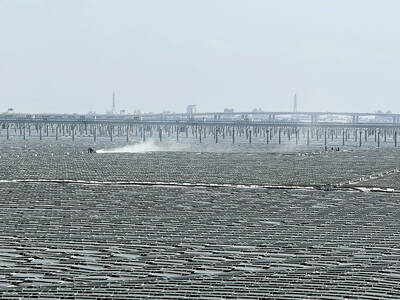
The arithmetic is straightforward and uncomfortable. By the end of 2025, Taiwan had committed itself to a 50-30-20 electricity mix — half natural gas, 30 per cent coal, 20 per cent renewables. The Ministry of Economic Affairs’s (MOEA) own monthly energy reports tell a different story. Natural gas reached 47.8 per cent of generation last year. Coal stood at 35.4 per cent, comfortably above its target ceiling. Renewables came in at 13.1 per cent, well short of the 20 per cent Taipei had pledged a decade earlier. Installed renewable capacity reached roughly half of the 12 gigawatts (GW) the government
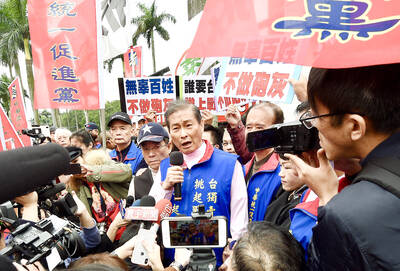
There are shadowy cabals plotting to sell out Taiwan to be annexed by China, by invasion if necessary. Fortunately, they are buffoons. In 2019, former Bamboo Union gangster and founder of the China Unification Promotion Party (CUPP), Chang An-le (張安樂, colorfully known as “White Wolf”), led a protest at the Legislative Yuan against comments made by then-premier Su Tseng-chang (蘇貞昌) that in the event of an attack by China, he would never surrender, but would protect the nation by fighting to the end, even if he only had a broom. Chang had party members bring a wooden casket that they
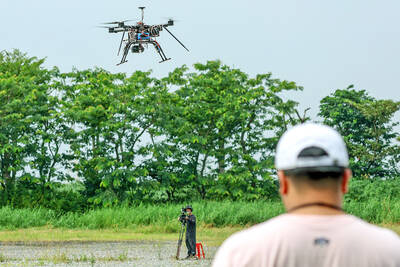
Taiwan’s drone exports are taking off, fuelled by the war in Ukraine, as Taiwanese companies seek a stake in the fast-growing global market for unmanned aerial vehicles (UAV). Low-cost drones used for reconnaissance and strikes are in high demand as governments around the world boost defense spending in the face of intensifying conflicts. A relative new player in the increasingly competitive industry, Taiwan’s pitch is to be an “Asian hub” for the production of UAVs and components free of Chinese materials, or “non-red.” That means its UAVs can be up to three times more expensive than their Chinese competitors, like the world’s biggest
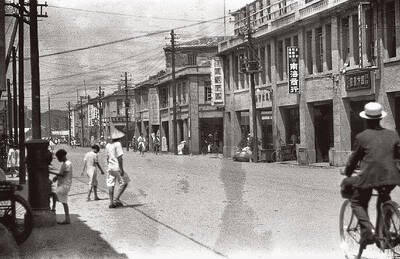
June 1 to June 7 "If all Taiwanese were as afraid of dying as you, then what would happen?” Physician Shih Chiang-nan (施江南) reportedly said this to his wife Chen Chiao-tung (陳焦桐) after she urged him to stop intervening on behalf of Taiwanese soldiers stranded overseas after serving in the Japanese Army during World War II. Shih had clashed with high-ranking officials over the issue, engaged in several heated arguments with Taiwan governor-general Chen Yi (陳儀) and allegedly shouted at general Ko Yuan-fen (柯遠芬), chief of staff of the Taiwan Garrison Command, over


 RSS
RSS