


From the outside, Mama Chao looks like an ordinary Chinese restaurant, situated in the alley behind the Sherwood Hotel. But the food served inside is sure to impress and will make you want to come back again.
The cuisine at Mama Chao is a mixture of Sichuan, Shanghai, Hakka, Hunan and, sometimes, Thai and Korean. From the menu you can choose typical dishes from all these countries and regions, all favorite foods of the owner Richard Chang (張迎誠). He says he likes to go around tasting all kinds of gourmet meals and enjoys mixing and matching, inventing new flavors and presenting the results on his extensive menu.
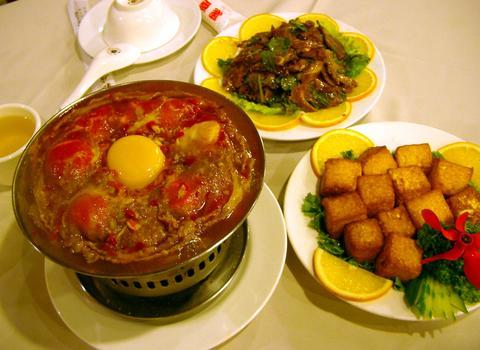
PHOTO: YU SEN-LUN, TAIPEI TIMES
Contrasting, perhaps, with the name of the restaurant, the general tastes of Mama Chao are strong and masculine, reflecting the outlook of Richard Chang -- a tall, big, northern Chinese man. Chang explained that the restaurant's name was inherited from the previous owner, who had an entirely different style of cuisine.
Spicy kimchi beef (辣泡菜牛肉) is an enjoyable dish from the point of view of its look and taste. Kimchi soup in a small heated pot has thin slices of beef on top and an egg yolk in the middle. When served, Korean chili sauce is poured on the meat and then the egg is broken on top of it and stirred. The mixture of kimchi, chili and sauce may cause a few tears but it does add to the taste of the beef.
Mix and stir (攪和攪和) is the name of a cold meat dish which is a good choice for starters. It is made of slices of beef loin, beef tendon and stomach, all of which have been previously stewed and cooled. The meat is mixed and stirred with the home-made Sichuan spicy hot sauce to enrich the flavor.
Country spare-rib (鄉村排骨) is a dish which is popular among foreign guests. The rib is first fried so the meat sauce is absorbed, and then it is quickly sauteed. To serve, you dip the rib with another house-made chili sauce. For a lighter taste try "old skin, tender meat" (老皮嫩肉), which is actually fried egg and tofu. Brand-name cabbage (招牌高麗菜) is cabbage stir-fry sprinkled with dried fish slices, which are also tasty.
You can also invent your own dishes. For example, you can mix your beef with either broccoli or cashew nuts. For your own stir-fry, tell the chef you want white sauce or brown sauce, spicy or non-spicy.

Taiwan’s English education system is being pulled apart by three opposing forces. Bilingual Nation 2030 pulls students toward English and global communication. Artificial Intelligence (AI) readiness pulls them toward digital judgment, verification and AI-mediated work. But Taiwan’s old exam culture pulls them back toward memorization, grammar drills, timed reading and correct answers. If the education system keeps using old exams to define success, it risks producing graduates who are neither genuinely bilingual nor genuinely AI-ready, but trained for tasks machines can already perform. The first force is Bilingual Nation 2030. Launched in 2018, the policy aimed to “help Taiwan’s workforce connect
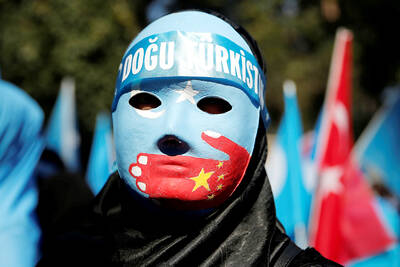
It seems every few days one bumps into one of those “real man” comments in which Taiwan is urged to “face reality” or similar, and “make a deal,” with the speaker implying that soon it will be too late. “Deal” advocates always present themselves as having a superior grip on reality, and the manly ability to make the “hard choice.” Their testosterone-laden language often echoes that of Taiwan sellout advocates. Note that such commentary always specifies a process (“make a deal, work with, make progress”), never the end state of what occupation by a violent authoritarian colonialist state will entail. In
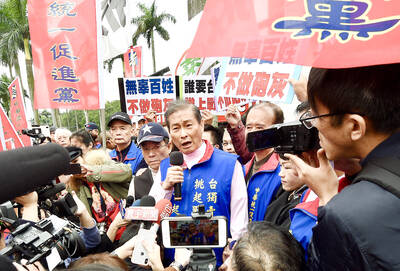
There are shadowy cabals plotting to sell out Taiwan to be annexed by China, by invasion if necessary. Fortunately, they are buffoons. In 2019, former Bamboo Union gangster and founder of the China Unification Promotion Party (CUPP), Chang An-le (張安樂, colorfully known as “White Wolf”), led a protest at the Legislative Yuan against comments made by then-premier Su Tseng-chang (蘇貞昌) that in the event of an attack by China, he would never surrender, but would protect the nation by fighting to the end, even if he only had a broom. Chang had party members bring a wooden casket that they
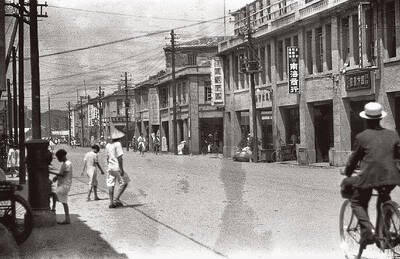
June 1 to June 7 "If all Taiwanese were as afraid of dying as you, then what would happen?” Physician Shih Chiang-nan (施江南) reportedly said this to his wife Chen Chiao-tung (陳焦桐) after she urged him to stop intervening on behalf of Taiwanese soldiers stranded overseas after serving in the Japanese Army during World War II. Shih had clashed with high-ranking officials over the issue, engaged in several heated arguments with Taiwan governor-general Chen Yi (陳儀) and allegedly shouted at general Ko Yuan-fen (柯遠芬), chief of staff of the Taiwan Garrison Command, over


 RSS
RSS