


Located on the western peripheries of the Central Mountain Range where Taichung and Nantou counties meet, Basianshan, or Eight Immortals Mountain (
Since it opened in the mid-1970s the park has been a popular destination for local tourists from nearby Taichung City looking to get away from the hustle and bustle.
Before becoming a place to play Basianshan was a major center for the logging industry. Established in 1914 during Japanese colonial rule the logging that once took place in the immediate area was responsible for decimating roughly 14,000 hectares of red wood forest.
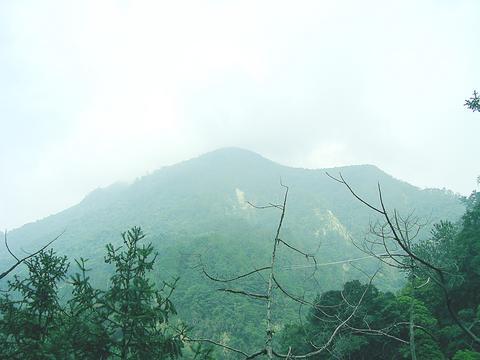
PHOTO: GAVIN PHIPPS, TAIPEI TIMES
"It was the Japanese who first opened up the area to extensive logging in the early 1990s. Not that the wood was used for building in Taiwan, nearly all of it was shipped to Japan," said park warden, Chiang Wen-chuan (蔣萬傳). "There's not much left of their legacy here anymore."
Unlike Alishan and Taipingshan, very little remains of Basianshan's questionably glorious past. There are no rail tracks and no small gauge trains to whisk visitors around. There are no old logging buildings, the old cable car is no more and disused and rusting equipment that visitors might wish to gawk at is non-existent.
In fact, with the exception of two pieces of concrete -- the only surviving vestige of a Japanese temple -- and a handful of signs adorned with old logging related photographs you'd be hard pressed to believe that anything save family picnics and blissful Sunday strolls had ever taken place there.
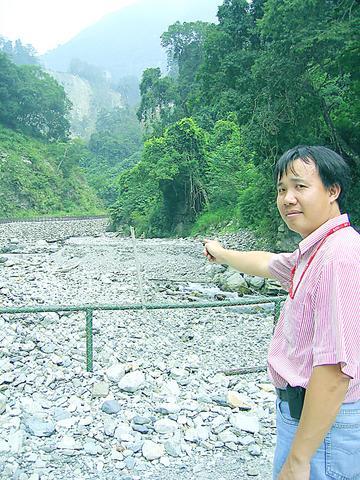
PHOTO: GAVIN PHIPPS, TAIPEI TIMES
The peace, however, was shattered after Mother Nature played not just one, but two cruel tricks on Basianshan in the space of two years. The first of these being the 921 earthquake and then, two years later, typhoons Toraji and Nari.
On both occasions entire mountainsides collapsed, burying the parks entrances and many of the adjoining roads under meters of rubble. The park's once picturesque Shiwen (
"It was a terrible two years. First we had the 921 earthquake and then the typhoons. Between them they destroyed much of the parks' scenery and many of its paths and roads," said Hong Chi-tsai (
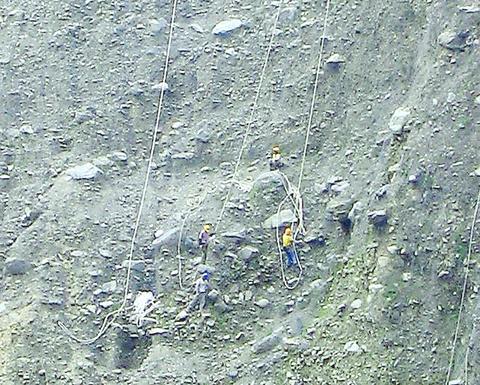
PHOTO: GAVIN PHIPPS, TAIPEI TIMES
While many of the scenic scars remain apparent today the park has returned to some semblance of normality. Over the past two years the Forestry Bureau under the auspices of the Central Government has spent over NT$1billion to restore the area to its former splendor.
"We had to basically close parts of the park for nearly two years because it was simply far too dangerous for people to walk around," explained the Forestry Bureau's Huang Wen-teng (黃文騰).
"Looking at it now, it's quite incredible how much of a difference the work has made. Even though many of the mountainsides are now reinforced with concrete the visitor would never know [about the destruction]. It looks as natural as it was before."
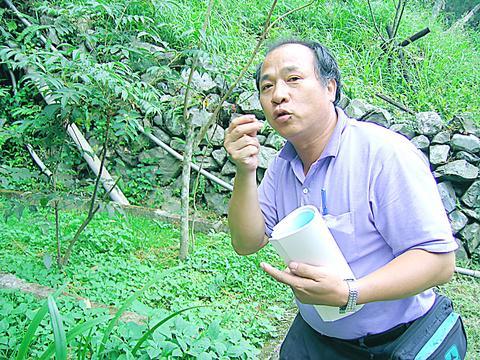
PHOTO: GAVIN PHIPPS, TAIPEI TIEMS
In order to ensure that the park and surrounding forest area looks as natural as possible rather than one huge man-made mountain, the Forestry Bureau used a special lightweight concrete base.
Instead of plastering it on the defoliated mountain slopes in heavy layers the concrete was applied with a special spray gun. Seedlings were then planted and water ducts added to channel future runoff.
Since the park reopened for business two years ago families have returned to picnic, hiking associations are again treading the park's restored pathways and visitors of all ages are once again setting out to discover Basianshan's many pleasures.
This summer saw a total of 15,786 people choosing to visit the park in August alone. It's a number, that, while on the surface may appear insignificantly small is, according to Hong a milestone in the park's recent, rather cheerless history.
"It's a great boost to us and even more so when you consider that the figures for this August are up 50 percent on last year," Hong said. "In fact, with the exception of January, when only roughly 6,000 people came here, the number of people coming here during the weekends and public holidays this year has surpassed all expectations."
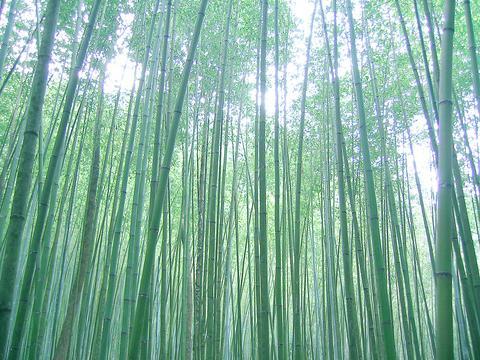
Covering an area of 2,492 hectares, the park offers visitors an array of vistas to enjoy and walks and environments in which to relax. Along with hardwood forested areas, the park has a bamboo forest in which visitors are encouraged to leave the pathways and roam around.
One of the park's uniquely interesting features is the small yet comprehensive plot of land informing visitors about the area's edible and poisonous flora.
Along with giving a brief introduction to each toxic plant, signs -- none of which are in English -- also point out the effects on the human body of eating or touching the respective flora.
While park officials believe such information is vital to anyone who decides to go trekking in Taiwan's boondocks, they don't advise the uninitiated to devour flora at random. This, according to Chiang, should on be done as a last resort and with expert guidance.
The park and surrounding hillsides can be explored in a day, but the recreational area does offer accommodation for overnight or weekend stays. The eight private cabins that can house up to four people, the small hotel and dorms with space for 52 people are pretty comfortable and offer all the standard amenities.
A well-trodden 6km-long pathway that snakes its way to the peak of Basianshan, which at 2,424m above sea level, offers some stunning views of the Central Mountain Range, means that relatively fit visitors can ascend the summit and descend in roughly six hours.
Although the pathway that takes hikers up to the summit is located within the recreational area and resembles any one of the dozen paths that litter the park, visitors wishing to hike to the top of the mountain are required to register with park officials before starting out.
The partially restored park might be enjoying a resurgence in popularity with visitors returning in increasing numbers, but not all of the Forestry Bureau's efforts are quite going to plan.
"One of the areas of the park remains problematic. Landslides still happen on a regular basis and I can see them continuing to be so," Huang said pointing to a bridge covered in rocks. "It's a shame it's so close to the park's entrance as it gives visitors a rather false indication of how well and how successful nearly all of the reconstruction projects have actually been."

Taiwan’s English education system is being pulled apart by three opposing forces. Bilingual Nation 2030 pulls students toward English and global communication. Artificial Intelligence (AI) readiness pulls them toward digital judgment, verification and AI-mediated work. But Taiwan’s old exam culture pulls them back toward memorization, grammar drills, timed reading and correct answers. If the education system keeps using old exams to define success, it risks producing graduates who are neither genuinely bilingual nor genuinely AI-ready, but trained for tasks machines can already perform. The first force is Bilingual Nation 2030. Launched in 2018, the policy aimed to “help Taiwan’s workforce connect

It seems every few days one bumps into one of those “real man” comments in which Taiwan is urged to “face reality” or similar, and “make a deal,” with the speaker implying that soon it will be too late. “Deal” advocates always present themselves as having a superior grip on reality, and the manly ability to make the “hard choice.” Their testosterone-laden language often echoes that of Taiwan sellout advocates. Note that such commentary always specifies a process (“make a deal, work with, make progress”), never the end state of what occupation by a violent authoritarian colonialist state will entail. In

There are shadowy cabals plotting to sell out Taiwan to be annexed by China, by invasion if necessary. Fortunately, they are buffoons. In 2019, former Bamboo Union gangster and founder of the China Unification Promotion Party (CUPP), Chang An-le (張安樂, colorfully known as “White Wolf”), led a protest at the Legislative Yuan against comments made by then-premier Su Tseng-chang (蘇貞昌) that in the event of an attack by China, he would never surrender, but would protect the nation by fighting to the end, even if he only had a broom. Chang had party members bring a wooden casket that they
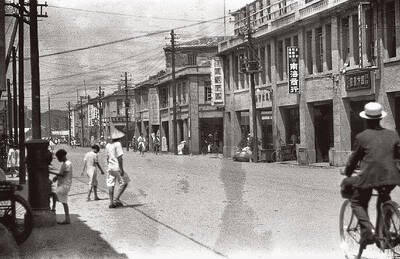
June 1 to June 7 "If all Taiwanese were as afraid of dying as you, then what would happen?” Physician Shih Chiang-nan (施江南) reportedly said this to his wife Chen Chiao-tung (陳焦桐) after she urged him to stop intervening on behalf of Taiwanese soldiers stranded overseas after serving in the Japanese Army during World War II. Shih had clashed with high-ranking officials over the issue, engaged in several heated arguments with Taiwan governor-general Chen Yi (陳儀) and allegedly shouted at general Ko Yuan-fen (柯遠芬), chief of staff of the Taiwan Garrison Command, over


 RSS
RSS