


Showing Real Asia 2003 -- a film funding project sponsored by National Geographic Channel (NGC) and the Economic Development Board (EDB) of Singapore -- is encouraging documentary-making talents in Asia.
Byran Smith, executive vice president of NGC and Tan Chek-ming (
The project is for four years and will fund 12 hours of film projects for Asian and Singaporean filmmakers. Besides financial aid, filmmakers will receive production assistance as well.

PHOTO COURTESY OF NGC
Meanwhile, starting this Sunday (Sept. 7), the channel will be showing the results of last year's Showing Real Asia project, by screening the 10 films sponsored and selected by the project.
For last year's Showing Real Asia, there were 550 proposals applying for grants and a total sum of US$1.98 million was given to 10 Asian documentary films.
The 10 selected films cover China, Hong Kong, Cambodia, Vietnam, India and Thailand. They will be aired on National Geographic Channel in 25 different languages throughout the world.
For example, Hong Kong's Big Bet, a film to be aired on Sunday, is a story exploring the region's obsession with horse-racing. The film follows two unusual stories: one about a poor man who became rich through gambling, and later was cheated of all his riches by his wife; the other about a former gambling addict with a strong, Christian faith.
Another film The Kung Fu Dragons of Wudang, is a documentary about the legends of Mount Wudang, the birthplace of various famous kung-fu styles, such as Tai Chi, Ba Gua Boxing and Wudang Swordplay. The film focuses on three characters, two teenage kung-fu apprentices and a sword fanatic, Wang, who chooses to isolate himself for 10 years, to demonstrate the power and styles of Wudang kung fu.
On Sunday, Sept 28, Cyberwars -- To Catch a Little Fish looks at the world of computer hacking. Specifically, the filmmaker meets the 14- to 20-year-old hackers from Asia who are breaking into the high tech computers of the West everyday. The film tries to ask the young hackers how and why.
Showing Real Asia 2003 is now open to entrants from now until Oct. 3. Applicants will be requested to submit proposals for their documentary projects. The selection result will be announced on Nov. 12. More entry information can be found at www.nationalgeographic.com.tw.
Showing Real Asia 2002 airs 9pm every Sunday on NGC, from Sept. 7 to Oct. 26.
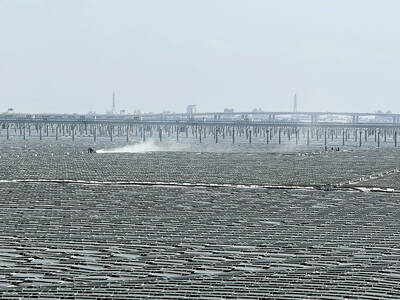
The arithmetic is straightforward and uncomfortable. By the end of 2025, Taiwan had committed itself to a 50-30-20 electricity mix — half natural gas, 30 per cent coal, 20 per cent renewables. The Ministry of Economic Affairs’s (MOEA) own monthly energy reports tell a different story. Natural gas reached 47.8 per cent of generation last year. Coal stood at 35.4 per cent, comfortably above its target ceiling. Renewables came in at 13.1 per cent, well short of the 20 per cent Taipei had pledged a decade earlier. Installed renewable capacity reached roughly half of the 12 gigawatts (GW) the government

There are shadowy cabals plotting to sell out Taiwan to be annexed by China, by invasion if necessary. Fortunately, they are buffoons. In 2019, former Bamboo Union gangster and founder of the China Unification Promotion Party (CUPP), Chang An-le (張安樂, colorfully known as “White Wolf”), led a protest at the Legislative Yuan against comments made by then-premier Su Tseng-chang (蘇貞昌) that in the event of an attack by China, he would never surrender, but would protect the nation by fighting to the end, even if he only had a broom. Chang had party members bring a wooden casket that they
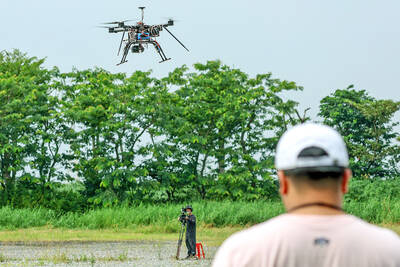
Taiwan’s drone exports are taking off, fuelled by the war in Ukraine, as Taiwanese companies seek a stake in the fast-growing global market for unmanned aerial vehicles (UAV). Low-cost drones used for reconnaissance and strikes are in high demand as governments around the world boost defense spending in the face of intensifying conflicts. A relative new player in the increasingly competitive industry, Taiwan’s pitch is to be an “Asian hub” for the production of UAVs and components free of Chinese materials, or “non-red.” That means its UAVs can be up to three times more expensive than their Chinese competitors, like the world’s biggest

June 1 to June 7 "If all Taiwanese were as afraid of dying as you, then what would happen?” Physician Shih Chiang-nan (施江南) reportedly said this to his wife Chen Chiao-tung (陳焦桐) after she urged him to stop intervening on behalf of Taiwanese soldiers stranded overseas after serving in the Japanese Army during World War II. Shih had clashed with high-ranking officials over the issue, engaged in several heated arguments with Taiwan governor-general Chen Yi (陳儀) and allegedly shouted at general Ko Yuan-fen (柯遠芬), chief of staff of the Taiwan Garrison Command, over


 RSS
RSS