


Deep beneath the ice-sheathed Arctic Ocean, a 1,609km seam in the earth's rocky crust, long thought to be largely dormant, has been revealed as a simmering necklace of volcanoes and hot-water vents that may harbor unique life forms.
Earlier surveys in the depths near the North Pole had identified a couple of seabed volcanoes in one place along the seam, which is called the Gakkel Ridge and bisects the polar ocean from Greenland to Siberia.
PHOTO: NYT
But sonar and seismic readings, rock samples and water measurements gathered during a recent joint expedition by German and American ice-breaking ships have created a detailed overview of the surprisingly dynamic geology of the ridge.
PHOTO: NYT
Researchers and experts not directly involved in the new work said the findings challenged longstanding notions about such midocean ridges, which are the geologic factories forging earth's ever-changing crust.
The charts and two accompanying papers appear in the current issue of the journal Nature and greatly elaborate on initial descriptions of the Arctic sea-floor vents published in the same journal in January.
The Gakkel is the least active of the midocean ridges found throughout the world's seas. These are the gutter-shaped valley and mountain systems where the crust of the sea floor spreads out to each side and hot magma pushes to the surface.
Earlier surveys measuring the magnetic signature of rocks in the Gakkel ridge found that it generally spreads just under a centimeter or so a year in each direction, about a seventh or less of the spreading rate seen in most midocean ridges.
The slow spreading rate was presumed until now to inhibit the surge of magma, the researchers and other experts said.
The likelihood of finding volcanoes and life-sustaining vents was so low that the 30-member team that put to sea in the summer of 2001 on the two ships included just one vent specialist, said that expert, Dr. Henrietta Edmonds, a geochemist from the University of Texas.
"I was brought along as a funky add-on," she said. "They were saying, `Man, she's going to be bored for a couple of months."'
That was before the results started pouring in from her instruments, which were attached to cables as they lowered rock-sampling dredges and checked for rising temperatures and turbidity -- hints of any upstream plume of mineral-rich, volcanically heated water gushing from the sea bed into the frigid sea.
The researchers said they were shocked when more than 80 percent of the instrument deployments detected such emissions over the 966km portion of the ridge that was surveyed. "We were expecting it to be practically dead," said Dr. Peter J. Michael, the lead author of one of the new Nature papers and a geologist at the University of Tulsa. "Instead we got so many readings that we thought the equipment was not working right."
By chance, that summer the polar ice pack was exceptionally thin and widely dispersed, so the ships -- the American Coast Guard vessel Healy and the German Polarstern -- were able to collect far more data than had been expected. Until this expedition, the only surveys of the ridge had been done sporadically by Navy submarines that, while submerged, cannot maintain precise coordinates on their positions.
"I think we know the topography of Mars and the moon better than that area of the Arctic," said Dr. Wilfried Jokat, a lead author of one of the Nature papers and a senior scientist at the Alfred Wegener Institute for Polar Research in Bremerhaven, Germany.
Some of the volcanic domes that the survey detected rise around 1.5km from the 4.8km-deep bottom of the rift valley running down the center of the Gakkel Ridge.
The hot spots found along the ridge appear to have existed fairly consistently for up to 25 million years in some cases, according to the papers.
It may be that the composition of the underlying rock, or other factors besides the rate at which the sea floor is spreading, determine whether there is volcanic activity or the kind of cracking and heat that can result in hydrothermal vents, Michael said.
The findings also raise the tantalizing prospect that the vents nourish novel ecosystems in the Arctic, Edmonds and other marine scientists said.
The Gakkel's hydrothermal vents, which spew torrents of water heated by magma welling from the planet's fiery depths, are similar to others found elsewhere in the world's oceans, most of them nourishing specialized ecosystems.
But because the Arctic Ocean is connected to the Pacific and Atlantic by relatively shallow passages, it is possible that vents there -- isolated for millions of years -- might support species not seen anywhere else, the scientists said.
One of the deepest connections is the strait running from the Arctic Ocean past Greenland to the North Atlantic, Edmonds said. But even there, she said, submerged ridges and Iceland act "like a wall between the Gakkel Ridge and the Mid-Atlantic Ridge," where vent communities have been seen.
The next challenge will be to explore the Arctic vents up close, Edmonds said. It is one thing to drop dredges and sensors into the Arctic off the stern of a great bluff-nosed icebreaker. It is another thing to consider doing the same thing with a submarine or even a costly unpiloted robotic vehicle. The grinding sea ice has been known to shear through heavy connecting cables.
Oceanographers are developing several new submersibles that by 2005 or 2006 might be able to do the job, Edmonds said.

A recent report from the Environmental Management Administration of the Ministry of Environment highlights a perennial problem: illegal dumping of construction waste. In Taoyuan’s Yangmei District (楊梅) and Hsinchu’s Longtan District (龍潭) criminals leased 10,000 square meters of farmland, saying they were going to engage in horticulture. They then accepted between 40,000 and 50,000 cubic meters of construction waste from sites in northern Taiwan, charging less than the going rate for disposal, and dumped the waste concrete, tile, metal and glass onto the leased land. Taoyuan District prosecutors charged 33 individuals from seven companies with numerous violations of the law. This

What is the importance within the Chinese Nationalist Party (KMT) of the meeting between Xi Jinping (習近平), the leader Chinese Communist Party (CCP), and Cheng Li-wun (鄭麗文), the leader of the KMT? Local media is an excellent guide to determine how important — or unimportant — a news event is to the public. Taiwan has a vast online media ecosystem, and if a news item is gaining traction among readers, editors shift resources in near real time to boost coverage to meet the demand and drive up traffic. Cheng’s China trip is among the top headlines, but by no means

As mega K-pop group BTS returns to the stage after a hiatus of more than three years, one major market is conspicuously missing from its 12-month world tour: China. The omission of one of the group’s biggest fan bases comes as no surprise. In fact, just the opposite would have been huge news. China has blocked most South Korean entertainment since 2016 under an unofficial ban that also restricts movies and the country’s popular TV dramas. For some Chinese, that means flying to Seoul to see their favorite groups perform — as many were expected to do for three shows opening
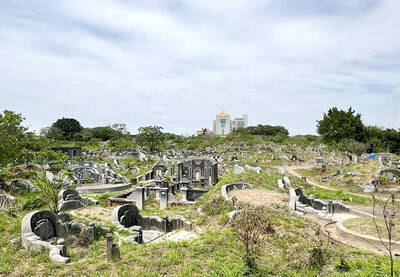
Apr. 13 to Apr. 19 From 17th-century royalty and Presbyterian missionaries to White Terror victims, cultural figures and industrialists, Nanshan Public Cemetery (南山公墓) sprawls across 95 hectares, guarding four centuries of Taiwan’s history. Current estimates show more than 60,000 graves, the earliest dating to 1642. Besides individual tombs, there are also hundreds of family plots, one of which is said to contain around 1,000 remains. As the cemetery occupies valuable land in the heart of Tainan, the government in 2018 began asking families to relocate the graves to make way for development. That


 RSS
RSS