


Wu Mi-sen (
In the films, there are no gangsters or lower-class people, only young and beautiful brooders in contemporary Taipei. The beautiful brooders engage in light, playful yet melancholy games of love.
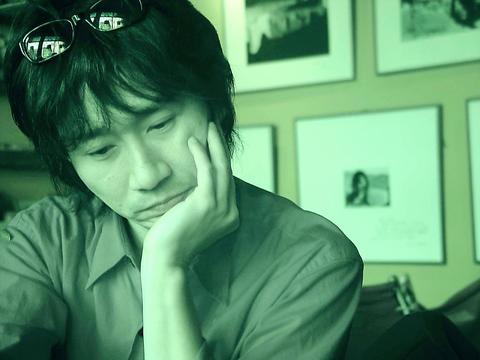
PHOTO COURTESY OF WU MI-SEN
Matching his beautiful casts are usually Wu's equally playful and poetic images.
And then there are the lines in Wu's 60-minute short Fluffy Rhapsody, such as, "I never put my clothes in the washing machine, because they'll get fluffy ... The clothes get fluffy when washed too much. It's the same in daily life; it gets fluffy when you have too much daily life."
The story of Fluffy Rhapsody is about a medical school graduate who refuses to practice medicine and prefers to stay jobless. He sleeps with various young girls and often changes his name. Then he starts a love affair with a high school girl who claims that she is a lesbian.
There is also a homosexual element in Wu's first long feature Drop Me A Cat (給我一隻貓), which will be released at both the Majestic Cinema and SPOT next weekend (June 14).
As for Wu's next feature film, The End of the War, he plans to talk about two female robots who somehow fall in love with each other, a story adapted from a sci-fi novel by Taiwanese author Chih Ta-wei (
"I use lesbian elements not to discuss the issue of homosexuality or sexuality. I don't really know why. It may be unconscious. But my idea is to talk about love in the film and maybe gay characters can best describe the nature of love that I try to point out in the film," Wu said.
Graduating from the School of Visual Arts in New York and City University of New York, Wu was first recognized for his graduation film Van Gogh's Ear, an experimental film featuring beat generation poet Allen Ginsberg reciting his poems. After making a few commercials and music videos, Wu decided to "let out his ego" and make a living as a full-time filmmaker.
Drop Me A Cat, Wu's first 35mm feature film is a fairy-tale-like story about love and death, starring Japanese star Shihji Takeda and Taiwanese model-actress Kuan Ying (
Perhaps the only film that doesn't star beautiful people is Wu's recent documentary Experimental Taiwanese.It is a humorous work about two mainlander veterans' nostalgic friendship. One, at the age of 77, is determined to learn the Taiwanese language. The other claims that he was China's No.1 spy against the Japanese during World War II.
Fluffy Rhapsody will be screened at SPOT from June 7. Drop Me A Cat will be screened at Majestic Cinema and SPOT from June 14. Both films have English subtitles.

Taiwan’s English education system is being pulled apart by three opposing forces. Bilingual Nation 2030 pulls students toward English and global communication. Artificial Intelligence (AI) readiness pulls them toward digital judgment, verification and AI-mediated work. But Taiwan’s old exam culture pulls them back toward memorization, grammar drills, timed reading and correct answers. If the education system keeps using old exams to define success, it risks producing graduates who are neither genuinely bilingual nor genuinely AI-ready, but trained for tasks machines can already perform. The first force is Bilingual Nation 2030. Launched in 2018, the policy aimed to “help Taiwan’s workforce connect

It seems every few days one bumps into one of those “real man” comments in which Taiwan is urged to “face reality” or similar, and “make a deal,” with the speaker implying that soon it will be too late. “Deal” advocates always present themselves as having a superior grip on reality, and the manly ability to make the “hard choice.” Their testosterone-laden language often echoes that of Taiwan sellout advocates. Note that such commentary always specifies a process (“make a deal, work with, make progress”), never the end state of what occupation by a violent authoritarian colonialist state will entail. In

June 1 to June 7 "If all Taiwanese were as afraid of dying as you, then what would happen?” Physician Shih Chiang-nan (施江南) reportedly said this to his wife Chen Chiao-tung (陳焦桐) after she urged him to stop intervening on behalf of Taiwanese soldiers stranded overseas after serving in the Japanese Army during World War II. Shih had clashed with high-ranking officials over the issue, engaged in several heated arguments with Taiwan governor-general Chen Yi (陳儀) and allegedly shouted at general Ko Yuan-fen (柯遠芬), chief of staff of the Taiwan Garrison Command, over

“Taiwan’s Opposition Leader Comes to US With a Message Straight Out of Beijing” read a May 31 headline in the Wall Street Journal. Top US administration officials and members of Congress almost certainly read the WSJ, and if there was a bullet point takeaway that people in Washington should absorb ahead of Chinese Nationalist Party (KMT) Chair Cheng Li-wun’s (鄭麗文) arrival in DC on June 9, that headline is it. The last few columns have discussed this very topic, and the timing is not coincidental. While those top officials likely do not read the Taipei Times, judging by the number


 RSS
RSS