


Combining the heroes of Maoist propaganda with the latest in ultra violent computer games is more than just amusing. In China, where the Cultural Revolution and cyberspace were less than 30 years apart, it may have been unavoidable.
A new single artist show at the Museum of Contemporary Art (MOCA), Taipei, Past Virtualized ? Future Cloned: Feng Mengbo 1994 to 2003 (
It is an ass-kicker of an exhibition. The viewer is a PC gamer, a first person shooter, training a chain gun on enemies of the Communist Party, real PC game (ro)bots and even the artist himself. It's frag or be fragged, and Communist Party fables are as real as video game mythologies, and also just as unreal.
First person shooter (FPS) is a video game genre introduced in 1993 with an ID Software production called Doom. In it, the screen represents a player's line of sight in a 3D dungeon, and as a referent to the player's position behind the screen, he or she (and it's usually a he) sees his virtual hands on screen in front of him and holding a weapon -- anything from a chainsaw to a rocket launcher.
The goal is to kill everything in sight while making one's way through steadily more difficult dungeons until finally the mega-monster is killed or the last bunker is destroyed.
The end of these mid-1990 versions was always an anticlimax, so FPS games evolved and crystallized into pure stalking and blasting through network games that let multiple players kill each other ad infinitum.
About half of Feng's show consists of FPS-based works, and you can even play some of them in the galleries. Taking Mount Doom by Strategy satirically brings together Doom with the Mao Zedong-approved "revolutionary model opera" (
It lets you play (in primitive 1997 graphics) the characters of a number of revolutionary heroes, including the Sino-Japanese war hero, Yang Zirong (
The latest, a DVD loop called Ah_Q (2003), is more like the mother of all Armageddons. Scenes are pulled from a simple one-room dungeon that Feng constructed using downloadable software, and each of the 32 gladiators crammed onto this killing floor is in Feng's own image: a slightly pudgy, shirtless, glasses-wearing kid carrying a DV cam in one hand and a huge gun in the other.
As fast as bullets can fly, Feng clones are sawed into clouds of blood and random limbs, just as in the latest real FPS games.
A companion piece, Ah_Q (Mirror of Death, the Dancing Pad Version) uses the foot-activated interface of the popular 2001 arcade game, Dance Dance Revolution, as the most bizarre FPS controller ever conceived. (As a video game, it's pointless, but maybe that is the point.)
These pieces all work through novel juxtapositions of People's Liberation Army soldiers as computer game elements, dance steps that fire rockets and in doing so flirt satirically with notions of morality and popular culture.
For example, how can we see these images of cruelty, be they video games, Maoist propaganda or Looney Tunes, and not be affected?
The piece that probes video games ethics most deeply and by doing so lets you know that Feng is not content with just saying, "Hey, look! Cool!" is a 1999 film called Q3 (The title abbreviates a Doom sequel, Quake III).
In it, Feng is a war correspondent who has, TRON-like, entered a computer generated Quake dungeon to interview "The clones, " his term for the game-bred opponents that players (you) kill.
Wearing an army helmet, carrying a DV camera and dangling a cigarette from the side of his mouth, his character is half-comical.
He moves through the virtual scenes of carnage interviewing clones, like CNN reporters interview Kurds (these days), reporting on the number of clone deaths needed to develop some new weapon and relating the last words of some kid (a player): "When God is dead, you'll know it!!" Then he surprises his news anchor by deciding to defect to the clones in support of their impossible cause.
If the question is: "Does video game violence generate real violence?" Feng's is an absurdist answer. He produced Q3 the same year America was searching its own conscience in the wake of the Columbine High School massacre, in which two teenage Doom junkies killed 13 of their fellow students and teachers in a real life shooting spree. And sitting in front of a CRT monitor in a Beijing apartment on the other side of the world, he replied: "Is it overkill? Yes. Am I addicted to it? Absolutely."
Feng's statement is more about how people generate a system of beliefs out of the information that surrounds them.
Many of his early works deal with the Maoist imagery of his early childhood, which he views ironically, as when he turns Mao's mighty arm sweep into the capitalist gesture for hailing a taxi.
But, at the same time, the Cultural Revolution was the only childhood he had, and he won't betray its propaganda completely.
There is always an element of nostalgia. Even now, as the exhibition catalogue admits, he prefers Yang Zirong to Arnold Schwarzenegger or Superman.
So he skips these alien Hollywood heroes completely and moves on to a cyberspace where he feels more free to project his own images.
There, Yang Zirong is free to be a hero again.
Past Virtualized -- Future Cloned is on display through July 27 at the Museum of Contemporary Art, Taipei (
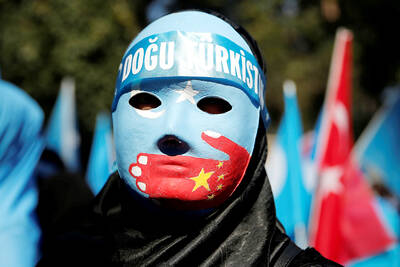
It seems every few days one bumps into one of those “real man” comments in which Taiwan is urged to “face reality” or similar, and “make a deal,” with the speaker implying that soon it will be too late. “Deal” advocates always present themselves as having a superior grip on reality, and the manly ability to make the “hard choice.” Their testosterone-laden language often echoes that of Taiwan sellout advocates. Note that such commentary always specifies a process (“make a deal, work with, make progress”), never the end state of what occupation by a violent authoritarian colonialist state will entail. In
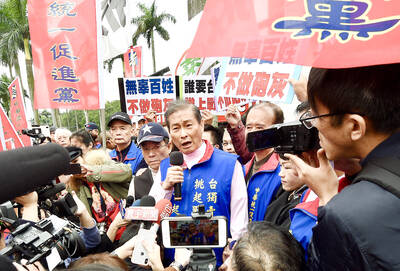
There are shadowy cabals plotting to sell out Taiwan to be annexed by China, by invasion if necessary. Fortunately, they are buffoons. In 2019, former Bamboo Union gangster and founder of the China Unification Promotion Party (CUPP), Chang An-le (張安樂, colorfully known as “White Wolf”), led a protest at the Legislative Yuan against comments made by then-premier Su Tseng-chang (蘇貞昌) that in the event of an attack by China, he would never surrender, but would protect the nation by fighting to the end, even if he only had a broom. Chang had party members bring a wooden casket that they
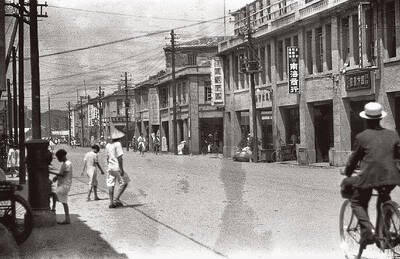
June 1 to June 7 "If all Taiwanese were as afraid of dying as you, then what would happen?” Physician Shih Chiang-nan (施江南) reportedly said this to his wife Chen Chiao-tung (陳焦桐) after she urged him to stop intervening on behalf of Taiwanese soldiers stranded overseas after serving in the Japanese Army during World War II. Shih had clashed with high-ranking officials over the issue, engaged in several heated arguments with Taiwan governor-general Chen Yi (陳儀) and allegedly shouted at general Ko Yuan-fen (柯遠芬), chief of staff of the Taiwan Garrison Command, over

Food prices have often played a major role in Taiwan’s history. The first major wave of migration from China occurred in 1628. A moderate drought, the Ming Dynasty maritime ban that prohibited fishing and trading (intended to reduce piracy) and a temporary tax, conspired to exhaust local resources, leading to famine in Fujian Province. The famed pirate and trader Zheng Zhilong (鄭芝龍), scooped up starving people from Fujian and transported them across the Taiwan Strait, where they settled under the Dutch. Two factors enabled Zheng. First, by 1624 he had settlements around today’s Beigang (北港) in Yunlin County with a small


 RSS
RSS