


Legend holds that when the ancient Atayal needed water they had only to call out qsya! qsya! and their cooking pots would be filled with enough to drink and make dinner.
Likewise, when they needed meat, they would yell vha! vha! and a mountain boar would appear. If they pulled a few hairs from the boar's hide and placed them in their cooking pots, within minutes the hair would turn into just enough meat to feed the entire family.
Today's Atayal should have it so easy.
When Rimuy Aki steps in front of her class, not only are there no magic words she can utter to teach her students all they should know of their ancestral language and culture, there aren't even many texts at her disposal.
The publication of a new bilingual series of children's books on Taiwanese Aboriginal folklore has forged a path by which educators and parents can teach children about Taiwan's aboriginal heritage from the Aborigines themselves.
Edited by the former Commissioner for Aboriginal Affairs Sun Ta-chuan (
In addition to the stories, each volume contains a glossary of words and phrases and encyclopedic information on the tribes' individual histories, cultures and customs, down to what they ate and -- in the case of the Atayal -- why women tattooed their faces and men hunted enemies' heads.
"We have no system of writing in the Atayal language and so a book like this is a welcome tool," said Rimuy, who served as the storyteller for the Atayal volume.
"Of course, my own students have heard these stories in their native language, but [the books] are a way for others to hear them, too."
Many of the stories, while based on myth, give insight into many Aborigines' modern-day customs. The Atayal legend of the giant stone, for example, tells not only of the tribe's origins, but why women tattooed their faces, a custom which is now rare but can still be seen in some elder members of the tribe.
According to the legend, the first Atayal man and woman were born from the same stone and shared the land with families of sika deer and birds. They saw the love these creatures had for one another but they didn't know how to have a family of their own.
One day they noticed a pair of flies resting on top of one another and were made aware of how to have children. But this embarrassed the man, who thought of the woman as his sister. The woman stole away from his side one night and, disguising her face with mud, met up with him the next day.
Lost without the only friend he'd ever known, the man embraced the stranger and together they bore a child. From then on, when an Atayal woman came of age, she would tattoo a band across the breadth of her face.
The Saisiat tribe creation legend, told by Iteh a Atau (
They decided to chop the child into pieces and throw it in the water. When they did, each piece became a new person. The names they gave each new person remain the family names of the Saisiat today.
Apart from being entertaining, the books are also educational. Like Rimuy, many of those involved with creating the series are educators -- including its editor, Sun, who is vice professor of ethnic development at Tunghua University (
If the books have a noticeable shortcoming for some foreign readers it's that only the stories themselves are translated into English, not the many pages of information on culture, customs and language.
Nonetheless, the stories go a long way towards individualizing tribes of people that are often looked at as a whole, and even offer lessons about our own contemporary customs.
"There's a lot that Aborigines know about sustainability that society today can learn from," said Robin Winkler, who translated the series.
So why can't Atayal call out for their food and water today? Long ago, one Atayal woman thought that if she took meat directly from the boar's hide she would have enough for the whole week and wouldn't have to cook.
After maiming the boar, it ran off into the forest and all the animals and plants vowed to never again heed the Atayal's magical summons. From then on, they would have to work for their food.
Greed, it would seem, isn't a sustainable practice.

Taiwan’s English education system is being pulled apart by three opposing forces. Bilingual Nation 2030 pulls students toward English and global communication. Artificial Intelligence (AI) readiness pulls them toward digital judgment, verification and AI-mediated work. But Taiwan’s old exam culture pulls them back toward memorization, grammar drills, timed reading and correct answers. If the education system keeps using old exams to define success, it risks producing graduates who are neither genuinely bilingual nor genuinely AI-ready, but trained for tasks machines can already perform. The first force is Bilingual Nation 2030. Launched in 2018, the policy aimed to “help Taiwan’s workforce connect
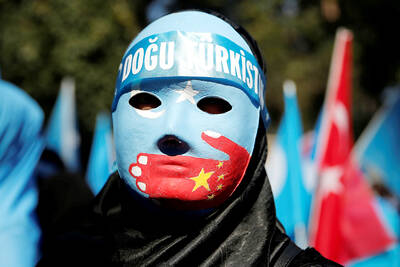
It seems every few days one bumps into one of those “real man” comments in which Taiwan is urged to “face reality” or similar, and “make a deal,” with the speaker implying that soon it will be too late. “Deal” advocates always present themselves as having a superior grip on reality, and the manly ability to make the “hard choice.” Their testosterone-laden language often echoes that of Taiwan sellout advocates. Note that such commentary always specifies a process (“make a deal, work with, make progress”), never the end state of what occupation by a violent authoritarian colonialist state will entail. In

There are shadowy cabals plotting to sell out Taiwan to be annexed by China, by invasion if necessary. Fortunately, they are buffoons. In 2019, former Bamboo Union gangster and founder of the China Unification Promotion Party (CUPP), Chang An-le (張安樂, colorfully known as “White Wolf”), led a protest at the Legislative Yuan against comments made by then-premier Su Tseng-chang (蘇貞昌) that in the event of an attack by China, he would never surrender, but would protect the nation by fighting to the end, even if he only had a broom. Chang had party members bring a wooden casket that they
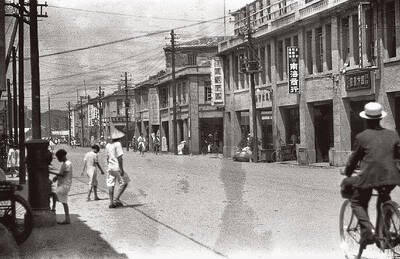
June 1 to June 7 "If all Taiwanese were as afraid of dying as you, then what would happen?” Physician Shih Chiang-nan (施江南) reportedly said this to his wife Chen Chiao-tung (陳焦桐) after she urged him to stop intervening on behalf of Taiwanese soldiers stranded overseas after serving in the Japanese Army during World War II. Shih had clashed with high-ranking officials over the issue, engaged in several heated arguments with Taiwan governor-general Chen Yi (陳儀) and allegedly shouted at general Ko Yuan-fen (柯遠芬), chief of staff of the Taiwan Garrison Command, over


 RSS
RSS