


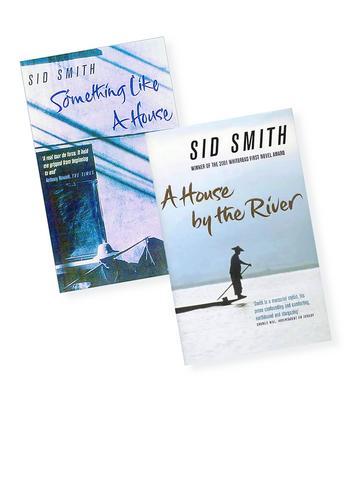
Sid Smith's unnerving but strangely poetic debut novel, Something Like a House (reviewed in the Taipei Times Oct. 14, 2001), won both the UK's Whitbread First Novel Award and the James Tait Black Memorial Prize. It was a mesmerizing story featuring biological warfare research and Chinese theories about race and genetics, set against a background of life among the minority Miao peoples in the 1960s.
What particularly surprised some reviewers was Smith's assertion that he'd never been to China. He still hasn't, but his new novel is once again set there, and once more on the upper reaches of the West River. This time it's the early 20th century, and a missionary couple arrive to bring the gospel to the local fishing and opium-growing communities.

Talking to Sid Smith by phone earlier this month, I asked him how he first became interested in the Chinese world.
"I was reviewing popular science books for London's Time Out magazine," he said, "and maybe half of them were about evolution. I soon got fed up, and wanted instead to write a novel on the subject. At first I was going to set it in the southwest of the United States. But when I read that the Chinese had their own distinct evolutionary theories, very different from the Western ones, then China seemed the right place to begin.
"Most people in the West think of mandarins, Confucius and long fingernails when you mention China. I wanted to show something different, and when I also came across information about biological weapons research and the life of the upland Miao, it seemed like a killer combination, and the more interesting way to go."
In A House by the River the missionary wife, Grace, though herself half-Chinese, is the more devoted of the couple to the Christian story. By contrast her husband, John, is attracted to the river fishermen's way of life, and so quickly becomes tolerant of their animist religious beliefs.
The pace of the action picks up half way through the book when John runs off down river with a village girl, and Grace heads out on a trip to preach to the opium-growers. She becomes convinced, through bizarre reasoning about some Chinese written characters, that China had originally worshipped the God of the Old Testament, but had turned away from the faith. China is "ancient in evil," she comes to believe.
"A friend of my wife's was at the time both a Sinophile and an evangelical Christian," Smith said. "He first told me about the theory that the Genesis story is hidden in some Chinese characters. It was in a London pub, and he scribbled down the characters on a scrap of paper. It's a belief that's been around for over a century, apparently. I thought straight away that you could build a novel around this idea."
Smith, who's now 53, has had a checkered career before finding success as a writer.
"After I left grammar school I worked briefly for the Inland Revenue [the UK tax office]. I hated it so much that they got rid of me, thank God! Then I spent seven years doing laboring jobs, mostly in Devon in southwestern England. Anything was better than working in an office.
"I was reading poetry a lot at that time, and anything else I could get hold of. Then when I was 26 I enrolled to do a degree at the University of Bangor, in North Wales. But I soon got fed up with the Eng Lit nonsense. The only bits that matter about literature are the ones you can't talk about, why this or that is beautiful and so on, not who influenced who."
After Bangor, Smith taught English in Greece, Italy and London, and more recently has worked as a sub-editor on London's Times and Independent newspapers.
"I think the publishers were right to emphasize that I had worked as a manual worker," he said. "Both novels are about a Westerner who becomes a peasant in China, or a coolie on a boat, as much as anything else. Strangely, I only realized this recently."
The vividness with which someone doing manual work perceives his tools, the people he's working alongside, and the job to be done contributed to his depiction of the rural population in upland China, he said.
He has researched this new book with the energy of a true bibliophile, but in addition he clearly responds strongly to the outdoor life. The chapters dealing with travel up and down the river, or treks over the mountain ridges to the opium plantations and beyond, are among the best things in the book.
Even so, he claims that 90 percent of the new book's material about the river and wild nature was invented.
"I've lived in the middle of London for 20 years. It's true that when I was laboring I was in the countryside, outside all day doing gardening. But the nearest I got to a true mountain river was through the window of a train in Japan. My wife's Japanese, and we went to Japan last year. If you have a river in the UK, and it's in the mountains, it's small. But one river I saw in Japan ran below a 3m wall of bare rock, and had a huge pebble beach, just like the one I describe. Quite amazing stuff!"
As for never going to China, Smith has written elsewhere that in the time it would take to fly there he could read a book containing the fruits of decades of exploration. And no amount of physical travel could take him back to China in the early 20th century the way reading in the British Library so vividly did.
Something Like a House achieved its power through its combination of shocking information and a dreamlike, poetic style. The new book depends more extensively for its effects on research into China's minority folk beliefs and customs. It's steeped in Chinese upland nature, and the resistance this constitutes to attempts to promulgate Christianity among the tribal peoples. There's a great deal of Miao and Yi folklore, plus fishing and rowing techniques in abundance. One shamanistic ritual is described at length, and there's material ranging from information about the imperial examinations to missionaries' attitudes to Chinese food.
There are subsidiary characters -- the local government tax collector and his secretary, the fishermen and their families, a malign shaman, and assorted up-river people, either tribals or the sons of the fishermen who have gone up-stream in the direction of Tibet to try out a more adventurous life.
Everyone who writes about Smith comments on his style. And this novel, like its predecessor, is written with a lapidary elegance. It's by turns evocative, understated, and quietly ironic. Also, because the two main characters in the book are missionaries, Smith is now able to add Biblical rhetoric to the already rich tapestry of his prose.
Once again, many phrases are hauntingly poetic. "Perhaps this stream was the last of the river -- a starved thing, lost in the mountains sucking stones," he writes. And one character sits "as God sits among His rusty thunderbolts, beaten by China."
What the two novels share is a sense, very powerfully conveyed, of the Chinese uplands as sad, rather hopeless places, caught in their rituals and superstitions, grubby and casually cruel, with a stubborn but vulnerable populace clutching their gods in threadbare villages. To this the new book adds scenes of cold mountain temples where shivering monks wrapped in blankets offer Tibetan tsampa and pipes of opium to the benighted traveler.
It's a highly poetic vision, and it's clearly one Smith, one of the most original voices to appear in British fiction in recent years, doesn't want to let go of. So, where will he go from here? "The novel I'm working on now is set among second generation Chinese people living in London, and their imagined idea of what China might be like. As a result, it's a slightly mythical, magical China. They're imagining how their ancestors were, and it's set on what they imagine the West River used to be like. The three books will make a trilogy."
Lastly, I asked Sid if he had any thoughts about SARS in the light of some of the details he put into Something Like a House.
"There's this long history of so-called Asian flu," he said. "Apparently it's because ducks and human beings live very close together in Southeast Asia. I'd prefer to stick with this straight-forward explanation rather than considering anything else."
Sid Smith is essentially a visionary, and he sees into other people's visions of the world. Few residents of this planet view life in a rational, scientific way. Instead, they are guided by folk beliefs, taboos, outlandish theories, and dreams. Smith's two extraordinary novels alert us to this, and transport some unfamiliar world-views -- as well as some more recent myths -- from the remoter corners of the planet into the rooms and offices of modern, urban man.
Sid Smith's A House by the River and Something Like a House are both published by Picador.

Taiwan’s English education system is being pulled apart by three opposing forces. Bilingual Nation 2030 pulls students toward English and global communication. Artificial Intelligence (AI) readiness pulls them toward digital judgment, verification and AI-mediated work. But Taiwan’s old exam culture pulls them back toward memorization, grammar drills, timed reading and correct answers. If the education system keeps using old exams to define success, it risks producing graduates who are neither genuinely bilingual nor genuinely AI-ready, but trained for tasks machines can already perform. The first force is Bilingual Nation 2030. Launched in 2018, the policy aimed to “help Taiwan’s workforce connect
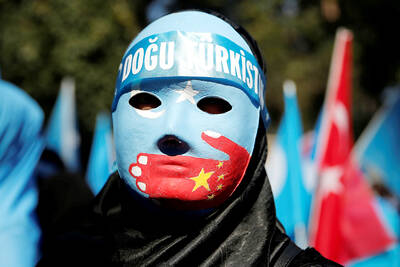
It seems every few days one bumps into one of those “real man” comments in which Taiwan is urged to “face reality” or similar, and “make a deal,” with the speaker implying that soon it will be too late. “Deal” advocates always present themselves as having a superior grip on reality, and the manly ability to make the “hard choice.” Their testosterone-laden language often echoes that of Taiwan sellout advocates. Note that such commentary always specifies a process (“make a deal, work with, make progress”), never the end state of what occupation by a violent authoritarian colonialist state will entail. In
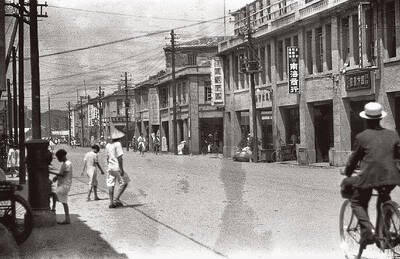
June 1 to June 7 "If all Taiwanese were as afraid of dying as you, then what would happen?” Physician Shih Chiang-nan (施江南) reportedly said this to his wife Chen Chiao-tung (陳焦桐) after she urged him to stop intervening on behalf of Taiwanese soldiers stranded overseas after serving in the Japanese Army during World War II. Shih had clashed with high-ranking officials over the issue, engaged in several heated arguments with Taiwan governor-general Chen Yi (陳儀) and allegedly shouted at general Ko Yuan-fen (柯遠芬), chief of staff of the Taiwan Garrison Command, over

“Taiwan’s Opposition Leader Comes to US With a Message Straight Out of Beijing” read a May 31 headline in the Wall Street Journal. Top US administration officials and members of Congress almost certainly read the WSJ, and if there was a bullet point takeaway that people in Washington should absorb ahead of Chinese Nationalist Party (KMT) Chair Cheng Li-wun’s (鄭麗文) arrival in DC on June 9, that headline is it. The last few columns have discussed this very topic, and the timing is not coincidental. While those top officials likely do not read the Taipei Times, judging by the number


 RSS
RSS