


The Bangkok International Film Festival opened a new chapter in its history on Friday with great pomp and circumstance as competition began for the first Golden Kinnaree award. A five-day gala is being held to celebrate the event's transformation into an international film festival -- one that aspires to become Asia's largest. Some 130 films are participating, 12 of which have been selected to compete for the Golden Kinnaree award, the festival's top honor. The lavish ceremonies with glittering traditional Thai dancers, the warm hospitality offered by the organizers and the Thai audience and the fancy leisure events for the guests all managed to cover flaws in the young event.
This year also marks a change in the festival's organizers. The previous four Bangkok Film Festivals had been organized by the independent newspaper The Nation. This year the Thai government's tourism authority has taken the helm with the goal of boosting both tourism and the Thai movie industry, transforming the festival into a big-budget event.
The 300 VIP guests are enjoying five-star hotel rooms and series of elaborate gala events replete with red-carpet entrances witnessed by attendees sipping wines and munching on Thai delicacies from the unlimited buffet. There was also a Bangkok Symphony Orchestra concert, a traditional Thai music show, a silk fashion show and a Thai boxing competition, as if the entire tourism industry in Thailand had been mobilized to contribute to the film festival.

PHOTO: TAIPEI TIMES
The festival's ambition -- to become a showcase for world cinema -- is equally grand. "The goal of the festival is to present the cinematic landscape of major world films to Asia," said Patrick de Bokay, worldwide executive director of the festival. "We anticipate that the Golden Kinnaree Competition will become Asia's equivalent of the Cannes Palm d'or in Europe."
He further explained: "Busan is a festival to encourage new Asian talent. And Sundance is a festival to discover independent talent in North America. But I think Bangkok is different. It is a neutral land, a place where East meets West. And like Cannes, it's the place that gives the exoticness, which helps [attract] people from [all over] the world. That's why we wanted the Kinnaree award to recognize world cinema, [as opposed to a] specific target or audience."
The 12 films selected for the competition represent such an aim. They include The Quiet American, based on the novel by Graham Greene and starring Michael Caine and Brendan Fraiser. From Spain, there is the widely acclaimed Talk to Her by Pedro Almodovar. Also screening are the Cannes Jury Grand Prix winner from Finland, Man Without a Past by Aki Kaurismaki, Polish director Krzysztof Zanussi's Supplement and the Israeli film Kedma by Amos Gitari.
Representing Asia at the competition are Takeshi Kitano's Dolls from Japan, Small Voices from the Philippines and the Indian film A Tale of Naughty Girl.
Many of these films have been shown at other film festivals and some of them have already been released. One of the exceptions is the opening film for the Kinnaree competition, Frida, which made its Asian premiere in Bangkok. The film chronicles the bold and uncompromising life of the Mexican artist Frida Kahlo. Salma Hayek plays the controversial artist who took the art world by storm with her husband, painter Diego Rivera (played by Alfred Molina). Frida was directed by Julie Taymor and stars Antonio Banderas, Ashley Judd, Edward Norton and Geoffrey Rush.
At the film's Asian premiere on Friday, Bangkok's La Scala cinema was crowded with movie fans and local and Asian celebrities. Delighted fans screamed when stars such as Jean-Claude Van Damme, Steven Segal and Jennifer Tilly appeared at the event.
Asian stars Rick Yone (Die Another Day), Leon Lai (黎明) and Christy Chung (鍾麗緹) also drew noisy cheers from the fans. Christy Chung, who stars in the Thai box-office hit Jan Dara, attracted special attention from Thai audiences when she introduced her new boyfriend, Chinese rock musician Yen Cheng-hsiang (嚴政翔), to the public.
Somewhat embarrassing was the fact that most of the stars present did not have films screening at the festival, and the filmmakers of the competition films did not turn up at the ceremony.
The Hollywood-style reception did not please everyone in Thai film circles. "I doubt this extravaganza will help strengthen the Thai film industry," one Thai filmmaker was quoted as saying in the Bangkok Post.
Others disagreed. "I think one of the main goals of [the Thai government] is try to make Thailand the destination for shooting Asian scenery, and to bring more international filmmakers to Thailand to make films," said Ladawan Kongcharoenvoot, a film producer. "If the goal can be achieved, it will also be helpful to the Thai film industry," she said.

Yesterday, the Democratic Progressive Party (DPP) nominated legislator Puma Shen (沈伯洋) as their Taipei mayoral candidate, the Chinese Nationalist Party (KMT) put their stamp of approval on Wei Ping-cheng (魏平政) as their candidate for Changhua County commissioner and former legislator Tsai Pi-ru (蔡壁如) of the Taiwan People’s Party (TPP) has begun the process to also run in Changhua, though she has not yet been formally nominated. All three news items are bizarre. The DPP has struggled with settling on a Taipei nominee. The only candidate who declared interest was Enoch Wu (吳怡農), but the party seemed determined to nominate anyone

In a sudden move last week, opposition lawmakers of the Chinese Nationalist Party (KMT) and Taiwan People’s Party (TPP) passed a NT$780 billion special defense budget as a preemptive measure to stop either Chinese leader Xi Jinping (習近平) or US President Donald Trump from blocking US arms sales to Taiwan at their summit in Beijing, said KMT heavyweight Jaw Shaw-kong (趙少康), speaking to the Taipei Foreign Correspondents Club on Wednesday night in Taipei. The 76-year-old Jaw, a political talk show host who ran as the KMT’s vice presidential candidate in 2024, says that he personally brokered the deal to resolve
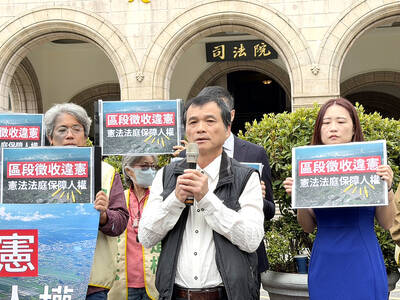
What government project has expropriated the most land in Taiwan? According to local media reports, it is the Taoyuan Aerotropolis, eating 2,500 hectares of land in its first phase, with more to come. Forty thousand people are expected to be displaced by the project. Naturally that enormous land grab is generating powerful pushback. Last week Chen Chien-ho (陳健和), a local resident of Jhuwei Borough (竹圍) in Taoyuan City’s Dayuan District (大園) filed a petition for constitutional review of the project after losing his case at the Taipei Administrative Court. The Administrative Court found in favor of nine other local landowners, but

The Chinese Nationalist Party (KMT) and its sock puppet, the Taiwan People’s Party (TPP), passed their version of the government’s proposed supplementary defense spending bill last week, engendering much commentary. While all eyes were on the defense budget, the PRC’s assault on Taiwan was advancing on other fronts. The removal of domestic drone production and other technologies critical to the nation’s asymmetrical defenses from the list of items purchased in the “compromise” bill shows how the KMT-TPP alliance appears to be serving the People’s Republic of China (PRC). Ironically, the cuts will impact industries heavily represented by tech firms in areas run


 RSS
RSS