


Japanese expats have been congregating in the area around Lane 119, Linshen N. Rd. for decades, and it is home to a great number of restaurants serving authentic Japanese cuisine for homesick Japanese. Wei Beer House is one of the most popular of these restaurants. However, proprietor Grace Huang (黃子瑄) is not satisfied with this niche market. A successful restaurant, Huang insists, should reach out to a wider range of customers with new cooking styles.
For this reason Huang opened Roman Tin in May in a quiet alley close to the Grand Formosa Regent Hotel. The fusion cuisine it specializes in makes Thai, Korean, Italian and French variations of Japanese dishes. The simple, refined and elegant decor is also a departure from the style of a traditional Japanese restaurant. "Traditional [Japanese] cuisine is often too expensive for customers during the current recession. Customers also grow tired of a menu that never changes. Fusion cuisine is a good way to deal with these problems," said Hsu Chi-ren (徐啟仁), Roman Tin's chief. "If you don't think up new ideas, you won't survive in changing times," Hsu said.
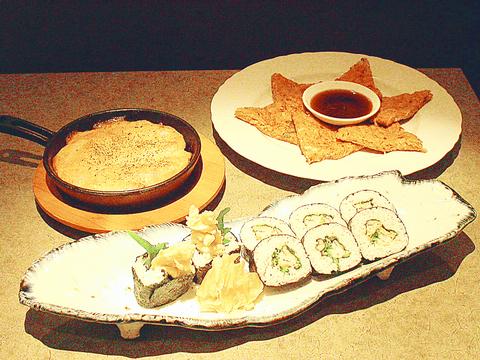
PHOTO: VICO LEE, TAIPEI TIMES
Hsu's boot-camp-style training under a perfectionist Japanese chef and his 20 years of cooking experience guarantees the quality of Roman Tin's dishes. In addition to Japanese cuisine, he has learned a variety of cooking styles from his chef friends, enabling him to come up with a new menu every month.
Korean seafood pancake (NT$220) is a pancake stuffed with fresh and chewy octopus cubes, spring onions, shrimp and squid and served with Japanese soy sauce. The Korean pancake is made much less spicy than usual, and accompanied by a piquant sauce. Baked potato with roe (NT$220) is one of the most popular items on the menu, especially with young people and Western customers. The imported marinated roe covers potato slices and is topped with ground seaweed. Aside from salty Japanese salad dressing, the dish is unseasoned. Baking it in the right temperature brings out the original flavor of the ingredients, which create a rich taste together.
Beef curry with French bread (NT$250) is a European dish with a Japanese twist. The pure Indian curry sauce is baked with beef tenderloin for up to three days until it attains a lingering aroma. The addition of a small amount of cheese to the sauce gives it extra flavor, and the baked bread softens on contact with the sauce.
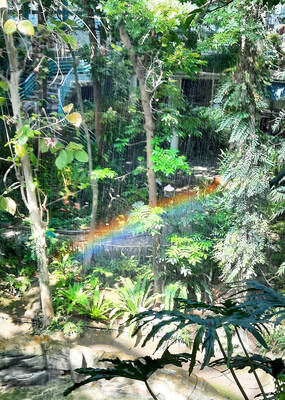
It’s only half the size of its more famous counterpart in Taipei, but the Botanical Garden of the National Museum of Nature Science (NMNS, 國立自然科學博物館植物園) is surely one of urban Taiwan’s most inviting green spaces. Covering 4.5 hectares immediately northeast of the government-run museum in Taichung’s North District (北區), the garden features more than 700 plant species, many of which are labeled in Chinese but not in English. Since its establishment in 1999, the site’s managers have done their best to replicate a number of native ecosystems, dividing the site into eight areas. The name of the Coral Atoll Zone might

On Monday morning, in quick succession, the Chinese Communist Party (CCP) and the Chinese Nationalist Party (KMT) released statements announcing “that the Central Committee of the Communist Party of China and General Secretary Xi Jinping (習近平) have invited KMT Chairwoman Cheng Li-wun (鄭麗文) to lead a delegation on a visit to the mainland” as the KMT’s press release worded it. The KMT’s press release added “Chairwoman Cheng expressed her gratitude for the invitation and has gladly accepted it.” Beijing’s official Xinhua news release described Song Tao (宋濤), head of the Taiwan Work Office of the CCP Central Committee, as
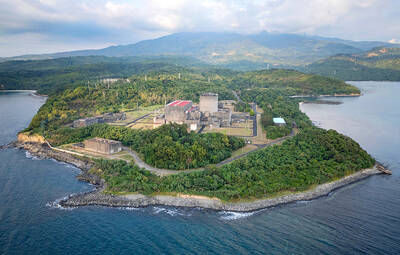
Nuclear power is getting a second look in Southeast Asia as countries prepare to meet surging energy demand as they vie for artificial intelligence-focused data centers. Several Southeast Asian nations are reviving mothballed nuclear plans and setting ambitious targets and nearly half of the region could, if they pursue those goals, have nuclear energy in the 2030s. Even countries without current plans have signaled their interest. Southeast Asia has never produced a single watt of nuclear energy, despite long-held atomic ambitions. But that may soon change as pressure mounts to reduce emissions that contribute to climate change, while meeting growing power needs. The

Last week saw Ko Wen-je (柯文哲), former Taipei mayor and founder of the Taiwan People’s Party (TPP), receive a 17-year sentence for crimes involving political corruption. This was only the opening round: the case is likely to drag on for several more years in appeals. Both the TPP and the Chinese Nationalist Party (KMT) are claiming that the prosecutors are engaging in a political witch hunt, green terror, fascism and so forth. It is easy to see this as a kind of compensation. After all, otherwise they would have to admit that the rather impressive collection of evidence against Ko actually


 RSS
RSS