


The Taiwan International Documentary Festival ended yesterday with an award ceremony handing out prizes for outstanding film and video documentary works.
German filmmaker Stefan Tolz took away the top prize, the Grand Prize, in the international film competition category, with his film, On the Edge of Time: Male Domains in the Caucasus, winning a cash prize of NT$300,000.
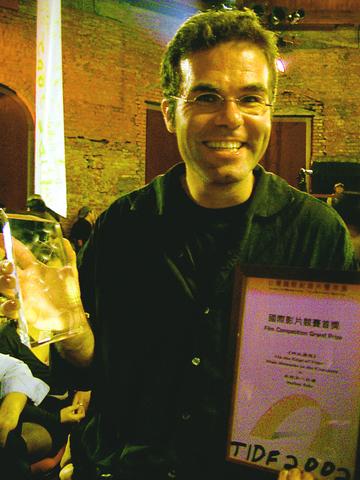
PHOTO: YU SEN-LUN, TAIPEI TIMES
The two second prize awards were given to Israeli director David Fisher's Love Inventory and Danish film Family by Phie Ambo-Nielson and Sami Martin Saif, each winning a cash prize of NT$100,000.
Taiwanese director Tang Shiang-chu's (
"In this film festival, we seem to have walked through the Caucasus, Siberia, temples in Taipei and an island in Bolivia. And we have learned how to fish in Norway, to lead a life as a homeless person in Buenos Aires and to climb the mountains of Hsinchu. ? This is the great thing about this festival," said jury member Alan Rosenthal referring to the films in the international film competition.
"We had a very smooth meeting. All the awards were decided without much disagreement," added Lee Daw-ming (
The winning film, On the Edge of Time: Male Domains in the Caucasus depicts a multi-ethic male-dominated culture and a simple lifestyle that seems to have been forgotten by time.
The jury gave this film the top award because of the enormous difficulties that had been overcome while shooting in the remote Caucasus region.
Tolz expressed great excitement at receiving the award for a film he said had previously been rejected by a German TV station. He was now able to prove them wrong.
"I have to thank the people of the Caucasus for opening their hearts to my camera," Tolz said as he got ready to celebrate his victory.
"My original idea was inspired by the millennium. I wanted to find a place where people live in a different time, without mobile phones or computers."
David Fisher's Love Inventory, a film digging into the filmmaker's own family secrets, took a second place Merit Award. Although the film has already picked up prizes in Berlin and at the Israeli Academy Awards, Fisher said this award was special to him. "I remember the warm reception I received here and the good questions from the audience. Also, I'm happy to show an Israeli film that is not about war or national historical problems," said Fisher.
In fact, the filmmakers found more than just a passionate audience for their films. They also found a market, with PTS, Taiwan's public TV network, expressing interest in some of the works.
In the international video competition category, the Grand Prize was given to Katorga by Russian filmmaker Evgeny Solomin, winning NT$100,000.
The two Merit Prizes are given to Zhao Liang (
Taiwanese filmmaker Zero Chou's (周美玲) Poles Extremity (極端寶島) and Finnish filmmaker Maria Lappalainen's On Edge were given Special Mention prizes in the video awards.
The two Taiwan Awards, designed to recognize local filmmakers, were given to Tseng Wen-chen (
The NETPAC Award, an award given by the Network for the Promotion of Asian Cinema, was given to Korean film Sky-blue Hometown by Kim So-young, about a Russian Korean painter in Uzbekistan. The film also won Best Documentary at the Pusan International Film Festival in 2000 and Yamagata International Documentary Film Festival in 2001.

Taiwan’s English education system is being pulled apart by three opposing forces. Bilingual Nation 2030 pulls students toward English and global communication. Artificial Intelligence (AI) readiness pulls them toward digital judgment, verification and AI-mediated work. But Taiwan’s old exam culture pulls them back toward memorization, grammar drills, timed reading and correct answers. If the education system keeps using old exams to define success, it risks producing graduates who are neither genuinely bilingual nor genuinely AI-ready, but trained for tasks machines can already perform. The first force is Bilingual Nation 2030. Launched in 2018, the policy aimed to “help Taiwan’s workforce connect

It seems every few days one bumps into one of those “real man” comments in which Taiwan is urged to “face reality” or similar, and “make a deal,” with the speaker implying that soon it will be too late. “Deal” advocates always present themselves as having a superior grip on reality, and the manly ability to make the “hard choice.” Their testosterone-laden language often echoes that of Taiwan sellout advocates. Note that such commentary always specifies a process (“make a deal, work with, make progress”), never the end state of what occupation by a violent authoritarian colonialist state will entail. In

There are shadowy cabals plotting to sell out Taiwan to be annexed by China, by invasion if necessary. Fortunately, they are buffoons. In 2019, former Bamboo Union gangster and founder of the China Unification Promotion Party (CUPP), Chang An-le (張安樂, colorfully known as “White Wolf”), led a protest at the Legislative Yuan against comments made by then-premier Su Tseng-chang (蘇貞昌) that in the event of an attack by China, he would never surrender, but would protect the nation by fighting to the end, even if he only had a broom. Chang had party members bring a wooden casket that they
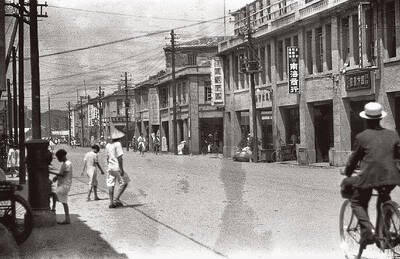
June 1 to June 7 "If all Taiwanese were as afraid of dying as you, then what would happen?” Physician Shih Chiang-nan (施江南) reportedly said this to his wife Chen Chiao-tung (陳焦桐) after she urged him to stop intervening on behalf of Taiwanese soldiers stranded overseas after serving in the Japanese Army during World War II. Shih had clashed with high-ranking officials over the issue, engaged in several heated arguments with Taiwan governor-general Chen Yi (陳儀) and allegedly shouted at general Ko Yuan-fen (柯遠芬), chief of staff of the Taiwan Garrison Command, over


 RSS
RSS