


To celebrate the re-launch of digital remastered Shaw Brothers films and the opening of the Shaw Brothers Film festival, Hong Kong stars from the 1970s gathered in Taipei yesterday at Breeze Center's Ambassador Cinema, meeting with their long-time fans and enjoying the spotlight.
"I don't think we're old. Our spirits are not old at all," said kung fu actor Liu Chia-hui (劉家輝), now 47 year-old. Liu was the lead actor in the classic kung fu drama The 36th Chamber of Shaolin (1977). He was accompanied by another action star, David Chiang (姜大衛). Also among the stars gathered were four cast members from The Love Eterne: Ling Bo, Hu Chin, Lee Kun and Ren Jie.
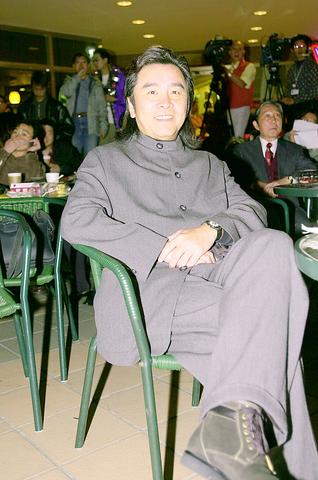
PHOTO: TAIPEI TIMES
Indeed none of the stars have given up their acting careers in the years since the decline of the Shaw Brothers empire. Liu, an action actor with solid kung fu skills, still has his trademark shaved head, just like when he played the Shaolin monk and kung fu master in 36th Chamber. Known as the "Yul Brynner of the East," Liu is currently acting in Quentin Tarantino's 2003 action film Kill Bill, playing the role of a Japanese fighter for the director who is known to be a big fan of 1970s Hong Kong action films.
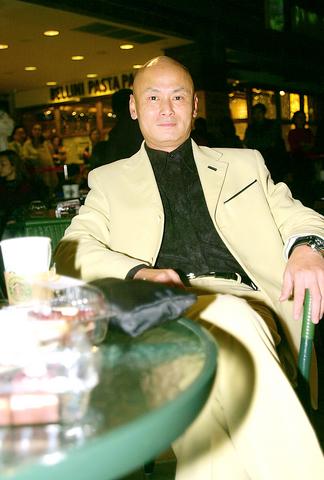
PHOTO: TAIPEI TIMES
"Tarantino told me he chose me for two reasons: First, I fight with real kung fu; and second, I have a shaved head like Yul Brynner," Liu told the Taipei Times. "I've tried acting in many roles with hair, but none of them were as successful as those in which my head was shaved," Liu said.
David Chiang, lead actor in Blood Brothers (1973), has long since left acting and become a director of films and TV dramas in Hong Kong. But now, as the old kung-fu movies are currently in fashion, he is back in action roles again. Chiang just finished Tai chi Warrior, an English-language martial arts film, in which he plays a tai chi master in Shanghai.
These are all good signs for Celestial Pictures who bought Shaw Brothers' 760 titles and invested heavily in remastering them. According to William Pfeiffer, CEO of Celestial Pictures, the Shaw Brothers week of movie screenings has generated such good box office numbers that it has been extended into a Shaw Brothers Month. "We even have plans to re-make some of the classic films," Pfeiffer said.

Taiwan’s English education system is being pulled apart by three opposing forces. Bilingual Nation 2030 pulls students toward English and global communication. Artificial Intelligence (AI) readiness pulls them toward digital judgment, verification and AI-mediated work. But Taiwan’s old exam culture pulls them back toward memorization, grammar drills, timed reading and correct answers. If the education system keeps using old exams to define success, it risks producing graduates who are neither genuinely bilingual nor genuinely AI-ready, but trained for tasks machines can already perform. The first force is Bilingual Nation 2030. Launched in 2018, the policy aimed to “help Taiwan’s workforce connect
It seems every few days one bumps into one of those “real man” comments in which Taiwan is urged to “face reality” or similar, and “make a deal,” with the speaker implying that soon it will be too late. “Deal” advocates always present themselves as having a superior grip on reality, and the manly ability to make the “hard choice.” Their testosterone-laden language often echoes that of Taiwan sellout advocates. Note that such commentary always specifies a process (“make a deal, work with, make progress”), never the end state of what occupation by a violent authoritarian colonialist state will entail. In

There are shadowy cabals plotting to sell out Taiwan to be annexed by China, by invasion if necessary. Fortunately, they are buffoons. In 2019, former Bamboo Union gangster and founder of the China Unification Promotion Party (CUPP), Chang An-le (張安樂, colorfully known as “White Wolf”), led a protest at the Legislative Yuan against comments made by then-premier Su Tseng-chang (蘇貞昌) that in the event of an attack by China, he would never surrender, but would protect the nation by fighting to the end, even if he only had a broom. Chang had party members bring a wooden casket that they

June 1 to June 7 "If all Taiwanese were as afraid of dying as you, then what would happen?” Physician Shih Chiang-nan (施江南) reportedly said this to his wife Chen Chiao-tung (陳焦桐) after she urged him to stop intervening on behalf of Taiwanese soldiers stranded overseas after serving in the Japanese Army during World War II. Shih had clashed with high-ranking officials over the issue, engaged in several heated arguments with Taiwan governor-general Chen Yi (陳儀) and allegedly shouted at general Ko Yuan-fen (柯遠芬), chief of staff of the Taiwan Garrison Command, over


 RSS
RSS