


Why does the human singing voice exist? No other primates sing, and singing has no obvious biological purpose, except perhaps courtship. People who believe that human beings have souls, and are not really comparable with any other mammals, can point to the singing voice as a prime item of evidence.
Great natural voices occur with all the strangeness associated with infant prodigies. You only have to listen to the thrilling tones of Andrea Bocelli or Renee Fleming to know you're in the presence of something altogether exceptional and extraordinary.
SENTIMENTO: ANDREA BOCELLI

Philips 470 400-2
Some people argue that recording companies home in on selected individuals and bring them to fame at the expense of others of equal talent whom it's not in their interests to promote. Nevertheless, Bocelli has the kind of voice that only rises to prominence a few times every century. Asia has a long tradition of blind musicians but they're rarer elsewhere. He is by any standards unusual.
On this new disc, Lorin Maazel, musical director of the New York Philharmonic, takes up the violin to accompany Bocelli, mostly in Italian songs from the 19th century. This was the popular music that lay behind Puccini and Mascagni's operas, music they took and raised to greater and more complex aesthetic heights. Maazel points out that a hundred years ago it was exactly this combination of tenor voice and violin that was especially popular -- he could have added it was the kind of music James Joyce most enjoyed. On this CD Maazel has taken 17 famous items, written solo violin parts for himself to play where necessary, and orchestrated them for the London Symphony Orchestra's accompaniment.
The result is absolutely stunning. Bocelli's voice is so beautiful, so resonant, and with such ringing purity, you feel you could happily listen to nothing else forever. When you arrive in heaven, this Italian music is what the angels will be singing, and Bocelli will be there leading them in resplendent tenor solos.
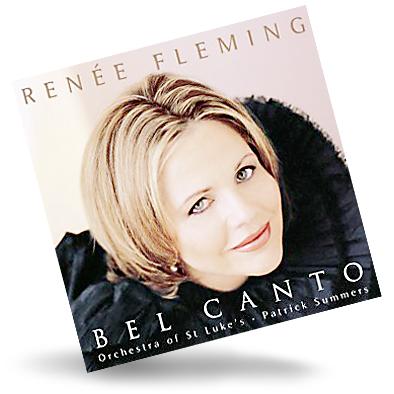
BEL CANTO: RENEE FLEMING
Decca 467 101-2
What are we to think of "bel canto"? It was a style of writing for the voice that flourished between the eras of Mozart and Verdi and is associated with the operas of Bellini, Donizetti and Rossini. It fell into disrepute in the early 20th century as representing all art and no feeling, but was revived in the 1950s and is these days is still in favor among self-styled connoisseurs. Its champions, of whom soprano Renee Fleming is one, claim the manner is capable of great musical sophistication and dramatic power if you look carefully at the operas it characterizes. This magnificent CD certainly bears out that claim.
Arias are selected from six representative operas and were recorded in New York's Masonic Hall in December 1999, with the Orchestra of St Luke's under Patrick Summers. They were no doubt selected to show off Renee Fleming's brilliant and fiery voice to full effect rather than to make a case yet again for the genre as such. Nevertheless, the closing scenes from Donizetti's Lucrezia Borgia and Bellini's Il Pirata are exceptionally powerful and dramatic. Bellini (who died at the age of 34) said he "vomited blood" writing this scene. Nevertheless, he noted that at its first performance it "aroused indescribable enthusiasm."
Renee Fleming's voice is marvelously versatile. She is superb in every register, intoxicating at the top, foreboding at the bottom. It's astonishing to read, incidentally, that she was first trained as a jazz singer. Of course operatic music like this is still not all she records. Even so, the two techniques required appear to have almost nothing in common.
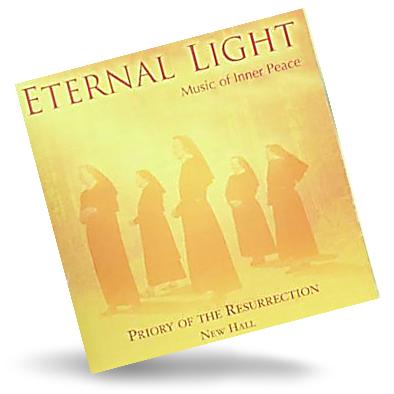
ETERNAL LIGHT: MUSIC OF
INNER PEACE
Deutsche Grammophon 471 090-2
This CD could be described as the sound of contented schoolgirls humming quietly to themselves. In fact it's the choir of a priory of English nuns, and the latest addition to the phenomenon of plainsong marketed for mass consumption. The voices are discreetly accompanied here and there by flute, clarinet and organ. The pale light of an English winter morning suffuses this recording which is nowhere strident in the way men singing plainchant can be. In fact, easy though it is to laugh at it, the result is strangely attractive. A placid gentleness is its essential feature, thought by some to especially characterize English spirituality (though history tells a different story). One oddity is that the notes claim the Canonnesses of the Holy Sepulchre have been at New Hall in eastern England since 1799, whereas Roman Catholics were only emancipated in the UK in 1829 and couldn't have openly run a religious community before that date. This nevertheless is an attractive CD. Old and modern items are mixed together, but all share the same slightly quaint tranquility.
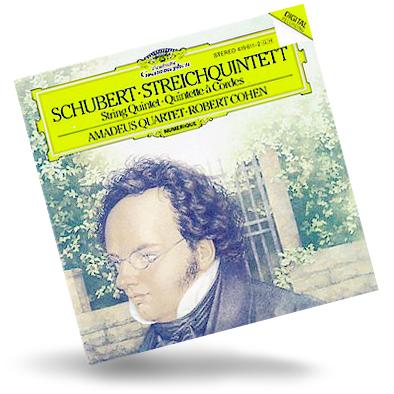
SCHUBERT: STRING QUINTET
AMADEUS QUARTET & ROBERT COHEN
Deutsche Grammophon 419 611-2
BEETHOVEN: VIOLIN CONCERTO, VIOLIN ROMANCES -- Arthur Grumiaux
Eloquence 468 114-2
These are both famous recordings, though far from new. It's impossible to fault either of them artistically. Schubert's heart-broken and heart-breaking quintet (which a friend of mine finds so devastating he can't bear to listen to it) is played by the Amadeus with great power. Nevertheless, the recording dates from 1986, and even then wasn't their first version of the work on disc. Few these days will opt for it rather than, say, the Lindsay Quartet's ethereal rendering (with Douglas Cummings). The Beethoven CD, too, was Arthur Grumiaux's second recording of this well-worn violin concerto, here with Amsterdam's Concertgebouw orchestra, and dates from 1974.
Neither of these performances is any longer a market leader, but they both continue to hold their place in the catalogues. The Beethoven appears on a new label, Eloquence, which takes vintage recordings with equal freedom from Deutsche Grammophon, Philips and Decca. The advantage this disc retains is that Eloquence is a budget-price label. The Amadeus's Schubert, however, is still on Deutsche Grammophon's full price list.

Taiwan’s English education system is being pulled apart by three opposing forces. Bilingual Nation 2030 pulls students toward English and global communication. Artificial Intelligence (AI) readiness pulls them toward digital judgment, verification and AI-mediated work. But Taiwan’s old exam culture pulls them back toward memorization, grammar drills, timed reading and correct answers. If the education system keeps using old exams to define success, it risks producing graduates who are neither genuinely bilingual nor genuinely AI-ready, but trained for tasks machines can already perform. The first force is Bilingual Nation 2030. Launched in 2018, the policy aimed to “help Taiwan’s workforce connect

It seems every few days one bumps into one of those “real man” comments in which Taiwan is urged to “face reality” or similar, and “make a deal,” with the speaker implying that soon it will be too late. “Deal” advocates always present themselves as having a superior grip on reality, and the manly ability to make the “hard choice.” Their testosterone-laden language often echoes that of Taiwan sellout advocates. Note that such commentary always specifies a process (“make a deal, work with, make progress”), never the end state of what occupation by a violent authoritarian colonialist state will entail. In

There are shadowy cabals plotting to sell out Taiwan to be annexed by China, by invasion if necessary. Fortunately, they are buffoons. In 2019, former Bamboo Union gangster and founder of the China Unification Promotion Party (CUPP), Chang An-le (張安樂, colorfully known as “White Wolf”), led a protest at the Legislative Yuan against comments made by then-premier Su Tseng-chang (蘇貞昌) that in the event of an attack by China, he would never surrender, but would protect the nation by fighting to the end, even if he only had a broom. Chang had party members bring a wooden casket that they
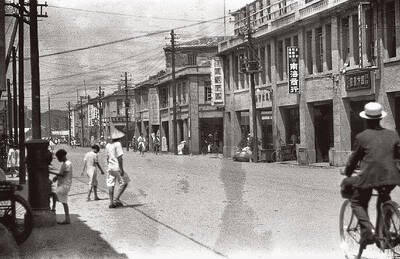
June 1 to June 7 "If all Taiwanese were as afraid of dying as you, then what would happen?” Physician Shih Chiang-nan (施江南) reportedly said this to his wife Chen Chiao-tung (陳焦桐) after she urged him to stop intervening on behalf of Taiwanese soldiers stranded overseas after serving in the Japanese Army during World War II. Shih had clashed with high-ranking officials over the issue, engaged in several heated arguments with Taiwan governor-general Chen Yi (陳儀) and allegedly shouted at general Ko Yuan-fen (柯遠芬), chief of staff of the Taiwan Garrison Command, over


 RSS
RSS