


The last time Onedotzero came to Taipei, they played their video art a nightclub. Now, returning as the world's largest digital film festival, the collective is showing in the Taipei Fine Arts Museum (TFAM) with a program that includes a Spike Jonze documentary, music videos for Radiohead, Unkle and the White Stripes, and 3-D animation from PC games Lara Croft Tomb Raider and Final Fantasy X.
"Now we're reaching a wider audience, so we're using different kinds of venues to accommodate that kind of recognition," said Onedotzero director Shane Walter, speaking yesterday at TFAM.
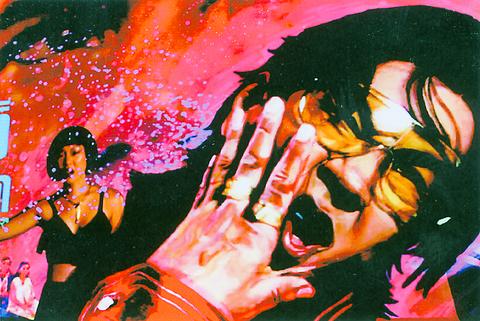
PHOTO: ONEDOTZERO
Walter founded Onedotzero with fellow Londoner Matt Hanson in 1996 as a festival to showcase digital film. This year they've shown digital programs in ten different countries in venues including the San Francisco Museum of Modern Art, movie theaters and dance clubs.
In regard to the festival's ability to bridge high art and pop culture, Walter said, "It can exist in both areas, and the different contexts are interesting because they allow different possibilities."
The sources of Onedotzero's films span the genre in a similar way. Works come from individuals and groups of more than a dozen creative disciplines, including artists, illustrators, nightclub VJs, film directors, photographers, musicians, architects and CGI technicians.
The result at TFAM is 12 separate 80 to 90-minute programs that will cycle in the museum's galleries between tomorrow, the show's opening day, and the end of October.
This weekend, Walter and several digital filmmakers will also share their works and views directly through a series of events. Participants include Walter, Anna Doyle (also of Onedotzero), Patrick Chen, Christian McKenzie and Bastian Glassner (the trio that makes up LynnFox), Andy Martin, Tim Hope, Stuart Warren Hill (Hexstatic) and local artists Chang Yun-chih (張耘之) and Akibo Lee (李明道).
Tomorrow and Sunday from 10am to 4pm these artists will present their works at TFAM, and at 4:15pm each day there will be group discussions featuring all of the day's lecturers. Tonight, Stuart Warren Hill will showcase his club visuals at Saloon, located at 107-2, Hsinyi Rd., Sec. 4, Taipei (北市信義路四段107之2號).

Taiwan’s English education system is being pulled apart by three opposing forces. Bilingual Nation 2030 pulls students toward English and global communication. Artificial Intelligence (AI) readiness pulls them toward digital judgment, verification and AI-mediated work. But Taiwan’s old exam culture pulls them back toward memorization, grammar drills, timed reading and correct answers. If the education system keeps using old exams to define success, it risks producing graduates who are neither genuinely bilingual nor genuinely AI-ready, but trained for tasks machines can already perform. The first force is Bilingual Nation 2030. Launched in 2018, the policy aimed to “help Taiwan’s workforce connect

It seems every few days one bumps into one of those “real man” comments in which Taiwan is urged to “face reality” or similar, and “make a deal,” with the speaker implying that soon it will be too late. “Deal” advocates always present themselves as having a superior grip on reality, and the manly ability to make the “hard choice.” Their testosterone-laden language often echoes that of Taiwan sellout advocates. Note that such commentary always specifies a process (“make a deal, work with, make progress”), never the end state of what occupation by a violent authoritarian colonialist state will entail. In

June 1 to June 7 "If all Taiwanese were as afraid of dying as you, then what would happen?” Physician Shih Chiang-nan (施江南) reportedly said this to his wife Chen Chiao-tung (陳焦桐) after she urged him to stop intervening on behalf of Taiwanese soldiers stranded overseas after serving in the Japanese Army during World War II. Shih had clashed with high-ranking officials over the issue, engaged in several heated arguments with Taiwan governor-general Chen Yi (陳儀) and allegedly shouted at general Ko Yuan-fen (柯遠芬), chief of staff of the Taiwan Garrison Command, over

“Taiwan’s Opposition Leader Comes to US With a Message Straight Out of Beijing” read a May 31 headline in the Wall Street Journal. Top US administration officials and members of Congress almost certainly read the WSJ, and if there was a bullet point takeaway that people in Washington should absorb ahead of Chinese Nationalist Party (KMT) Chair Cheng Li-wun’s (鄭麗文) arrival in DC on June 9, that headline is it. The last few columns have discussed this very topic, and the timing is not coincidental. While those top officials likely do not read the Taipei Times, judging by the number


 RSS
RSS