


Ms Wang, like many women in Taiwan, had not hesitated to resort to abortion when faced with an unwanted pregnancy. This did not mean she felt good about it. She called up Kuo Su-ching (
She had first heard about Kuo after reading of her powers in a magazine. Kuo spoke on the phone, sitting in a room with many images of her friends -- images of gods and spirits. She asked Wang's full name, date of birth, home address, and the number of times she'd had an abortion. "Three? That's okay. But you've never prayed and helped them to `pass on,' correct?"
The Chinese term she used is chao tu, which refers to helping the spirits of the dead pass through purgatory and continue through the cycle of reincarnation.
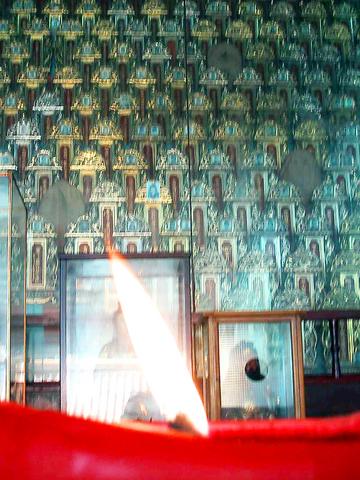
PHOTO: EMILY WU, TAIPEI TIMES
Even as she spoke on the phone, Kuo was possessed by the spirit of Bodhidharma, who she later said spoke Hindi. She jumped in and out of her possessed state, first speaking in tongues, then translating to her interlocutor.
"He sees a girl behind you. There is definitely a baby spirit near you. She is very young, very shy, and very pretty. She looks like you," she said.
"It is crucial for you to come here and help the `baby spirits' pass on, otherwise you will have bad health and bad concentration in anything you do," she said.
Kuo, who presides at the Wufu Chiensuei Temple in Sanchung (五府千歲宮), said about 10 women each day come to her for help. Ghost month (which reached its midpoint yesterday in the Chungyuan Festival) is especially busy. Kuo welcomes each of visitor warmly and with great sympathy -- as long as the full NT$3,000 service fee is paid.
It is no surprise that some women turn to religion after the trauma of abortion. According to Kuo, the most common request is that they no longer be haunted by the `baby spirits.'
According to the Web site of the Jiayun Ossuary (
This is part of a more general belief in Chinese superstition that if the spirits of the dead are not cared for, they will stay among the living and cause accidents and misfortunes by way of revenge. This system of belief puts considerable pressure on women who have opted to terminate pregnancies.
"Should anything unfortunate happen to these women, they become uneasy and suspicious about being clung to by baby spirits," said a temple worker surnamed Lin from the Linchi Temple (臨濟寺), a Buddhist temple in Taipei, explained. According to Lin, of the thousands who attend a typical chao tu ceremony, there will usually be a 100 or so who are there specifically to help the spirits of the unborn children pass on.
Specific rituals are required, with a slip of yellow paper bearing the mothers name and the abjuration that Buddha help "aborted children, still birth children, children who died in the womb move onto their next life." While most Buddhist temples do not impose a fee for this service, they do encourage donations.
Ritual practice for the spirits of the dead is anything but consistent, with a host of superstitions and theories about what is correct procedure. Even Lin, a lay worker at Linchi Temple, sees the process in largely psychological terms. "After a miscarriage or an abortion, if the woman feels guilty about the death of her child, she will begin to suspect baby spirits," he said. He added that the process is probably still a good thing for these women.
Wang Shu-fen (王淑芬), a social worker who works with unmarried women with abortion at The Garden of Hope (麗星基金會), a foundation dedicated to single mothers, agrees. "Although the superstition is not mainstream, if helping baby spirits contributes to the wellbeing of the women, it can also be used as a form of counseling," Wang said.
Although Wang and her colleagues do not promote such practice, they do not oppose if women desire it. Mrs Chen, a 48-year-old mother of two, expressed the other side of the argument.
"This is wrong," she said angrily. "The concept of redemption in this sense is unacceptable. You can't just burn some incense after you have killed somebody and expect everything to be fine again! Where is your morality?"
Chen, who has herself had an abortion due to economic concerns, says that although 20 years have passed, it is hard not to think about it. "You shouldn't merely visit the temple and expect to be forgiven," she said. But her husband thinks there is nothing wrong with "setting up a security net for the guilt and fear these women face," he said.
Lin-lin, a 22-year-old travel agent, sometimes feels the need of such a safety net, although not particularly religious. When speaking about her first aborted child, she admitted that, "I just feel so guilty.
"Even today, five years after my first abortion, I have nightmares about my first dead child," Lin-lin said. "Sometimes I wake up in the morning feeling as if there is a kid sleeping beside me," she continued.
Lin-lin has never participated in a chao tu ceremony for the spirits of either of the two "children" she aborted. Going to a temple is too much time and trouble.
Several Taiwanese Web sites have solved this problem by creating online temples. For just NT$1,000, virtual shrines can be created on the site. On one such site, the "baby spirit" has all he will need: dinning hall, bathtub, fruit stands, and a candy store. Below, are a mailbox to which the mother can write letters to and a bucket where she can burn ghost money for him to buy things.
Kuo, when she heard of Web sites such as this one, said it was no more than a scam. But for the busy would-be mother in today's networked world, isn't it just a way of burning ghost money without any smoke?

If one asks Taiwanese why house prices are so high or why the nation is so built up or why certain policies cannot be carried out, one common answer is that “Taiwan is too small.” This is actually true, though not in the way people think. The National Property Administration (NPA), responsible for tracking and managing the government’s real estate assets, maintains statistics on how much land the government owns. As of the end of last year, land for official use constituted 293,655 hectares, for public use 1,732,513 hectares, for non-public use 216,972 hectares and for state enterprises 34 hectares, yielding
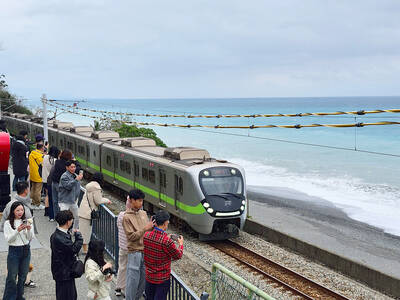
The small platform at Duoliang Train Station in Taitung County’s Taimali Township (太麻里) served villagers from 1992 to 2006, but was eventually shut down due to lack of use. Just 10 years later, the abandoned train station had become widely known as the most beautiful station in Taiwan, and visitors were so frequent that the village had to start restricting traffic. Nowadays, Duoliang Village (多良) is known as a bit of a tourist trap, with a mandatory, albeit modest, admission fee of NT$10 giving access to a crowded lane of vendors with a mediocre view of the ocean and the trains

One of the challenges with the sheer availability of food in today’s world is that lots of us end up spending many of our waking hours eating. Whether it’s full meals, snacks or desserts, scientists have found that it’s not uncommon for us to be mindlessly grazing at some point during all of our 16 or so waking hours. The problem? As soon as this food hits the bloodstream in the form of glucose, it initiates the release of the hormone insulin. This in turn activates a switch present in every one of our cells, which is responsible for driving cell
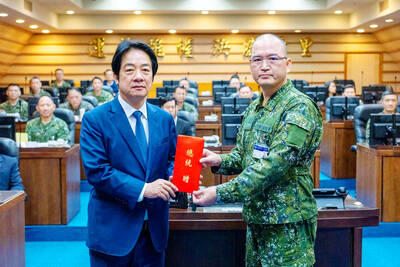
President William Lai (賴清德) on Nov. 25 last year announced in a Washington Post op-ed that “my government will introduce a historic US$40 billion supplementary defense budget, an investment that underscores our commitment to defending Taiwan’s democracy.” Lai promised “significant new arms acquisitions from the United States” and to “invest in cutting-edge technologies and expand Taiwan’s defense industrial base,” to “bolster deterrence by inserting greater costs and uncertainties into Beijing’s decision-making on the use of force.” Announcing it in the Washington Post was a strategic gamble, both geopolitically and domestically, with Taiwan’s international credibility at stake. But Lai’s message was exactly


 RSS
RSS