


The name is familiar to anyone who has been in Taipei any length of time, but the restaurant/bar that opened at the top of Roosevelt Road two months ago is a very different place from the rather grungy gay bar formerly located on Kuling Street. Webster Chen (陳文彥) sees the new establishment as a radical shift from his life as a bar owner, not just in his taking over a kitchen that serves a good selection of Taiwanese home cooking, but also in creating an elegant environment where people can drink, dance and dine. "I even made it a smoke free environment, but this went too much against the grain, so we allow smoking now. I felt bad about it, but it was necessary," Chen said.
In the two months since it opened, The Source has been serving European food, but in a total makeover of the menu, Chen is turning the place into a Chinese restaurant with himself as chef. This is much more in keeping with the Chinoiserie with which the restaurant is outfitted. The highlight of the building is a steep staircase winding its way around a central stairwell to the fourth story. "The building used to be a massage parlor," said Chen, happy with the association.
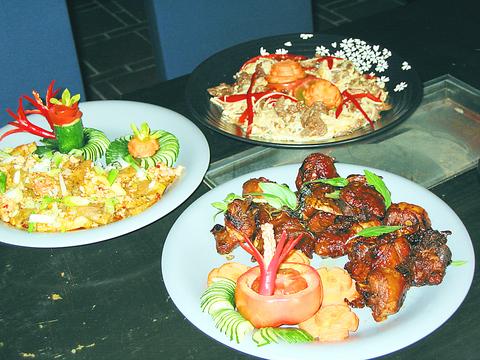
PHOTO: IAN BARTHOLOMEW, TAIPEI TIMES
On Friday and Saturday, the second floor is converted into a dance floor with a DJ spinning a retro selection of 1980s and 1990s music. "I really don't want to get caught up in the whole techno and drugs thing," Chen said. "The aim here is to create a comfortable space where people can get together." For this reason, Chen has established a 5pm to 7pm happy hour with Heineken for just NT$20. The music isn't too loud either, so people can talk, making The Source a much-needed alternative to clubs where you can't even hear yourself think. Chen specializes in home-style dishes and his three-cups chicken is highly recommended. Basically a self-taught cook, Chen says that although he uses conventional ingredients, his experience means that dishes come out with their own distinctive style. Portions are hearty and Chen's slight variations -- most notably in his eggplant in hot-sour sauce -- add a twist to established dishes.
The Source is located just up the road from Exit 4 of the Chiang Kai-shek Memorial Hall MRT station, and is an easy walking distance from the National Theater and Concert Hall, making it ideal for pre and post-show drinks and dining.

Taiwan’s English education system is being pulled apart by three opposing forces. Bilingual Nation 2030 pulls students toward English and global communication. Artificial Intelligence (AI) readiness pulls them toward digital judgment, verification and AI-mediated work. But Taiwan’s old exam culture pulls them back toward memorization, grammar drills, timed reading and correct answers. If the education system keeps using old exams to define success, it risks producing graduates who are neither genuinely bilingual nor genuinely AI-ready, but trained for tasks machines can already perform. The first force is Bilingual Nation 2030. Launched in 2018, the policy aimed to “help Taiwan’s workforce connect

It seems every few days one bumps into one of those “real man” comments in which Taiwan is urged to “face reality” or similar, and “make a deal,” with the speaker implying that soon it will be too late. “Deal” advocates always present themselves as having a superior grip on reality, and the manly ability to make the “hard choice.” Their testosterone-laden language often echoes that of Taiwan sellout advocates. Note that such commentary always specifies a process (“make a deal, work with, make progress”), never the end state of what occupation by a violent authoritarian colonialist state will entail. In
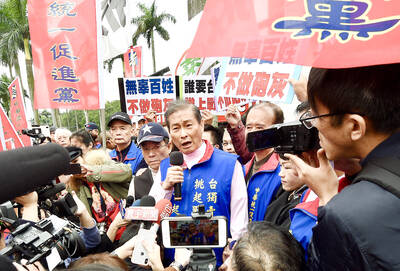
There are shadowy cabals plotting to sell out Taiwan to be annexed by China, by invasion if necessary. Fortunately, they are buffoons. In 2019, former Bamboo Union gangster and founder of the China Unification Promotion Party (CUPP), Chang An-le (張安樂, colorfully known as “White Wolf”), led a protest at the Legislative Yuan against comments made by then-premier Su Tseng-chang (蘇貞昌) that in the event of an attack by China, he would never surrender, but would protect the nation by fighting to the end, even if he only had a broom. Chang had party members bring a wooden casket that they
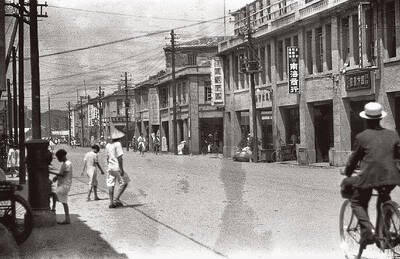
June 1 to June 7 "If all Taiwanese were as afraid of dying as you, then what would happen?” Physician Shih Chiang-nan (施江南) reportedly said this to his wife Chen Chiao-tung (陳焦桐) after she urged him to stop intervening on behalf of Taiwanese soldiers stranded overseas after serving in the Japanese Army during World War II. Shih had clashed with high-ranking officials over the issue, engaged in several heated arguments with Taiwan governor-general Chen Yi (陳儀) and allegedly shouted at general Ko Yuan-fen (柯遠芬), chief of staff of the Taiwan Garrison Command, over


 RSS
RSS