


During Taipei's hot summer days, three murders have taken place within a week: The head of a chemical industry group is found dead in his office. His body is cold as if he was drowned in ice water, but he never walked out of his office. A legislator's mistress, who had been involved in several corruption scandals, was killed in her apartment. Her body was burned, though there was no sign of fire in her house. A few days later an American priest named Lorenzo, who was reportedly involved in arms sales between the US and Taiwan, is found dead in his church. He was disemboweled and his intestines were washed and put back.
The three were unacquainted, but the coroner discovers a mysterious black fungus in their brains, along with evidence that they had all died in a hallucinatory state.
Double Vision, a rarely seen slasher film from Taiwan which screened this week at Cannes, is quite a shock for timid audiences. The film is steeped in a mysterious atmosphere. Scenes of dead bodies, removing hearts from corpses and having tongues pulled out of screaming mouths appear throughout the film. If this isn't enough to bother you, there is a massacre that takes place in a Taoist temple in which religious fanatics chop off the heads and hands of police officers.
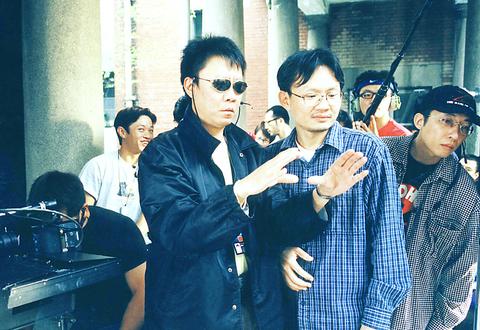
PHOTO: COLUMBIA ASIA
There hasn't been a Taiwanese film in a long time that quickens your pulse and makes you grab for the person's arm sitting beside you. Director Chen Kuo-fu (
This big budget, large-cast film, stars Hong Kong actor, Tony Leung Ka-Fai (梁家輝) and US actor David Morse and is loaded with visual effects and make-up work.
Huang Hou-tu (Leung) is relegated to the do-nothing job of Foreign Affairs Officer after having uncovered a police corruption scandal. Because the serial killings require hi-tech laboratory tests, he teams up with FBI expert Kevin Richter (David Morse), to track down the killer. The two unexpectedly discover that the killings are connected to a group of former computer business tycoons turned religious fanatics. In a Taoist temple mysteriously built inside a hi-tech skyscraper, the zealots believe in attaining immortality by annihilating sinners.
"This film has a typical [Hollywood] structure but with Taiwanese content," Chen said. The most fascinating part of the story, at least for its Cannes audience, was the way it connected ancient supernatural beliefs with Taiwan's high-tech-savvy middle class. "Many social phenomena indicate that cult fanatics come from an anxious urban middle class," Chen said.
"I am not at all a believer. I've been around people all my life who believe in energy healing, ghosts, and whatnot. I make a film about it in an attempt to understand. ... In order to shoot Double Vision, I had to put myself in the shoes of a believer, so that by the end, I was so absorbed in the `reality' of the supernatural and felt like I believed."
Visually, Chen also wanted to present a different picture than previously-seen slashers. He said he wanted to present Taipei as a very real, very cruel city.
"You see every detail of a person in pictures. With this kind of slightly exaggerated, surreal photography I intend to make the audience -- especially the Taiwanese audience -- dissolve in the story," he said.
"I cried in the film last night, the first time I saw the film as a member of the audience. I was touched by Chen's power," Leung said. "At first I couldn't understand why a Taiwanese cop could be so repressive about his feelings and inner fears." he added.
According to Columbia Asia, the film is set to be released in Taiwan on Sept. 28.

Michael slides a sequin glove over the pop star’s tarnished legacy, shrouding Michael Jackson’s complications with a conventional biopic that, if you cover your ears, sounds great. Antoine Fuqua’s movie is sanctioned by Jackson’s estate and its producers include the estate’s executors. So it is, by its nature, a narrow, authorized perspective on Jackson. The film ends before the flood of allegations of sexual abuse of children, or Jackson’s own acknowledgment of sleeping alongside kids. Jackson and his estate have long maintained his innocence. In his only criminal trial, in 2005, Jackson was acquitted. Michael doesn’t even subtly nod to these facts.
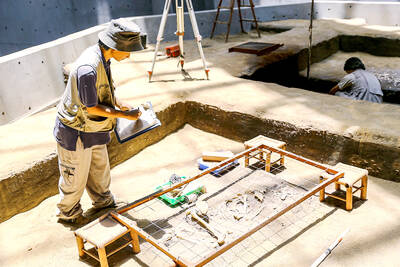
Writing of the finds at the ancient iron-working site of Shihsanhang (十 三行) in New Taipei City’s Bali District (八里), archaeologist Tsang Cheng-hwa (臧振華) of the Academia Sinica’s Institute of History and Philology observes: “One bronze bowl gilded with gold, together with copper coins and fragments of Tang and Song ceramics, were also found. These provide evidence for early contact between Taiwan aborigines and Chinese.” The Shihsanhang Web site from the Ministry of Culture says of the finds: “They were evidence that the residents of the area had a close trading relation with Chinese civilians, as the coins can be
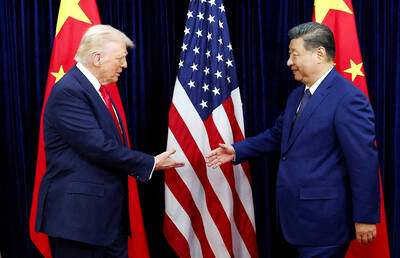
The March/April volume of Foreign Affairs, long a purveyor of pro-China pablum, offered up another irksome Beijing-speak on the issues and solutions for the problems vexing the People’s Republic of China (PRC) and the US: “America and China at the Edge of Ruin: A Last Chance to Step Back From the Brink” rang the provocative title, by David M. Lampton and Wang Jisi (王緝思). If one ever wants to describe what went wrong with US-PRC relations, the career of Wang Jisi is a good place to start. Wang has extensive experience in the US and the West. He was a visiting

The January 2028 presidential election is already stirring to life. In seven or eight months, the primary season will kick into high gear following this November’s local elections. By this point next year, we will likely know the Democratic Progressive Party (DPP) candidate and whether the Taiwan People’s Party (TPP) will be fielding a candidate. Also around this time, the Chinese Nationalist Party (KMT) will either have already completed their primary, or it will be heading into the final stretch. By next summer, the presidential race will be in high gear. The big question is who will be the KMT’s


 RSS
RSS