


Riding on the success of last year's Men Dancing, the series presenting choreography by and for male dancers from various cultures, the Novel Dance Series 2002 is bringing to Taipei Action Women. The new series, though consisting of only two performances, is aimed at giving people in Taiwan a rare chance to see the celebrated pieces by world-renowned female choreographers.
One of the two choreographers invited by Lin Huai-min (
The other participating choreographer is Chandralekha, who, according to Lin, illustrates how the process of time alters a choreographer. "Her works are like spring tea that leaves behind a lingering aroma long after you've tasted it," Lin said.
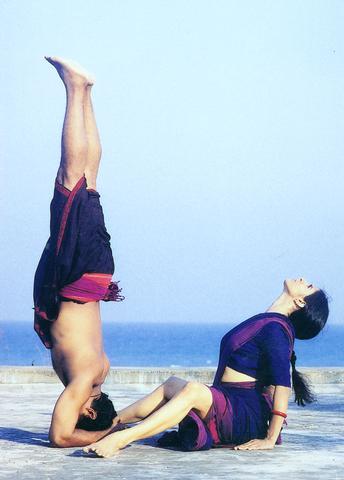
PHOTO COURTESY OF NOVEL HALL
The two choreographers, both in Taiwan for the first time, are meant to contrast each other with their different cultural backgrounds and expression.
Streb Go: ActionHeroes, by the New York-based choreographer, is an in-your-face dynamic piece that appears more like sport than dance.
Calling her own choreography "pop action," Streb has been creating works since 1979 which combine the disciplines of dance and athletics. Sending her dancers flying, bouncing and crashing off surfaces, Streb set out to test the boundaries of physical motion. One of the performances by the Streb Company that drew rave reviews was at New York's Brooklyn Bridge Anchorage, where harnessed dancers bounced off a 12m wall.
This is how Streb brings out the potential of human movement. "We can show that they are moving animals. I try to share with the people in the room that they can learn how to fly," Streb was quoted as saying when Streb Go: ActionHeroes toured Chicago earlier this year.
Streb's "ActionHeroes" are the American stunt artists who put their lives at risk to thrill audiences. Indignant about the fact that their feats have gone uncelebrated, Streb meant to pay them homage with a show filled with action.
The show opens with Rise and Fall, an episode in which a line-up of eight dancers appear standing on a beam. As it begins to rise, each of the dancers take turns falling to the mats below. The last dancer waits until the beam almost reaches the the top of the stage to fall, landing face down with a loud wallop.
These movements, in which dancers seem to completely give themselves up to faith is what Streb calls "pop action technique." The rest of the show, which bursts with physical impact, will make the audience breathless throughout.
Starting next Friday, controversial southern Indian choreographer Chandralekha will present her latest production Sharira -- Fire and Desire with her Indian dancers. When premiered at "Bharatanatyam in the Diaspora," the first international conference on the traditional Indian dance form, last September in Chicago, the piece embarassed quite a few parents with children in tow with its untamed expression of sensuality. However, it was by no means the first time the iconoclast jolted?public sensibilities.
Infusing the classical with the contemporary, Chandralekha has created dance pieces involving forms like yoga, Indian martial arts, mudras and Bharatanatyam, India's oldest dance form.
Despite being a successful Bharatanatyam dancer in the 1950s and 1960s, Chandralekha believed at the time that the dance form badly needed reforming. Breaking away from the classical dance scene, she began working as a writer and graphic designer, while participating in women's and human rights movements.
Chandralekha made her comeback in 1985 with Angika, which took the dance world by storm, making her one of the most important figures in the Indian counter-cultural movement in the 1980s.
However, her most controversial work so far remains Raga: In search of Femininity. In this performance, two bare-chested male dancers entagle themselves in no-holds-barred homoerotic poses. A group of female dancers pant and peek at, and often partake in the mock coitus.
The similarly sexually-charged Sharira -- Fire and Desire provoked strong reaction at its premiere with its spiritual energy that originates from Bharatanatyam and an explicit body language which was thought to be incompatible with the traditional dance form.
The duet opens with the female dancer entering the stage in the dark, spreading her body and receiving a flow of energy with her private parts, all the while caressing herself. The male dancer soon follows her on stage. Seeing the woman, he stands on his head as a form of worship of the female pudendum. The two then become intwined in a spiritual coitus, which evolves into a sexual awakening for both.
The tension between the male and female dancers is a palpable, sizzling energy throughout the dance, imbueing the excruciatingly slow yet continuous movements with excitement. Apart from the strength of their movements, the shifting formation of the two is stunningly powerful.

Taiwan’s English education system is being pulled apart by three opposing forces. Bilingual Nation 2030 pulls students toward English and global communication. Artificial Intelligence (AI) readiness pulls them toward digital judgment, verification and AI-mediated work. But Taiwan’s old exam culture pulls them back toward memorization, grammar drills, timed reading and correct answers. If the education system keeps using old exams to define success, it risks producing graduates who are neither genuinely bilingual nor genuinely AI-ready, but trained for tasks machines can already perform. The first force is Bilingual Nation 2030. Launched in 2018, the policy aimed to “help Taiwan’s workforce connect
It seems every few days one bumps into one of those “real man” comments in which Taiwan is urged to “face reality” or similar, and “make a deal,” with the speaker implying that soon it will be too late. “Deal” advocates always present themselves as having a superior grip on reality, and the manly ability to make the “hard choice.” Their testosterone-laden language often echoes that of Taiwan sellout advocates. Note that such commentary always specifies a process (“make a deal, work with, make progress”), never the end state of what occupation by a violent authoritarian colonialist state will entail. In
June 1 to June 7 "If all Taiwanese were as afraid of dying as you, then what would happen?” Physician Shih Chiang-nan (施江南) reportedly said this to his wife Chen Chiao-tung (陳焦桐) after she urged him to stop intervening on behalf of Taiwanese soldiers stranded overseas after serving in the Japanese Army during World War II. Shih had clashed with high-ranking officials over the issue, engaged in several heated arguments with Taiwan governor-general Chen Yi (陳儀) and allegedly shouted at general Ko Yuan-fen (柯遠芬), chief of staff of the Taiwan Garrison Command, over

“Taiwan’s Opposition Leader Comes to US With a Message Straight Out of Beijing” read a May 31 headline in the Wall Street Journal. Top US administration officials and members of Congress almost certainly read the WSJ, and if there was a bullet point takeaway that people in Washington should absorb ahead of Chinese Nationalist Party (KMT) Chair Cheng Li-wun’s (鄭麗文) arrival in DC on June 9, that headline is it. The last few columns have discussed this very topic, and the timing is not coincidental. While those top officials likely do not read the Taipei Times, judging by the number


 RSS
RSS