


Despite the heavy rain and delays due to traffic, the 38th Golden Horse Awards took place last night in the warm and welcoming atmosphere of Hualien County sports stadium. In a jolly carnival-like atmosphere marked by Aboriginal music and dance, awards went out relatively evenly, with Lan Yu emerging late in the event, picking up the important Best Director and Best Leading Actor, among a number of smaller prizes. Qin Hailu, though, was a huge hit, picking up both Best New Performer and Best Actress for her feature film debut. Durian Durian, in which she starred, also picked up Best Picture.
One of the more controversial aspects of this year's awards was the comprehensive sidelining of Tsai Ming-liang with the Jury Prize.
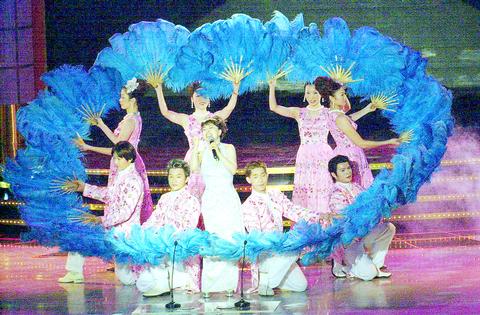
PHOTO: THE LIBERTY TIMES
Tsai, who has steered clear of the Golden Horse Awards since his film The River was boycotted by the Golden Horse committee in 1998 because of its controversial homosexual content, returned to the event this year with What Time is it There?
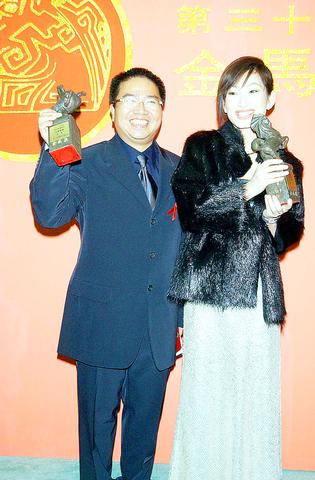
PHOTO: THE LIBERTY TIMES
The film, which has been critically acclaimed internationally, received the Special Jury Award, as did its director. In an acceptance speech in which the director barely repressed his emotions, Tsai wondered if "this is a consolation prize?" Rather ruefully, he added, "I suppose this puts me out of contention for Best Director." His film, which had a total of five nominations, received no awards in conventional categories, with even the award for best sound effects, in which Tu Tuu-chih was nominated for his efforts in both What Time...? and Millennium Mambo, going to the latter film.
What Time is it There? has won numerous awards in international competition, including Jury's Grand Prize, Best Director, and Best Cinematography at the Chicago International Film Festival. It went to official competition at the Cannes Film Festival and has been highly praised by US and European critics alike.
Contention for Best Picture was between a number of highly experience directors with strong track records, such as Fruit Chan (
As for Best Director, this is Stanley Kwan's second time to receive the award. Accepting the award, Kwan said he was very happy that a gay-themed melodrama could find such success at the Golden Horse Awards. His joy was particularly personal as the film was a reflection of his own 11-year relationship.
Qin Hailu was overjoyed to pick up two awards and also for her classmate Liu Ye, who picked up Best Leading Actor. The two both studied at the Central Theater Academy in Beijing, the same school that produced Gongli (鞏俐) and Zhang Zhiyi (章子怡).
In addition to the strong showing by Chinese actors, Hong Kong's film industry also had a pronounced presence, with Cantonese almost eclipsing Mandarin as the language spoken on stage, especially by those receiving awards, during some sections of the ceremony. Interviewing award winners, local media even found themselves in need of translators, a situation underlining the poor performance of Taiwan's film industry over the last year.
In a year notable for the absence of major stars among the nominees, the two supporting actor awards went to relative unknowns Patrick Tam and Yoky Lo, both of whom impressed with their energetic and spontaneous acting. Lo plays Fion in Gimme Gimme, a teenager addicted to telephone relationships. Hardly out of university herself, Lo said Fion was very close to her own personality.
Vivaciousness also proved a strong draw in other film categories, with Cheng Sui-tang picking up his first award for Best Action Choreography. He was nominated last year, and this year was nominated for both Shaolin Soccer and My Classmate, The Barbarian. He is currently working on a film by Zhang Yimou (張藝謀) titled Hero (英雄).
The award for best screenplay adaptation went to one of the favorites of the event, Lan Yu, which was particularly notable for deriving its story from a steamy homoerotic Internet novel. According to Jimmy Ngsi, one of the hardest aspects of the adaptation process was in setting the complex social and political background of Beijing in the last decade so as not to obtrude onto the more intimate aspect of the story.
Lee Ping-bing, who picked up the award for Best Cinematography for In the Mood for Love last year was a strong contender this year and picked up his fourth Golden Horse in this category. As a cinematographer with an international reputation, Lee said he feels great pressure as all the awards put him into a position as a representative of Taiwan's film industry.

Taiwan’s English education system is being pulled apart by three opposing forces. Bilingual Nation 2030 pulls students toward English and global communication. Artificial Intelligence (AI) readiness pulls them toward digital judgment, verification and AI-mediated work. But Taiwan’s old exam culture pulls them back toward memorization, grammar drills, timed reading and correct answers. If the education system keeps using old exams to define success, it risks producing graduates who are neither genuinely bilingual nor genuinely AI-ready, but trained for tasks machines can already perform. The first force is Bilingual Nation 2030. Launched in 2018, the policy aimed to “help Taiwan’s workforce connect
It seems every few days one bumps into one of those “real man” comments in which Taiwan is urged to “face reality” or similar, and “make a deal,” with the speaker implying that soon it will be too late. “Deal” advocates always present themselves as having a superior grip on reality, and the manly ability to make the “hard choice.” Their testosterone-laden language often echoes that of Taiwan sellout advocates. Note that such commentary always specifies a process (“make a deal, work with, make progress”), never the end state of what occupation by a violent authoritarian colonialist state will entail. In
June 1 to June 7 "If all Taiwanese were as afraid of dying as you, then what would happen?” Physician Shih Chiang-nan (施江南) reportedly said this to his wife Chen Chiao-tung (陳焦桐) after she urged him to stop intervening on behalf of Taiwanese soldiers stranded overseas after serving in the Japanese Army during World War II. Shih had clashed with high-ranking officials over the issue, engaged in several heated arguments with Taiwan governor-general Chen Yi (陳儀) and allegedly shouted at general Ko Yuan-fen (柯遠芬), chief of staff of the Taiwan Garrison Command, over

“Taiwan’s Opposition Leader Comes to US With a Message Straight Out of Beijing” read a May 31 headline in the Wall Street Journal. Top US administration officials and members of Congress almost certainly read the WSJ, and if there was a bullet point takeaway that people in Washington should absorb ahead of Chinese Nationalist Party (KMT) Chair Cheng Li-wun’s (鄭麗文) arrival in DC on June 9, that headline is it. The last few columns have discussed this very topic, and the timing is not coincidental. While those top officials likely do not read the Taipei Times, judging by the number


 RSS
RSS