


Although none of the members of the Irish folk-influenced band Ballycotton actually hail from Ireland, they can, according to banjo player Jock Brocks at least, hold their own when it comes to drinking Guinness.
Which is probably just as well as the five members of the band, named after a fishing town located in County Cork, are all Austrian nationals, have only been to Ireland on brief excursions and don't speak a word of Gaelic.
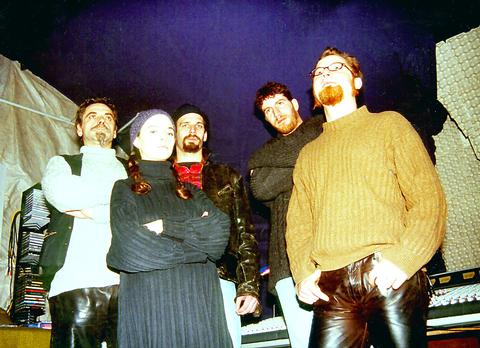
PHOTO COURTESY OF PARIS INTERNATIONAL
Not that the limited contact Jock Brocks, Alex Konig, Christina Gaismeier, Andy Neumeister and Harold G. Binder have had with the land of the Blarney Stone has inhibited their ability to perform and adapt traditional Celtic music into their own hybrid brand of world music.

PHOTO COURTESY OF PARIS INTERNATIONAL
It wasn't solely a love of Irish suds that led to the founding of the Teutonic Irish band. None of the band's members were overly impressed with the alternatives.
Mere mention of yodeling, or worse still German rap -- a musical style popular in Austria -- leads to stares of indignation from Brocks, and is enough to get their fiery faux-Celtic blood pumping.
"It's terrible all that yodeling," said Brocks. "And Austrian radio is even worse. They play nothing but pappy-popular music from the US or Britain. You hardly get to hear original modern Austrian bands and when you do it's usually at three or four o'clock in the morning."
Formed in 1996 as a knock-about-band by a group of folk musicians in Vienna, the band began its early days playing to hard-drinking punters in some of the Austrian capital's more liberally minded watering holes.
A year later the group traveled to Germany, where they played a mixed bag of venues that ranging from congenial local pubs to huge rambunctious beer halls in several of Germany's larger industrial cities.
Success at home and in Germany saw the band traveling to the Netherlands and Luxembourg and playing a few gigs in the lowlands -- gigs that have resulted in the band building up a strong fan base in much of non-Gaelic-speaking central Europe.
The band soon discovered, however, that playing traditional Irish music to people drinking steins of pilsner as opposed to pints of heavy had its limitations.
"We'd play original material for hours in a bar only to have somebody stand up at the end of the set and ask for us to play The Wild Rover, the only Irish tune they knew," Brocks told the Taipei Times. "It's great fun, but it became impossible to develop from only playing standard Celtic. The crowds didn't know how to react when we tried something different."
Impossible to develop it may have been, but the novelty of being one of Austria's only Irish-influenced folk bands was quite lucrative.
According to the band's guitarist, Alex Konig, many of his fellow Austrians are aware of Saint Patrick's Day, only there appears to be some confusion as to its exact date.
"We'd be very busy in mid-March as people in Austria know about the Irish holiday and are fully aware that it's an excuse to drink a lot, but they don't really know when it is," recalled a sniggering Konig. "One year we played at seven Saint Patrick's Day parties on different nights of the week."
In between tours, the band has made time to venture into the recording studio on three occasions.
While the material on 1996's Joanna's Wedding and 1997's Fairytale relied heavily on traditional Irish tunes as a basis, the band's latest release, A La Cut, sees the five-piece folk band branching out and experimenting with other forms and genres of music.
"It's not something we planned to do. It sort of fell into place," said Brocks of the band's recent shift to more world-folk orientated music. "We'd be practicing and Alex would play acoustic rock riffs, I'd play a Celtic-based tune and the violinist would cut in with a classical piece and we discovered that such combinations worked really well and sounded surprisingly natural."
A La Cut, while kicking in with Gnome's Firedance, a tune which carries as much Celtic clout as the Irish national rugby union team's front row, incorporates gypsy, classical and even central European folk styles.
Released in Europe earlier this year, A La Cut hit local record store shelves early last week. At present, Brocks and company aren't sure exactly how many copies of the album have sold in Taiwan. The faux-Irish Austrians have been assured by their record promoters, though, that the album did outsell a recent solo effort by an ex-Rolling Stone and looks set to have Taiwan jigging for sometime to come.

Yesterday, the Democratic Progressive Party (DPP) nominated legislator Puma Shen (沈伯洋) as their Taipei mayoral candidate, the Chinese Nationalist Party (KMT) put their stamp of approval on Wei Ping-cheng (魏平政) as their candidate for Changhua County commissioner and former legislator Tsai Pi-ru (蔡壁如) of the Taiwan People’s Party (TPP) has begun the process to also run in Changhua, though she has not yet been formally nominated. All three news items are bizarre. The DPP has struggled with settling on a Taipei nominee. The only candidate who declared interest was Enoch Wu (吳怡農), but the party seemed determined to nominate anyone

In a sudden move last week, opposition lawmakers of the Chinese Nationalist Party (KMT) and Taiwan People’s Party (TPP) passed a NT$780 billion special defense budget as a preemptive measure to stop either Chinese leader Xi Jinping (習近平) or US President Donald Trump from blocking US arms sales to Taiwan at their summit in Beijing, said KMT heavyweight Jaw Shaw-kong (趙少康), speaking to the Taipei Foreign Correspondents Club on Wednesday night in Taipei. The 76-year-old Jaw, a political talk show host who ran as the KMT’s vice presidential candidate in 2024, says that he personally brokered the deal to resolve

What government project has expropriated the most land in Taiwan? According to local media reports, it is the Taoyuan Aerotropolis, eating 2,500 hectares of land in its first phase, with more to come. Forty thousand people are expected to be displaced by the project. Naturally that enormous land grab is generating powerful pushback. Last week Chen Chien-ho (陳健和), a local resident of Jhuwei Borough (竹圍) in Taoyuan City’s Dayuan District (大園) filed a petition for constitutional review of the project after losing his case at the Taipei Administrative Court. The Administrative Court found in favor of nine other local landowners, but

The Chinese Nationalist Party (KMT) and its sock puppet, the Taiwan People’s Party (TPP), passed their version of the government’s proposed supplementary defense spending bill last week, engendering much commentary. While all eyes were on the defense budget, the PRC’s assault on Taiwan was advancing on other fronts. The removal of domestic drone production and other technologies critical to the nation’s asymmetrical defenses from the list of items purchased in the “compromise” bill shows how the KMT-TPP alliance appears to be serving the People’s Republic of China (PRC). Ironically, the cuts will impact industries heavily represented by tech firms in areas run


 RSS
RSS