


If you're tired of many restaurants' superfluous service, Ah-Chih Lei Cha offers a unique chance to serve yourself by letting you make your own tea.
Lei cha, or pounded tea, is a traditional Hakka beverage. Legend has it that during China's Three Kingdoms era, when General Chang Fei (張飛) led his troops into the then capital Chengdu and was about to capture it, a plague broke out among his men. An old doctor prescribed a tea brewed from pounded sesame seeds, peanuts, tea leaves and fruit kernels. It cured all the ill soldiers and was handed down from generation to generation.
Lei cha was later used in traditional tea ceremonies to welcome guests. "If you visit a Hakka house and they let you pound your own lei cha, that means they respect you," said Chiu De-chih (邱得治) or Ah-chih (阿治), co-owner of the restaurant.
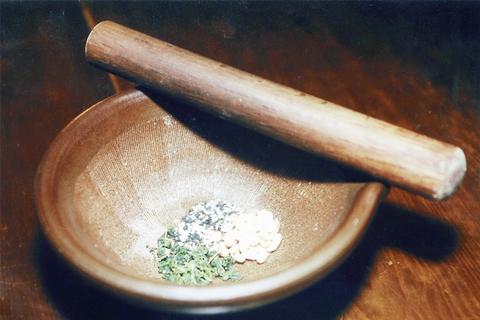
PHOTO: DAVID VAN DER VEEN, TAIPEI TIMES
At present, Ah-Chih Lei Cha is the only place in Taipei that serves the traditional drink.
A Hakka himself, Chiu tried to combine his long-time dream of running a coffee shop and his ambition to introduce people to Hakka culture. The Hakkas' characteristic perseverance and work ethic are manifested in the making of lei cha, which involves a lot of pounding. The finer the ingredients are pounded, the better the tea tastes. The concoction tastes refreshing and is nutritious and rich in fiber to boot.
Ah-Chih Lei Cha's dishes are mostly defined by their strong flavors.
"The Hakkas endured a lot of hardship in history. Often there wasn't enough [money] for dishes -- only rice to eat. So the dishes were made heartier to go with more rice," said Su Chang-wei (蘇章瑋), who also owns a stake in the restaurant.
Spicy tofu pork chunks (NT$250) may repel some people with its excess of fat. But its preparation -- first frying the meat, then stewing it in spicy tofu for an hour and serving with lemon grass -- rid it of the greasy taste. Also, the process leaves the pork with an intriguing taste of tofu and is not spicy at all.
The relaxing restaurant also offers a variety of Hakka desserts to choose from, including sweet lei cha masu and salty turnip cakes. They go well with the pomelo tea that combines dried pomelo processed with Chinese herbs to create a smooth taste and delightful fragrance.
At present, the restaurant is offering several kinds of set meals with special prices in celebration of its second anniversary.

Taiwan’s English education system is being pulled apart by three opposing forces. Bilingual Nation 2030 pulls students toward English and global communication. Artificial Intelligence (AI) readiness pulls them toward digital judgment, verification and AI-mediated work. But Taiwan’s old exam culture pulls them back toward memorization, grammar drills, timed reading and correct answers. If the education system keeps using old exams to define success, it risks producing graduates who are neither genuinely bilingual nor genuinely AI-ready, but trained for tasks machines can already perform. The first force is Bilingual Nation 2030. Launched in 2018, the policy aimed to “help Taiwan’s workforce connect
It seems every few days one bumps into one of those “real man” comments in which Taiwan is urged to “face reality” or similar, and “make a deal,” with the speaker implying that soon it will be too late. “Deal” advocates always present themselves as having a superior grip on reality, and the manly ability to make the “hard choice.” Their testosterone-laden language often echoes that of Taiwan sellout advocates. Note that such commentary always specifies a process (“make a deal, work with, make progress”), never the end state of what occupation by a violent authoritarian colonialist state will entail. In
June 1 to June 7 "If all Taiwanese were as afraid of dying as you, then what would happen?” Physician Shih Chiang-nan (施江南) reportedly said this to his wife Chen Chiao-tung (陳焦桐) after she urged him to stop intervening on behalf of Taiwanese soldiers stranded overseas after serving in the Japanese Army during World War II. Shih had clashed with high-ranking officials over the issue, engaged in several heated arguments with Taiwan governor-general Chen Yi (陳儀) and allegedly shouted at general Ko Yuan-fen (柯遠芬), chief of staff of the Taiwan Garrison Command, over

“Taiwan’s Opposition Leader Comes to US With a Message Straight Out of Beijing” read a May 31 headline in the Wall Street Journal. Top US administration officials and members of Congress almost certainly read the WSJ, and if there was a bullet point takeaway that people in Washington should absorb ahead of Chinese Nationalist Party (KMT) Chair Cheng Li-wun’s (鄭麗文) arrival in DC on June 9, that headline is it. The last few columns have discussed this very topic, and the timing is not coincidental. While those top officials likely do not read the Taipei Times, judging by the number


 RSS
RSS