


It has been slow in coming, but now that the work of painter Sanyu (常玉) is gaining critical attention his works are fetching high prices at international art auctions. Earlier this year at Christie's Spring auction in the US, a Sanyu oil painting made during the last few years of his life was sold for NT$15 million, a record price for a work by an artist of Chinese decent, according to Christie's.
Yesterday, Christie's featured another of Sanyu's works, Water Buffalo, in its 20th century Chinese Art auction. The work sold for NT$6.5 million.
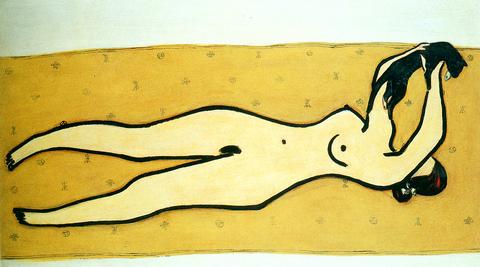
PHOTO: COURTESY OF NMH
Interest in Sanyu's work has been growing over the years, but the artist himself did little to build up his reputation. A Chinese expatriate in France, Sanyu became part of the scene in the Paris of the late 1920s, and would be found sketching at the Academie de la Grande-Chaumiere in Montparnasse.
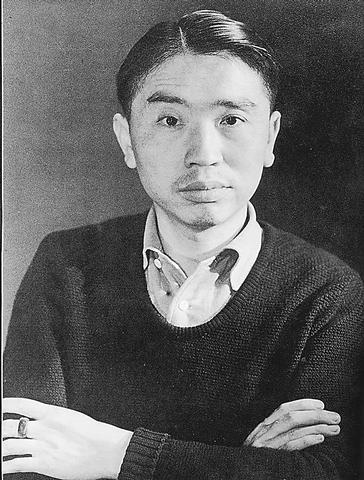
PHOTO COURTESY OF NMH
While his attention was rarely focused on the models posing, often fixing on some hunch-backed old woman or maybe a stocky young man, the result was usually a female nude.
Most of the Chinese students studying art in Paris, such as Xu Bei-hong (
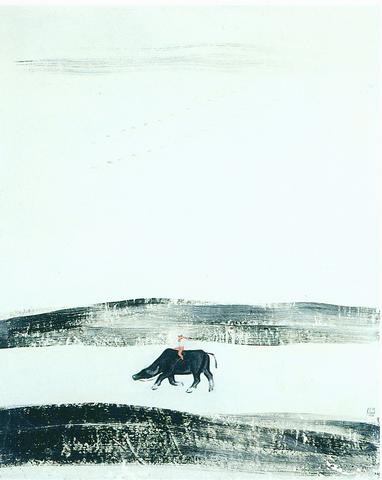
PHOTO: COURTESY OF CHRISTIE'S
With financial support from his wealthy brother, Sanyu hardly bothered himself with artistic movements. He rejected academia and decided not to return to his homeland, throwing himself into the revelry of Parisian highlife.
Sanyu's dandyism was combined with a disdain for the commercialism of art that was characteristic of traditional Chinese literati. In his memoirs, Sanyu's friend Pang Xunqin (
His distrust of art dealers was at odds with the French milieu, where successful artists often had to know how to collaborate with these people, who were the driving force behind the art market.
With the death of his brother in 1931, Sanyu got his first taste of impoverishment and had to engage in more serious artistic endeavors. Though still disdainful of dealers, he didn't seem to mind associating with collectors.
The French writer and collector Henri-Pierre Roche and Dutch composer Johan Franco were important friends and patrons, who helped promote his paintings through exhibitions.
But his work never became popular during his lifetime.
Sanyu mainly painted female nudes, a common subject in Western paintings, but he used Chinese calligraphy techniques which were not appreciated by his European audience and his work was regarded as exotic at best. Sanyu approached the subject, which is completely foreign to Chinese artists, at first with Confucian prudery and then playful inventiveness.
"Sanyu's nudes are always seen from the back, drawn in several flowing lines with little anatomical detail given to the female body. This might have resulted from the traditional Chinese idea of the naked body as too obscene to be the subject in art," said Rita Wong (衣淑凡), the author of the Chronology of Sanyu, a biography of the painter.
Later he began to paint nudes not as they were but merely as an experiment with shapes and forms.
One of the paintings titled Nude depicts a female nude lying with arms around her legs, showing her genitalia which he humorously painted as an exclamation mark, while Four Nudes sleeping on a Gold Tapestry places the nudes in parallel with each other without seeming strained or crowded.
In addition to painting, Sanyu became friends with many artists, who were drawn to him by his good humor and carefree attitude.
Robert Frank, the Swiss-American photographer who was his friend for 20 years and the director of Sanyu, a film commemoration of their friendship, once said that, "Sanyu always saw things in perspective. He shrugged off trivialities to focus on things that meant a lot to him."
Although he had many friends, he intentionally remained detached from strong ties with groups or individuals. While the Chinese community found him eccentric, his European friends knew no more about him than his gentleness and humor.
According to the French journalist Albert Dahan, Sanyu's good friend at the time, shortly before Sanyu's death, he told Dahan that he had just started a new painting, one that would express his solitude and embrace his desire for simplicity. A few days later Sanyu showed him the painting. "It was a miniscule elephant ... running in an immense desert ... pointing to the elephant, he told me, `that's me!'"
Many of Sanyu's later paintings depict wild animals in an expansive, engulfing landscape.
They are said to express his isolation as a freewheeling soul caught in a strange world.
In 1988, the Taipei Fine Arts Museum held China-Paris: Seven Chinese Painters Who Studied in France, 1918 to 1960, a pioneering exhibition that featured Sanyu's works. It was the first exhibition to place him in the company of other important 20th century Chinese, such as Xu Bei-hong and Liu Hai-su (劉海粟).
Sotheby's inaugural auction in Taipei four years later included an oil painting by Sanyu, which went and sold for almost three times its presale estimate.
This set the stage for the first exhibition and sale of Sanyu's works at the Dimension Art Center(
The turnabout in recognition of Sanyu's paintings has been dramatic. "The first people to appreciate Sanyu's paintings and sense their market potential were Asians. Now Americans, after the Europeans, also begin to realize his significance. The fusion of Western and Chinese elements appeals to collectors across cultures," said Vinci Chang (張嘉珍), an art specialist at Christie's 20th century Chinese art department.
As to why this belated recognition has come 40 years after the death of the artist, Chang said that Sanyu's habit of always using less than three colors and the paintings' simple yet harmonious composition are in line with the current minimalist trend.
Art Notes
To celebrate the 100th anniversary of Sanyu, the National Museum of History is holding In Search of a Homeland -- The Art of Sanyu, an exhibition of over 129 paintings by Sanyu including nudes, still life and landscape and animal paintings. The exhibition is open until Dec. 2.
An accompanying exhibition, Woman and Cat -- Models of Sanyu, at the Lin and Keng Gallery (
The arithmetic is straightforward and uncomfortable. By the end of 2025, Taiwan had committed itself to a 50-30-20 electricity mix — half natural gas, 30 per cent coal, 20 per cent renewables. The Ministry of Economic Affairs’s (MOEA) own monthly energy reports tell a different story. Natural gas reached 47.8 per cent of generation last year. Coal stood at 35.4 per cent, comfortably above its target ceiling. Renewables came in at 13.1 per cent, well short of the 20 per cent Taipei had pledged a decade earlier. Installed renewable capacity reached roughly half of the 12 gigawatts (GW) the government
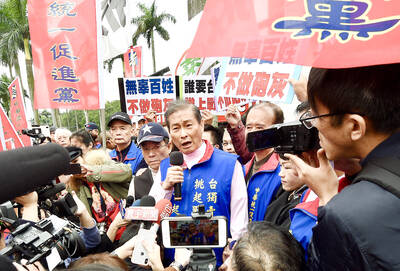
There are shadowy cabals plotting to sell out Taiwan to be annexed by China, by invasion if necessary. Fortunately, they are buffoons. In 2019, former Bamboo Union gangster and founder of the China Unification Promotion Party (CUPP), Chang An-le (張安樂, colorfully known as “White Wolf”), led a protest at the Legislative Yuan against comments made by then-premier Su Tseng-chang (蘇貞昌) that in the event of an attack by China, he would never surrender, but would protect the nation by fighting to the end, even if he only had a broom. Chang had party members bring a wooden casket that they
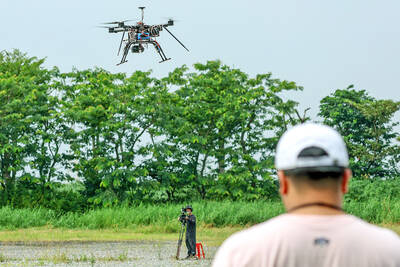
Taiwan’s drone exports are taking off, fuelled by the war in Ukraine, as Taiwanese companies seek a stake in the fast-growing global market for unmanned aerial vehicles (UAV). Low-cost drones used for reconnaissance and strikes are in high demand as governments around the world boost defense spending in the face of intensifying conflicts. A relative new player in the increasingly competitive industry, Taiwan’s pitch is to be an “Asian hub” for the production of UAVs and components free of Chinese materials, or “non-red.” That means its UAVs can be up to three times more expensive than their Chinese competitors, like the world’s biggest
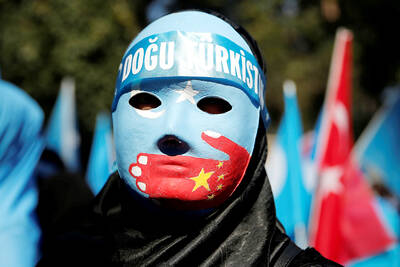
It seems every few days one bumps into one of those “real man” comments in which Taiwan is urged to “face reality” or similar, and “make a deal,” with the speaker implying that soon it will be too late. “Deal” advocates always present themselves as having a superior grip on reality, and the manly ability to make the “hard choice.” Their testosterone-laden language often echoes that of Taiwan sellout advocates. Note that such commentary always specifies a process (“make a deal, work with, make progress”), never the end state of what occupation by a violent authoritarian colonialist state will entail. In


 RSS
RSS