


For almost 50 years, Taipei's Hwahsi Street (
After Hwahsi Street was designated an official tourist spot by the Taipei City Government in the mid-1980s, periodic campaigns were mounted, largely in vain, to rid the area of vice. It was not until this year, when a controversial ban on prostitution went into effect, that the last vestiges of prostitution were cleared from the streets surrounding Snake Alley.
The area's notorious reputation has proven hard to shrug off. Sex is still big business on Hwahsi Street, with people looking for love skulking the many sex stores. Only now the search is for latex companions, rather than the flesh and blood variety.
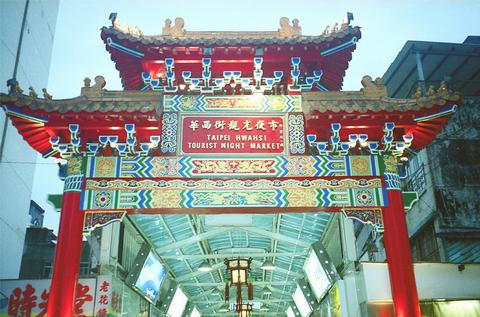
PHOTO: GAVIN PHIPPS, TAIPEI TIMES
Another of Hwahsi Street's traditions that has come under scrutiny in recent years is the sale of snake or turtle blood, which is used in various recipes for their supposed sexual potency-enhancing qualities.
News of medicine store employees slaughtering live snakes, turtles and even the occasional monkey in full public view reached international animal rights groups, who in turn began to pressure local authorities to outlaw the practice.
Unwilling and unable to stamp out the 1,000-year-old tradition of using blood as an aphrodisiac, authorities instead simply asked store owners to be a bit more discreet when extracting creatures' blood.
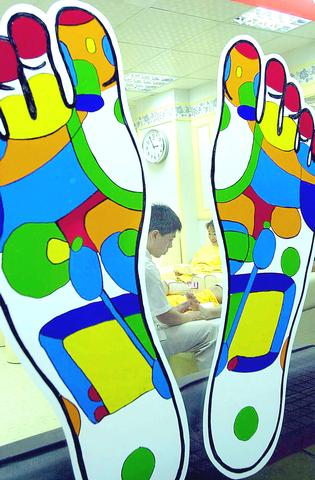
PHOTO: CHIANG YING-YING, TAIPEI TIMES
Stores selling such aphrodisiacs, like Chindai Mountain Medicinal Foods (
The store often finds itself doubling as a petting zoo during the early evening hours. Staff can often be seen taking one of the snakes out of its cage and allowing curious children to pet the creature.
"There are a lot of curious children who come to the street with their parents who have never seen a snake up close before. I think a lot of them believe the snakes are pets because we're always being asked to get one or two for them to touch," said store proprietor, Wei Hong-jyh (魏鴻志). "Their faces drop, however, when it's explained to them what we use them for. There have been instances when the child has been close to tears after their parents tell them."
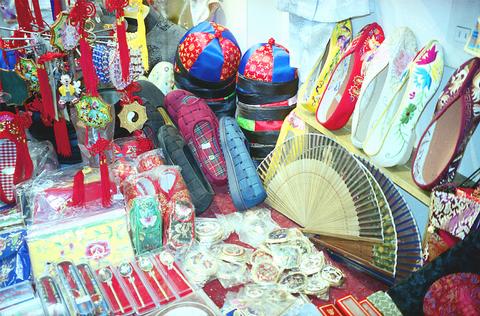
PHOTO: GAVIN PHIPPS, TAIPEI TIMES
While the historic sex-related industries that once thrived on Hwahsi Street have been brought to heel, the narrow thoroughfare is not totally void of tradition.
Not all about vice
The Jinyuan Bookstore (
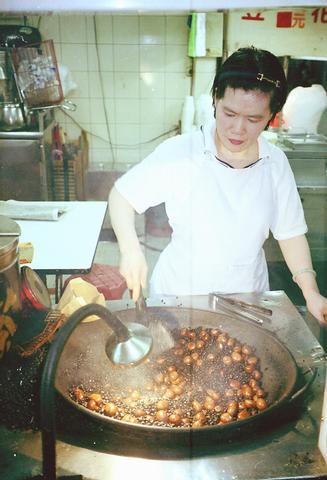
PHOTO: GAVIN PHIPPS, TAIPEI TIMES
With everything from basic fengshui manuals to gold-plated fengshui compasses costing upwards of NT$15,000, the store is ground zero for anyone interested in this Chinese art. The store also stocks several English-language fengshui publications.
"We get a pretty mixed bag of people coming here. There's the tourists who stop by out of curiosity and then there's our regular customers who are either learning about fengshui or who are practicing geomancers," said Lin Jin-yuan (
Hwahsi Street is also a favored location to enjoy a legitimate and reasonably priced massage. Be it aching feet, headaches, liver problems or a bad case of constipation, the masseurs at Lu Cheng Foot Massage Clinic (
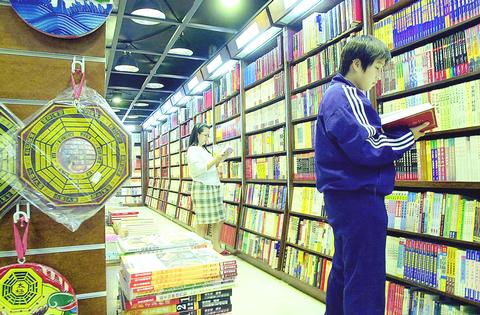
PHOTO: CHIANG YING-YING, TAIPEI TIMES
"Believe it or not there are over 60 pressure points on each foot, which makes every massage unique. If a customer is having trouble with their liver the masseur will gently massage an area on the ball of the right foot, or if the customer is suffering from arthritis we'll massage the spot near the ankle," said masseuse Ah Hui (阿慧) during a break. A basic massage takes about 45 minutes but can last up to an hour and a half if the targeted ailment requires more time. Foot massages are not always painless, and it is believed the more the massage hurts the worse are the customer's health problems.
Homemade cures and food
Visitors to Hwahsi Street who shy away from a foot massage or sipping snake's blood soup or deer penis stew may find comfort in the odd medicines to be found at the various temporary stalls set up on a nightly basis on the sidewalk.
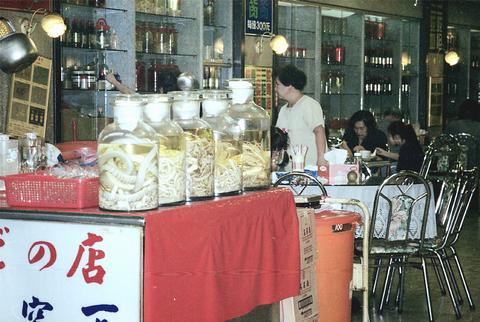
PHOTO: GAVIN PHIPPS, TAIPEI TIMES
Everything from the common cold to a nasty bout of swollen genitalia can be cured -- if one believes the vendors' hype. The ingredients of these miracle cures are closely guarded secrets, but the shocking photographs informing people of the specific ailments and parts of the anatomy that the creams, teas and balms can cure leave very little to the imagination.
Of course, Hwahsi Street isn't solely a place for those with aches to soothe and desires to fulfill. Hwahsi Street is, after all, a night market, so, as in all such places, food plays an important role.
One of the best spots to catch a bite to eat is Tainan Dan Tze Mien Restaurant (
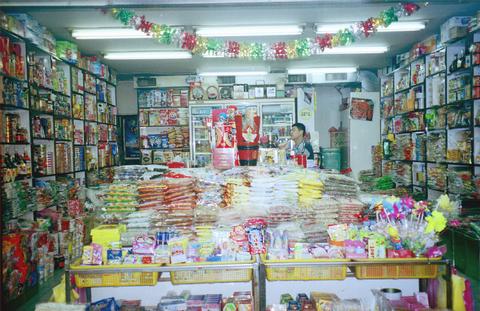
PHOTO: GAVIN PHIPPS, TAIPEI TIMES
Another of the street's famous eateries is Old 88 Seafood Restaurant (
Hwahsi Street, like many night markets, has a profusion of stores selling a dizzying mix of seemingly useless trinkets and cheap everyday goods. Whether it's a giant wooden carved statue of a Taoist deity, or an ashtray in the shape of an erect penis, or even a bronze tortoise to usher in prosperity, these stores sell almost anything.
Many of the stores are worth perusing for some time, as the shelves and floors are often loaded with piles of goods arranged in no apparent order. Amid the kitsch items are some interesting and sometimes mind-boggling objects. One of the oddest, and at present one of the most popular goods sold by several of the stores, are Soviet-era Russian military binoculars with the words "made in the CCCP" emblazoned on them. Chances are they're fakes, but that's part of the novelty value found in almost everything on Hwahsi Street.

Taiwan’s English education system is being pulled apart by three opposing forces. Bilingual Nation 2030 pulls students toward English and global communication. Artificial Intelligence (AI) readiness pulls them toward digital judgment, verification and AI-mediated work. But Taiwan’s old exam culture pulls them back toward memorization, grammar drills, timed reading and correct answers. If the education system keeps using old exams to define success, it risks producing graduates who are neither genuinely bilingual nor genuinely AI-ready, but trained for tasks machines can already perform. The first force is Bilingual Nation 2030. Launched in 2018, the policy aimed to “help Taiwan’s workforce connect
It seems every few days one bumps into one of those “real man” comments in which Taiwan is urged to “face reality” or similar, and “make a deal,” with the speaker implying that soon it will be too late. “Deal” advocates always present themselves as having a superior grip on reality, and the manly ability to make the “hard choice.” Their testosterone-laden language often echoes that of Taiwan sellout advocates. Note that such commentary always specifies a process (“make a deal, work with, make progress”), never the end state of what occupation by a violent authoritarian colonialist state will entail. In

“Taiwan’s Opposition Leader Comes to US With a Message Straight Out of Beijing” read a May 31 headline in the Wall Street Journal. Top US administration officials and members of Congress almost certainly read the WSJ, and if there was a bullet point takeaway that people in Washington should absorb ahead of Chinese Nationalist Party (KMT) Chair Cheng Li-wun’s (鄭麗文) arrival in DC on June 9, that headline is it. The last few columns have discussed this very topic, and the timing is not coincidental. While those top officials likely do not read the Taipei Times, judging by the number
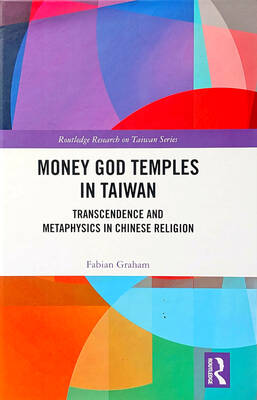
As someone who normally steers clear of books with “transcendence” or “metaphysics” in their subtitles, this reviewer — a casual observer of local belief systems since the 1990s — found Fabian Graham’s Money God Temples in Taiwan a challenging read. Those who’ve only dipped their toes into temple culture will likely need to parse several sections with special care if they’re to keep up with the author, a British ethnographic researcher whose previous books have investigated religious practices among ethnic Chinese in Southeast Asia. This scholarly volume examines a facet of Taiwan’s religious landscape that didn’t exist a century ago, and


 RSS
RSS