


Sure, it's very un-rock 'n' roll for a band to break up because the guitarist decides to go study abroad, but maybe that's just Taiwan. In any case, there is absolutely no question that Ladybug, a four-woman group formed in 1995 that has toured America twice, is both one of the founders of Taiwan's rock scene and one of the best bands the island has ever seen.
And now that guitarist Wan-ting (

PHOTO: COURTESY OF LANDBUG
"Ladybug is pure music," said Yoz (

PHOTO: COURTESY OF RANDY
"They came out and they were all about music and nothing else," he said, "not like LTK (
Sitting on a barstool by the DJ booth at Underworld, where Ladybug bass player Xiao Pao (
"It was all really fast back then," said guitarist and vocalist Mei Mei (
"Our second CD [both on Crystal Records] was all instrumental and the songs were more musically complicated," she said.
Those early recordings got the band booked at Portland, Oregon's North by Northwest festival in late 1997, which led to a handful of other US west coast gigs in the following month. Then, in 1998, they got in touch with an American booking agent who sent them on the east coast tour circuit, during which they performed alongside Yo La Tengo, Shonen Knife and scores of lesser-known bands they now remember fondly, like Hosemobile and Competitor.
"It was all really fresh back then, so it was really fun," said Ellie. "Even when everybody crammed into the van or whatever, it was such a great experience."
"And that guy from Hosemobile was really cute," added Xiao Pao, while bringing up a Flaming Lips track on the Underworld sound system.
"Next week when we play, we'll play songs from both albums," said Mei Mei, "plus one new song we don't even have a name for yet."
To tell the truth, Ladybug acts more like they're on hiatus than broken up. Since Wan-ting went to Chicago to study how to become a recording engineer more than a year ago, other band members have gone about their business, mostly sticking to music in one way or another.
Ellie recently produced a one-woman CD, playing all the instruments, singing and coming up with a sort of Cibo Matto sound. Xiao Pao, meanwhile, continues to DJ at Underworld while also working as an editor for an on-line music Web site.
"We're never going to rely on music to support ourselves," declared Mei Mei with a smile, nevertheless admitting she wouldn't mind if it happened one day. As for the band getting back together once Wan-ting finally finishes school a year or two down the road, the thought got her to grin and say, "Maybe!"

Yesterday, the Democratic Progressive Party (DPP) nominated legislator Puma Shen (沈伯洋) as their Taipei mayoral candidate, the Chinese Nationalist Party (KMT) put their stamp of approval on Wei Ping-cheng (魏平政) as their candidate for Changhua County commissioner and former legislator Tsai Pi-ru (蔡壁如) of the Taiwan People’s Party (TPP) has begun the process to also run in Changhua, though she has not yet been formally nominated. All three news items are bizarre. The DPP has struggled with settling on a Taipei nominee. The only candidate who declared interest was Enoch Wu (吳怡農), but the party seemed determined to nominate anyone

In a sudden move last week, opposition lawmakers of the Chinese Nationalist Party (KMT) and Taiwan People’s Party (TPP) passed a NT$780 billion special defense budget as a preemptive measure to stop either Chinese leader Xi Jinping (習近平) or US President Donald Trump from blocking US arms sales to Taiwan at their summit in Beijing, said KMT heavyweight Jaw Shaw-kong (趙少康), speaking to the Taipei Foreign Correspondents Club on Wednesday night in Taipei. The 76-year-old Jaw, a political talk show host who ran as the KMT’s vice presidential candidate in 2024, says that he personally brokered the deal to resolve
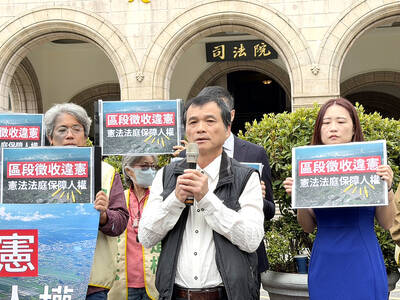
What government project has expropriated the most land in Taiwan? According to local media reports, it is the Taoyuan Aerotropolis, eating 2,500 hectares of land in its first phase, with more to come. Forty thousand people are expected to be displaced by the project. Naturally that enormous land grab is generating powerful pushback. Last week Chen Chien-ho (陳健和), a local resident of Jhuwei Borough (竹圍) in Taoyuan City’s Dayuan District (大園) filed a petition for constitutional review of the project after losing his case at the Taipei Administrative Court. The Administrative Court found in favor of nine other local landowners, but

The Chinese Nationalist Party (KMT) and its sock puppet, the Taiwan People’s Party (TPP), passed their version of the government’s proposed supplementary defense spending bill last week, engendering much commentary. While all eyes were on the defense budget, the PRC’s assault on Taiwan was advancing on other fronts. The removal of domestic drone production and other technologies critical to the nation’s asymmetrical defenses from the list of items purchased in the “compromise” bill shows how the KMT-TPP alliance appears to be serving the People’s Republic of China (PRC). Ironically, the cuts will impact industries heavily represented by tech firms in areas run


 RSS
RSS