


Eat to your heart's content at this buffet-only restaurant named after the Hawaiian word for hello. Frequent customers will notice that the dishes on the buffet stands have changed, since a new chef, named Rex Fan (
Fan was previously a preventive medicine professional, and worked at a military hospital before turning to the catering industry 10 years ago. Fan said one impetus to his switch in careers was that he saw many young people developing chronic diseases, which he traced to improper diets. Another reason was that he wanted to improve upon the healthy, but tasteless food at the hospital at which he worked. So, he quit his 9-to-5 job to become a chef.
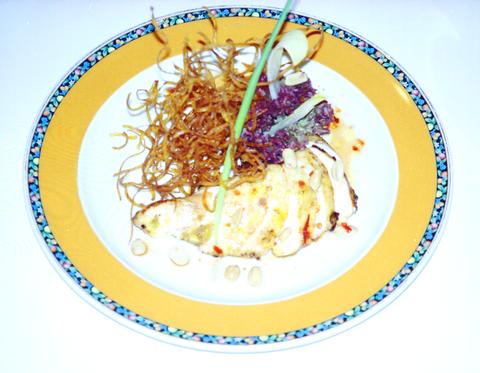
PHOTO: CHANG JU-PING, TAIPEI TIMES
His training at the Hilton Hotel helped him become knowledgeable in French, Italian and Californian cuisines.
Judging from Fan's background, it is no surprise that the menu is comprised of healthy dishes. There are no chemical additives, artificial coloring, or MSG. Fan uses chicken stock, beef stock, fruit juice or vegetable juice to enhance the tastes and colors of his dishes.
The buffet is made up of nine starters and cold dishes, five salads, 13 hot dishes and an open kitchen, with a steam area centered around seafood combinations of your choice, and a roast beef carving area. There is also a Taiwanese noodle stand with options of Hakka bantiao, rice noodles, glass noodles and others.
For summer, Fan strongly recommends the lamb and beef. Braised lamb shank with rice sauce, flavored with apple, pear and kiwi juice, as well as marinated beef short rib are the highlights. The meat in both dishes is tender and mildly sweet. For those who like spicy food, try the grilled spicy chicken with peanuts and sauteed linguine with chili and garlic.
Fan said his dishes are mostly French, but the buffet provides a bit of most other cuisines. There are Korean sweet and sour vegetables with chili, Italian-style wild mushroom salad, Japanese baked chicken leg with teriyaki sauce and lemon, Hakka-style baked pork chop with citrus sauce and oriental vegetables in a bitter, melon-based salad. All are well worth a try.

Taiwan’s English education system is being pulled apart by three opposing forces. Bilingual Nation 2030 pulls students toward English and global communication. Artificial Intelligence (AI) readiness pulls them toward digital judgment, verification and AI-mediated work. But Taiwan’s old exam culture pulls them back toward memorization, grammar drills, timed reading and correct answers. If the education system keeps using old exams to define success, it risks producing graduates who are neither genuinely bilingual nor genuinely AI-ready, but trained for tasks machines can already perform. The first force is Bilingual Nation 2030. Launched in 2018, the policy aimed to “help Taiwan’s workforce connect
It seems every few days one bumps into one of those “real man” comments in which Taiwan is urged to “face reality” or similar, and “make a deal,” with the speaker implying that soon it will be too late. “Deal” advocates always present themselves as having a superior grip on reality, and the manly ability to make the “hard choice.” Their testosterone-laden language often echoes that of Taiwan sellout advocates. Note that such commentary always specifies a process (“make a deal, work with, make progress”), never the end state of what occupation by a violent authoritarian colonialist state will entail. In
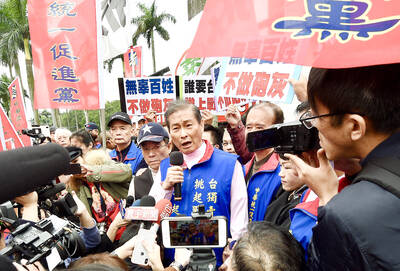
There are shadowy cabals plotting to sell out Taiwan to be annexed by China, by invasion if necessary. Fortunately, they are buffoons. In 2019, former Bamboo Union gangster and founder of the China Unification Promotion Party (CUPP), Chang An-le (張安樂, colorfully known as “White Wolf”), led a protest at the Legislative Yuan against comments made by then-premier Su Tseng-chang (蘇貞昌) that in the event of an attack by China, he would never surrender, but would protect the nation by fighting to the end, even if he only had a broom. Chang had party members bring a wooden casket that they
June 1 to June 7 "If all Taiwanese were as afraid of dying as you, then what would happen?” Physician Shih Chiang-nan (施江南) reportedly said this to his wife Chen Chiao-tung (陳焦桐) after she urged him to stop intervening on behalf of Taiwanese soldiers stranded overseas after serving in the Japanese Army during World War II. Shih had clashed with high-ranking officials over the issue, engaged in several heated arguments with Taiwan governor-general Chen Yi (陳儀) and allegedly shouted at general Ko Yuan-fen (柯遠芬), chief of staff of the Taiwan Garrison Command, over


 RSS
RSS