


Once again, it's necessary to evoke the phrase East-meets-West in anticipation of a performance at the National Theater.
This time, the show is Raise the Red Lantern (
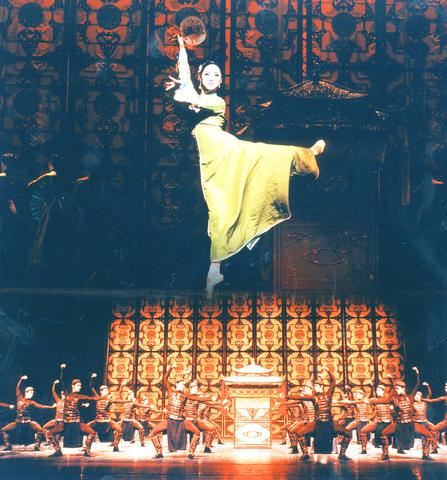
PHOTO: COURTESY OF NEW ASPECT FOUNDATION
The show, staged by the National Ballet of China (
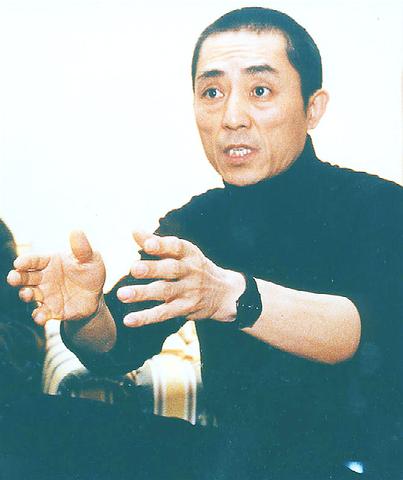
Like Zhang's award-winning film, which won the Silver Lion at the Venice Film Festival in 1991 and was nominated for an Oscar for best foreign film, the ballet of Raise the Red Lantern is based on the novel Wives and Concubines by Su Tong (
In the ballet, the story will be more succinct, enriched with profound symbolic expressions and powerful visual representations, according to the show's organizer New Aspect Foundation (新象文教基金會).
Set in a deep, quiet courtyard home in the 1920s, the ballet's tone is less haunting than the film's. The focus has been shifted from depicting the inner politics between the wives and servants to the forbidden romance of the concubines and the ensuing sacrifice. And the role of the fourth wife, played by Gong Li (
In the performance, a young girl is forced into a bridal palanquin. She is to be the third wife, the second concubine of the master of the big house. Before getting on the palanquin, she recalls her lover -- a young male actor in a Peking Opera troupe.
As the first and second wives welcome her with complex emotional undertones, she quickly learns the true nature her new life. If a red lantern is raised at night outside her apartment, it signifies that, of the three wives, she will be honored that night by a visit from the master. And on her wedding night, the young bride is finally overpowered and submits to her new husband after desperate resistance.
At a mahjong session between the master and his two other wives, the third wife flees to meet her lover only to soon be discovered by the second wife. The master then catches the lovers red-handed.
The second wife, who had hoped to regain the husband's favor through her minor detective work, is instead punished by the outraged master along with the lovers.
"This story is very suitable to present in the stage performance, as it contains folk architecture, Peking opera and very traditional folk-flavored elements," said Zhang in an interview in Beijing prior to the ballet's premiere.
He said the film was already very much like stage performance, the four seasons represented in the film appearing as the four scenes of a stage play.
The ballet begins with a segment of Peking opera music, and a female Peking opera character singing high-pitched songs along with the music.
The second scene of the show is a complex mixture of ballet, Chinese acrobatics and percussion. In a technical and physical challenge, the dancers perform Peking opera gestures and movements at the same time as they dance ballet steps.
In the third scene, the mahjong playing in the house juxtaposes with the secret lovers courting outside the house and the settings and props made with fabrics such as red silk and cotton paper magnify the dramatic effect.
Present in each of the scenes is Zhang's distinctive dramatic style -- bold, with high contrasts and sensuous pleasures, yet neat and structurally organized to convey the full strangling effect of feudal society.
Raise the Red Lantern's Beijing premiere in May received mixed reviews.
Some said they felt overwhelmed by the visual stimulation that Zhang presents in the performance and that the combination of different art forms was too much of a jolt. Others lauded the music and said the show could also be a great concert.
Zhang, who had never directed ballet and knows very little about dancing, said the main reason he wanted to work with the National Ballet of China was to attract a larger audience for ballet with his blend of drama and dance.
Though Zhang has never directed a ballet before, he has crossed over into different performing art forms on other projects, as in 1997 and 1998, when he directed the grand opera Turandot in Italy and in Beijing's Forbidden City. In that show, Zhang worked with stage talents from around the world.
As in Turandot, Raise the Red Lantern also features an international crew, with French-Chinese composer Chen Qigang (陳其鋼), German-Chinese choreographer Wang Xinpeng (王新鵬), French costume designer Jerome Kaplan and lighting designer Yves Bernard.
What: Raise the Red Lantern, a ballet directed by Zhang Yimou.
Where: National Theater (國家戲劇院), 21 Chungshan S. Road (中山南路21號).
Tickets: NT$600 - NT$2,500, at Era ticket outlets

Yesterday, the Democratic Progressive Party (DPP) nominated legislator Puma Shen (沈伯洋) as their Taipei mayoral candidate, the Chinese Nationalist Party (KMT) put their stamp of approval on Wei Ping-cheng (魏平政) as their candidate for Changhua County commissioner and former legislator Tsai Pi-ru (蔡壁如) of the Taiwan People’s Party (TPP) has begun the process to also run in Changhua, though she has not yet been formally nominated. All three news items are bizarre. The DPP has struggled with settling on a Taipei nominee. The only candidate who declared interest was Enoch Wu (吳怡農), but the party seemed determined to nominate anyone

In a sudden move last week, opposition lawmakers of the Chinese Nationalist Party (KMT) and Taiwan People’s Party (TPP) passed a NT$780 billion special defense budget as a preemptive measure to stop either Chinese leader Xi Jinping (習近平) or US President Donald Trump from blocking US arms sales to Taiwan at their summit in Beijing, said KMT heavyweight Jaw Shaw-kong (趙少康), speaking to the Taipei Foreign Correspondents Club on Wednesday night in Taipei. The 76-year-old Jaw, a political talk show host who ran as the KMT’s vice presidential candidate in 2024, says that he personally brokered the deal to resolve
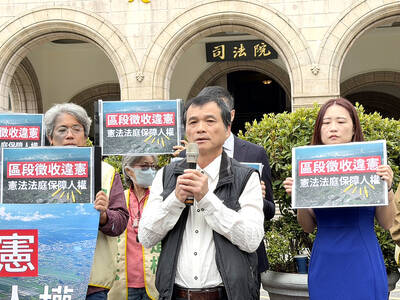
What government project has expropriated the most land in Taiwan? According to local media reports, it is the Taoyuan Aerotropolis, eating 2,500 hectares of land in its first phase, with more to come. Forty thousand people are expected to be displaced by the project. Naturally that enormous land grab is generating powerful pushback. Last week Chen Chien-ho (陳健和), a local resident of Jhuwei Borough (竹圍) in Taoyuan City’s Dayuan District (大園) filed a petition for constitutional review of the project after losing his case at the Taipei Administrative Court. The Administrative Court found in favor of nine other local landowners, but

The Chinese Nationalist Party (KMT) and its sock puppet, the Taiwan People’s Party (TPP), passed their version of the government’s proposed supplementary defense spending bill last week, engendering much commentary. While all eyes were on the defense budget, the PRC’s assault on Taiwan was advancing on other fronts. The removal of domestic drone production and other technologies critical to the nation’s asymmetrical defenses from the list of items purchased in the “compromise” bill shows how the KMT-TPP alliance appears to be serving the People’s Republic of China (PRC). Ironically, the cuts will impact industries heavily represented by tech firms in areas run


 RSS
RSS