


Saints & Sinners
Address: 114-116 Anho Rd., Sec. 2, Taipei (台北市安和路二段114-116號)
Telephone: (02) 2739-9001
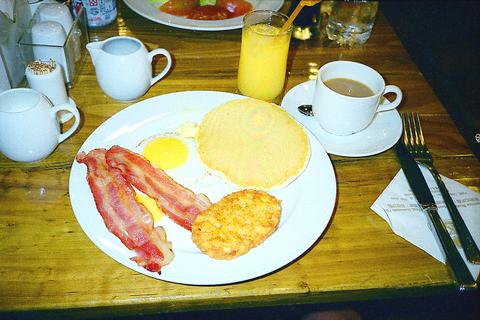
PHOTO: DAVID FRAZIER, TAIPEI TIMES
Open: 11:30am to 2am daily
Average meal: NT$300 lunch, NT$400 dinner
Details: Credit cards accepted. Reservations recommended for medium to large parties
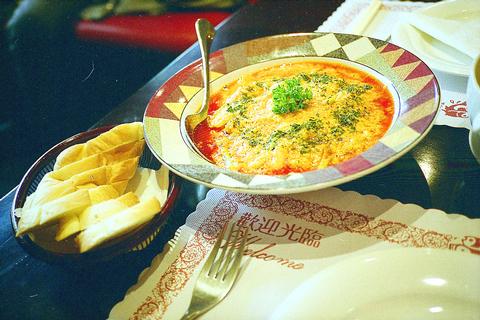
PHOTO: DAVID FRAZIER, TAIPIE TIMES
Even though it's fairly new, Saints & Sinners gives you a kind of familiar feeling when you walk in for the first time. This has a lot to do with the owners -- the Taiwanese and expat restaurateurs responsible for Malibu, Malibu West, the Combat Zone's popular spot My Place and the bankers' watering hole My Other Place.
When Saints & Sinners first opened a year ago it was actually called Someplace Else, before undergoing the adjustments that led to its renaming in February. Now what it offers is a very good Chinese bar and restaurant that caters to a Western crowd with Western favorites and hybrid Chinese-Thai cuisine.
The restaurant's pedigree brings a certain guarantee of quality to the dining, as the owners have already proven that they know how to run a kitchen. If you order a cheeseburger (NT$250), you know you'll get a big juicy cheeseburger. The same standards of authenticity carry for the other Western dishes -- everything from cottage pie to escargots -- which comprise half the menu.
How Saints & Sinners differs from its sister establishments is its Chinese-Thai menu. Finally, here is a place where you can not only tell the green curry from the red curry, you can also tell that the chefs are professionals, not just recent graduates of a Ko Samui cooking school with a nifty business plan.
While not overly spicy, Chinese-Thai dishes provide a good mix of flavors and offer high-quality ingredients. Both the shrimp cake appetizer and the lemon fish are delicious. Dishes are also free from heavy oils and other unwanted fillers -- they go down light but still manage to fill you up. Prices are also reasonable, especially if you go with a few friends.
So far, the place has already managed a word-of-mouth reputation among Taipei's expat community, both for its food and as a bar. This is in large part due to the establishment's success at hosting parties, both for groups like Taiwan's Foreign Correspondents' Club and the engineers of the High Speed Rail Corp, as well as open quiz nights and other similar activities.
The friendly service and airy layout are also commendable. Beer will also be cheap this summer, only NT$70 for a bottle of Tiger Beer during the daily 6pm to 8pm "Crazy Hour," one of the establishment's several inventive specials that also include "Girlie Thursdays."
Jake's Urban Kitchen East (久客美墨西餐)
Address: 48-6 Hoping E. Rd., Sec. 3, Taipei (台北市和平東路三段48-6號)
Telephone: (02) 8732-3667
Open: 8am to midnight daily
Average meal: NT$200 - NT$300
Details: English menu. Credit cards accepted.
Jake's Urban Kitchen East is probably the closest thing to an American-style diner in southern Taipei. Its recipes, in fact, are a direct legacy of the American presence in Taiwan during the Vietnam War era. At that time, proprietor Al Lo's father was growing up as a domestic for locally stationed GIs. When the soldiers finally went home at the conflict's end, Al's father went ahead and opened a restaurant, Jake's Country Kitchen, in Tienmu. He still runs the place today. Two months ago, Al and his wife finally decided it was time to expand the family business to southern Taipei.
The atmosphere, which makes a fair stab at that of a country-style family eatery, is probably what draws the foreign crowd. Pretty much everything is dark-stained hardwood, most notably the tables, chairs and benches. The service is also good and friendly, and there are plenty of newspapers and magazines, making it a good place for an extended brunch or a comfortable afternoon of free coffee refills and pecan pie.
That said, the cooking itself is unfortunately a little bit too close to the American diner original, meaning that it's up and down, depending on what you order. On the upside, breakfasts are solid, as the pancakes, bacon, sausage, eggs and other standards are all grilled in authentic home style and are also available all day, as diner breakfasts should be. Combos include both orange juice and coffee, which, sadly, is a rarity in Taiwan. Another menu plus is the side order lineups for dinner combos, which can include a healthy slate of soup, salad, bread and nachos depending on what you order.
On the downside, some dishes tend to be bland, especially salads and Mexican dishes. Most of the salads are made with iceberg lettuce, which makes you wonder why they bother to make salads at all. After all, the Pizza Hut all-you-can-eat bar is hardly worth emulating. Mexican dishes take a similar swerve for the worse with their low-grade pizza cheese and general lack of flavor, problems which could probably be ameliorated with something as simple as dabs of guacamole and sour cream. The Mexican food's major redeeming characteristic is the salsa, which is very spicy in a tasty way.
All told, Jake's is a comfortable eatery that needs to spruce up a few of its dishes. I fear that some of its traditional American recipes have mutated a little since the GIs handed them down, just as Jake's name has transformed "country kitchen" into "urban kitchen" in the second generation. And though such replication-mutation effects might be cute when it comes to language, they really haven't done much for the burritos.

Taiwan’s English education system is being pulled apart by three opposing forces. Bilingual Nation 2030 pulls students toward English and global communication. Artificial Intelligence (AI) readiness pulls them toward digital judgment, verification and AI-mediated work. But Taiwan’s old exam culture pulls them back toward memorization, grammar drills, timed reading and correct answers. If the education system keeps using old exams to define success, it risks producing graduates who are neither genuinely bilingual nor genuinely AI-ready, but trained for tasks machines can already perform. The first force is Bilingual Nation 2030. Launched in 2018, the policy aimed to “help Taiwan’s workforce connect
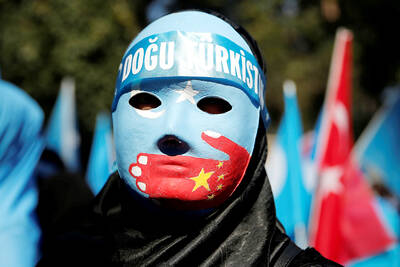
It seems every few days one bumps into one of those “real man” comments in which Taiwan is urged to “face reality” or similar, and “make a deal,” with the speaker implying that soon it will be too late. “Deal” advocates always present themselves as having a superior grip on reality, and the manly ability to make the “hard choice.” Their testosterone-laden language often echoes that of Taiwan sellout advocates. Note that such commentary always specifies a process (“make a deal, work with, make progress”), never the end state of what occupation by a violent authoritarian colonialist state will entail. In
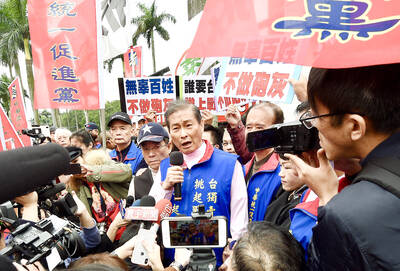
There are shadowy cabals plotting to sell out Taiwan to be annexed by China, by invasion if necessary. Fortunately, they are buffoons. In 2019, former Bamboo Union gangster and founder of the China Unification Promotion Party (CUPP), Chang An-le (張安樂, colorfully known as “White Wolf”), led a protest at the Legislative Yuan against comments made by then-premier Su Tseng-chang (蘇貞昌) that in the event of an attack by China, he would never surrender, but would protect the nation by fighting to the end, even if he only had a broom. Chang had party members bring a wooden casket that they
June 1 to June 7 "If all Taiwanese were as afraid of dying as you, then what would happen?” Physician Shih Chiang-nan (施江南) reportedly said this to his wife Chen Chiao-tung (陳焦桐) after she urged him to stop intervening on behalf of Taiwanese soldiers stranded overseas after serving in the Japanese Army during World War II. Shih had clashed with high-ranking officials over the issue, engaged in several heated arguments with Taiwan governor-general Chen Yi (陳儀) and allegedly shouted at general Ko Yuan-fen (柯遠芬), chief of staff of the Taiwan Garrison Command, over


 RSS
RSS