


The sound of gongs and cymbals will thunder through the Dr Sun Yat-sen Memorial Hall over the next week, where an all-star series of Peking Opera is currently showing. The series, performed by the China Peking Opera Theater (CPOT,
In its seventh visit to Taipei, CPOT has brought over 76 actors and actresses and a program of 10 plays which will be performed over the course of one week.
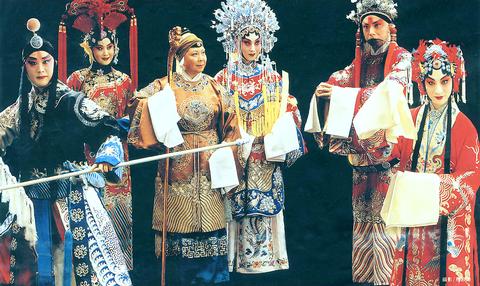
PHOTO COURTESY OF ARS FORMOSA
The ten shows were selected with an eye for Taiwanese audiences who prefer a classical repertoire, thereby providing an excellent chance for beginners in Peking opera appreciation to enjoy some of the major classics of the repertoire.
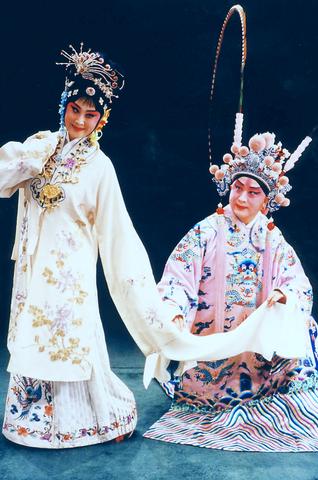
PHOTO: ARS FORMOSA
In a rehearsal for the show, renowned actor Yu Kuizhi (
Yu, leader of the theater's second troupe, is one of the most popular Peking Opera actors on either side of the Taiwan Strait, and brings with him enormous box office drawing power. Since Yu's first Taiwan visit in 1993, local fans have been strongly attracted by his soft and well-round voice and his stage charm -- a fact apply demonstrated by his sales record.
Yu, who is already a veteran of the Taiwan stage, will be playing the lead role in seven of the 10 shows that he is bringing to Taiwan on this visit.
"He [Yu] is among the most influential actors of the past few decades. He specializes in the role of senior male or laosheng (
Founded in 1955, CPOT is a national level theater troupe which operates under China's Cultural Ministry. It's founding director was Peking opera legend Mei Lanfang (梅蘭芳). In more than four decades, CPOT has attracted top performers, playwrights and musicians to maintain its leading position in the world of Peking opera.
Studying at the Chinese Traditional Drama School and getting a place in CPOT are the highest aspirations for any child in China interested in traditional drama," said Liu.
Including Yu himself, there are 12 performers and musicians in the current visiting group who are ranked as National First-class Performers (國家一級演員).
According to Liu, to be chosen as a national first-class performer requires 14 years of hard work with 120 performances each year. This is another quality guarantee for this week's performances.
Highlights of the 10 shows are Saturday evening's Generals of the Yang Family (
For those who prefer qingyi (
For scenes of flirtation, Chiang Qihu (
Peking opera is particularly well-known for its fighting scenes, and CPOT has brought in famous acrobatic performers such as Xi Zhonglu (
"Cultural barriers are not a big issue for us," said Liu Xiaohua. "From the voices of the actors, the handcrafted costumes and stage properties, as well as the intricate gestures and music, it is not difficult to appreciate the aesthetics of 200 year-old Peking Opera. The historical background of the dramas are not the main thing," he added.
"From our experience performing in the US and Europe, we have found that Western audiences have been able to grasp many of the basic cultural elements of this traditional Chinese drama. They are not only there to see acrobatic or kungfu scenes," Liu added.
All shows will have Chinese subtitles.
Performance Notes:
What: China Peking Opera Theater 2001 Joint Performance (中國京劇院2001訪台大匯演)
When: June 13 to 20, 7:30pm June 16 and 17, 2:30pm
Where: Dr Sun Yat-sen Memorial Hall (國父紀念館), 505, Jenai Rd. Sec. 4, Taipei (台北市仁愛路四段 505號)
Tickets: NT$600, NT$900, NT$1,200, NT$1,500, NT$1,800. ERA ticketing or tal: 2771-5676
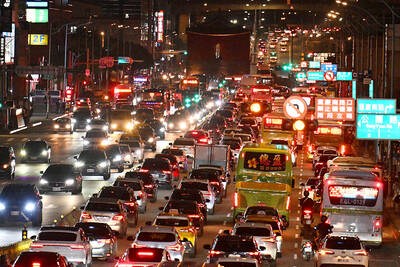
By global standards, the traffic congestion that afflicts Taiwan’s urban areas isn’t horrific. But nor is it something the country can be proud of. According to TomTom, a Dutch developer of location and navigation technologies, last year Taiwan was the sixth most congested country in Asia. Of the 492 towns and cities included in its rankings last year, Taipei was the 74th most congested. Taoyuan ranked 105th, while Hsinchu County (121st), Taichung (142nd), Tainan (173rd), New Taipei City (227th), Kaohsiung (241st) and Keelung (302nd) also featured on the list. Four Japanese cities have slower traffic than Taipei. (Seoul, which has some

In our discussions of tourism in Taiwan we often criticize the government’s addiction to promoting food and shopping, while ignoring Taiwan’s underdeveloped trekking and adventure travel opportunities. This discussion, however, is decidedly land-focused. When was the last time a port entered into it? Last week I encountered journalist and travel writer Cameron Dueck, who had sailed to Taiwan in 2023-24, and was full of tales. Like everyone who visits, he and his partner Fiona Ching loved our island nation and had nothing but wonderful experiences on land. But he had little positive to say about the way Taiwan has organized its

Michael slides a sequin glove over the pop star’s tarnished legacy, shrouding Michael Jackson’s complications with a conventional biopic that, if you cover your ears, sounds great. Antoine Fuqua’s movie is sanctioned by Jackson’s estate and its producers include the estate’s executors. So it is, by its nature, a narrow, authorized perspective on Jackson. The film ends before the flood of allegations of sexual abuse of children, or Jackson’s own acknowledgment of sleeping alongside kids. Jackson and his estate have long maintained his innocence. In his only criminal trial, in 2005, Jackson was acquitted. Michael doesn’t even subtly nod to these facts.
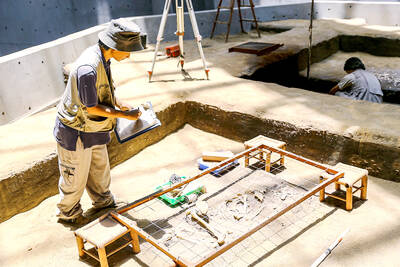
Writing of the finds at the ancient iron-working site of Shihsanhang (十 三行) in New Taipei City’s Bali District (八里), archaeologist Tsang Cheng-hwa (臧振華) of the Academia Sinica’s Institute of History and Philology observes: “One bronze bowl gilded with gold, together with copper coins and fragments of Tang and Song ceramics, were also found. These provide evidence for early contact between Taiwan aborigines and Chinese.” The Shihsanhang Web site from the Ministry of Culture says of the finds: “They were evidence that the residents of the area had a close trading relation with Chinese civilians, as the coins can be


 RSS
RSS