


In 1966, a film crew from Twentieth Century Fox were in Keelung to shoot The Sand Pebbles, directed by Robert Wise and starring Steve McQueen and Candice Bergen. Before they left, the crew visited an art gallery in Taipei where they bought all the 32 watercolors on display. These were works by Wang Pan-youn (
A year later, the Americans sent the paintings back to Taiwan asking that the artist sign them. They were returned soon afterwards with the initials "P.Y." on one corner of each painting.
P.Y. is the signature used by Wang, who is now 90 years old. The exhibition back in 1966 was his first solo show, and the fact that all the works were sold, would, for most artists, be cause for celebration. But for Wang, to see his work taken away to the other side of the Pacific Ocean, was heart breaking. He has since acquired a reputation as an artist with a strong disinclination to sell his paintings and who seldom exhibits. For the most part, he lives a secluded life in Ilan, on Taiwan's northeast coast.
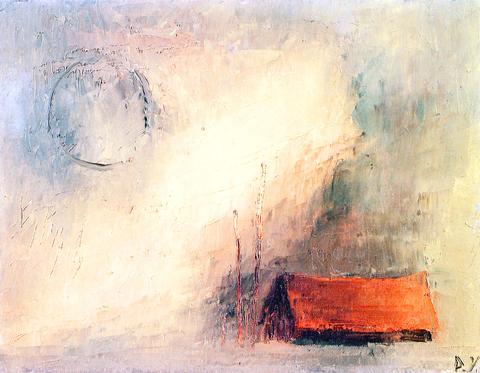
PHOTO: COURTESY OF METAPHYSICAL ART GALLERY
"I still regret [selling my works]...," Wang said in a telephone interview. "I keep my favorite art works. It makes me feel uncomfortable to see them taken away." The current exhibitions are the result of much persuasion, for Wang believes his works to be the most cherished secrets of his heart.
The two exhibitions currently taking place constitute the largest collection of his work to be shown at one time, including 88 oils and watercolors dating from 1952 on view at the National Museum of History and another nine pieces dating from 1975 at the smaller Metaphysical Art Gallery. All of them are from Wang's own collection.
"I have known him for 20 years, but I am seeing some of the paintings for the first time," said Metaphysical's manager Celia Huang (
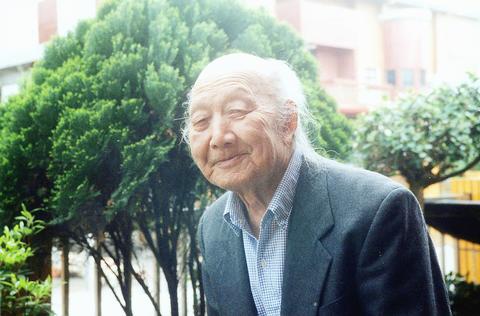
PHOTO COURTESY OF METAPHYSICAL ART GALLERY
Wang is inclined to agree with this assessment. "I have had a tough life. I don't know if fame and fortune are that important to me, but I do know I like my paintings. They are my best company," said Wang.
Wang's work is easy to distinguish, both by his use of color and their forlorn and somber mood. A Cherished Memory (懷念, 1999) depicts a hut at one side of the canvas against a background of yellow and red, suggestive of a place deep in the memory. No Branch to Perch (無枝可棲, 1985) creates a clean division between white and black along an arc, at one end of which there are some birds, and at the other the setting sun. The sadness and solitude shown in Wang's works are a reflection of his life, which has seen much turmoil and upheaval.
Wang was born into a wealthy family in China's Jiangsu Province (
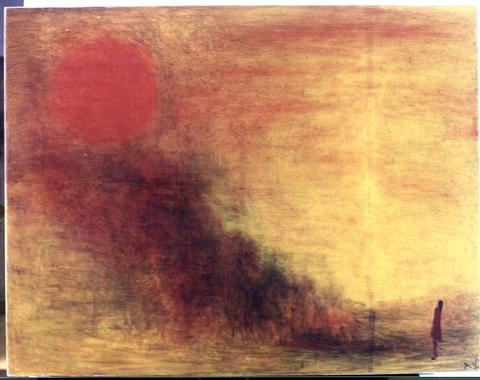
PHOTO COURTESY OF METAPHYSICAL ART GALLERY
As an art student in Shanghai, Wang was often dependant on the charity of fellow students, and when he fell sick, was rescued by a total stranger, Ji Chu-chun (季竹君), who is remembered in Wang's paintings as the woman in red, a motif he has used repeatedly in such paintings as Beautiful Silhouette (麗影,1995).
Wang's links with what remained of his family, and more importantly, his patrimony (which he hoped to use to finance further studies) was cut off by war, and he continued to live a lonely and impoverished life. It was not until he turned 35 that he met his current wife, Ni Yueh-ching (
The couple came to Taiwan in 1949. Wang moved to Ilan and started to teach at a high school in 1952. He was totally impoverished, but managed to support his wife and children in humble circumstances. Often feeling homesick he would dream about scenes from his childhood, which became an inspiration for the paintings of his first solo show in 1966.
Wang has come a long way since then, but he still retains his own individual style. Behind the simplistic coloring and composition, we see a man of strong character who stands against the trends and fashions that disturb that art world.
"Some people say I am strange, but that is just the way I am," said Wang, who wants nothing more that to live quietly at home with his wife and children, painting.
"We all need to keep a little bit of our own character in life, whether it fits with the world or not."
Exhibition Notes:
What: In Pursuit of Solar Perfection: Exhibition of Self-Selection by Wang Pan-youn at Ninety (攀圓追日:王攀元九十自選展)
Where: National Museum of History (國立歷史博物館), 49, Nanhai Rd.,Taipei (台北市南海路49號); Metaphysical Art Gallery (形而畫廊), 5F, 218-2, Chunghsiao E. Rd., Sec. 4, Taipei (台北市忠孝東路四段218-2號5樓)
When: Until June 24 at the National Museum of History and until July 15 at the Metaphysical Art Gallery.

Taiwan’s English education system is being pulled apart by three opposing forces. Bilingual Nation 2030 pulls students toward English and global communication. Artificial Intelligence (AI) readiness pulls them toward digital judgment, verification and AI-mediated work. But Taiwan’s old exam culture pulls them back toward memorization, grammar drills, timed reading and correct answers. If the education system keeps using old exams to define success, it risks producing graduates who are neither genuinely bilingual nor genuinely AI-ready, but trained for tasks machines can already perform. The first force is Bilingual Nation 2030. Launched in 2018, the policy aimed to “help Taiwan’s workforce connect
It seems every few days one bumps into one of those “real man” comments in which Taiwan is urged to “face reality” or similar, and “make a deal,” with the speaker implying that soon it will be too late. “Deal” advocates always present themselves as having a superior grip on reality, and the manly ability to make the “hard choice.” Their testosterone-laden language often echoes that of Taiwan sellout advocates. Note that such commentary always specifies a process (“make a deal, work with, make progress”), never the end state of what occupation by a violent authoritarian colonialist state will entail. In
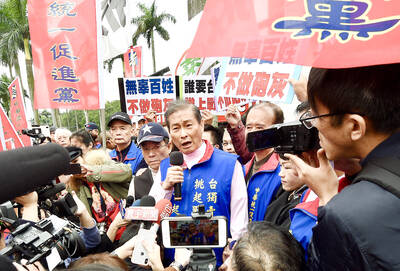
There are shadowy cabals plotting to sell out Taiwan to be annexed by China, by invasion if necessary. Fortunately, they are buffoons. In 2019, former Bamboo Union gangster and founder of the China Unification Promotion Party (CUPP), Chang An-le (張安樂, colorfully known as “White Wolf”), led a protest at the Legislative Yuan against comments made by then-premier Su Tseng-chang (蘇貞昌) that in the event of an attack by China, he would never surrender, but would protect the nation by fighting to the end, even if he only had a broom. Chang had party members bring a wooden casket that they
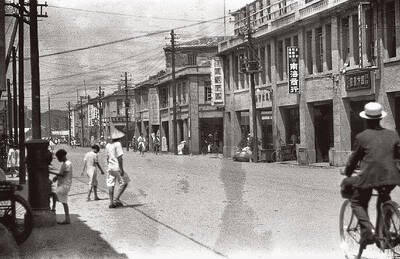
June 1 to June 7 "If all Taiwanese were as afraid of dying as you, then what would happen?” Physician Shih Chiang-nan (施江南) reportedly said this to his wife Chen Chiao-tung (陳焦桐) after she urged him to stop intervening on behalf of Taiwanese soldiers stranded overseas after serving in the Japanese Army during World War II. Shih had clashed with high-ranking officials over the issue, engaged in several heated arguments with Taiwan governor-general Chen Yi (陳儀) and allegedly shouted at general Ko Yuan-fen (柯遠芬), chief of staff of the Taiwan Garrison Command, over


 RSS
RSS