


When the lines between dance and drama blur, the end result can take many forms. Indeed, the Taipei International Arts Festival this year seems to have gone out of its way to find groups that simply defy conventional categorizations. And for this we should be thankful, for there is huge potential for artistic expression outside and between the types of theater that Taiwanese have become accustomed to -- largely from lack of choice, rather than any unwillingness to experiment.
Frantic Assembly, the first of five shows to run at the Dr Sun Yat-sen Memorial Hall (
Frantic Assembly is one of a new generation of theater groups to specifically address a young audience, "bringing [theater] back into contention as a form of entertainment," Hogget said in an interview with the Times. To do this, it has drawn on the conventions of cinema and video, using music and movement to drive the pace of the performance.
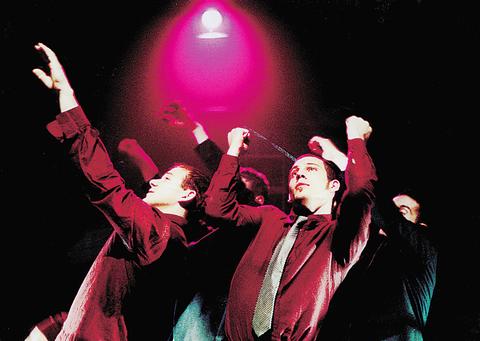
PHOTO: COURTESY OF TAIA
Regarded as "physical theater," Frantic Assembly moves in intricately choreographed and acrobatically demanding movements that nevertheless preserve an affinity with the body language of daily life. In Hymns, released in September 1999, which many critics regard as one of their most introspective shows to date, four suited "lads" come together to mourn the loss of a fifth friend through suicide. Their inability to express their grief is what makes the movements so expressive for the audience.
Such is the physicality of the show that sometimes the script has difficulty keeping up, but Hymns makes a concerted effort to balance movements and words, but in the end, it is the movement that becomes the more powerful language. Boppy music, athleticism and the strong-minded treatment of contemporary issues all go to make Frantic Assembly a class act highly recommended for anyone interested in where theater is going in the 21st century.
WHO Frantic Assembly
WHAT Hymns
WHEN Tomorrow, 7:30pm and Sunday, 2:30pm
WHERE Dr Sun Yat-sen Memorial Hall
TICKET NT$300-NT$1500 from Era ticketing,
tel (02) 2341-9898 or url: http://www.ticket.com.tw

This month the government ordered a one-year block of Xiaohongshu (小紅書) or Rednote, a Chinese social media platform with more than 3 million users in Taiwan. The government pointed to widespread fraud activity on the platform, along with cybersecurity failures. Officials said that they had reached out to the company and asked it to change. However, they received no response. The pro-China parties, the Chinese Nationalist Party (KMT) and Taiwan People’s Party (TPP), immediately swung into action, denouncing the ban as an attack on free speech. This “free speech” claim was then echoed by the People’s Republic of China (PRC),

Exceptions to the rule are sometimes revealing. For a brief few years, there was an emerging ideological split between the Democratic Progressive Party (DPP) and Chinese Nationalist Party (KMT) that appeared to be pushing the DPP in a direction that would be considered more liberal, and the KMT more conservative. In the previous column, “The KMT-DPP’s bureaucrat-led developmental state” (Dec. 11, page 12), we examined how Taiwan’s democratic system developed, and how both the two main parties largely accepted a similar consensus on how Taiwan should be run domestically and did not split along the left-right lines more familiar in
Many people in Taiwan first learned about universal basic income (UBI) — the idea that the government should provide regular, no-strings-attached payments to each citizen — in 2019. While seeking the Democratic nomination for the 2020 US presidential election, Andrew Yang, a politician of Taiwanese descent, said that, if elected, he’d institute a UBI of US$1,000 per month to “get the economic boot off of people’s throats, allowing them to lift their heads up, breathe, and get excited for the future.” His campaign petered out, but the concept of UBI hasn’t gone away. Throughout the industrialized world, there are fears that
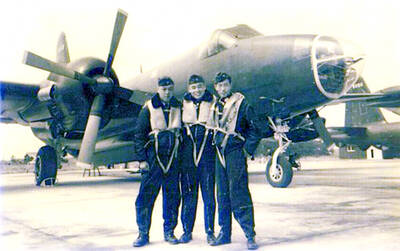
Most heroes are remembered for the battles they fought. Taiwan’s Black Bat Squadron is remembered for flying into Chinese airspace 838 times between 1953 and 1967, and for the 148 men whose sacrifice bought the intelligence that kept Taiwan secure. Two-thirds of the squadron died carrying out missions most people wouldn’t learn about for another 40 years. The squadron lost 15 aircraft and 148 crew members over those 14 years, making it the deadliest unit in Taiwan’s military history by casualty rate. They flew at night, often at low altitudes, straight into some of the most heavily defended airspace in Asia.


 RSS
RSS