


Last year's Spring Scream festival in Kenting featured 110 bands on two stages over four days and this year's show promises to be at least of the same scale.
In the run-up to this year's Spring Scream, scheduled for April 5 to April 8, again in Kenting National Park, Taipei Times will profile several of the highlight acts coming from abroad and all over Taiwan to take the stage at this year's event.
We begin in Taiwan with the Taichung band, Milk.
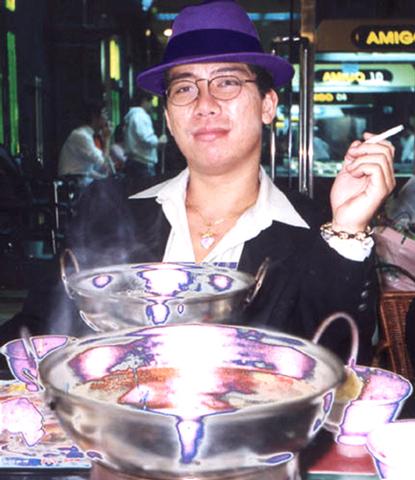
PHOTO COURTESY OF MILK
After two concerts last weekend -- one at the Say Yes to Taiwan Concert (和平演唱會) at the 228 Peace Park and the other at Taipei's Zeitgeist (聖界) club -- the owners of Zeitgeist were so impressed they immediately asked the band to return for another show this weekend. Milk even managed to hog all the air time on TVBS's broadcast of the Peace Park show. So if you missed Milk last weekend, you'll have another chance tomorrow night when they play with three other bands at a thrash rock and hip-hop theme night.
But Milk is neither a thrash nor hip-hop band. The seven-piece chicken fetish ensemble is more what one would call a barnyard funk and groove band, slightly in the tradition of Dribdas, the now defunct group started by Spring Scream organizers Jimmy Moe and Wade Davis.
"We're not really songwriters, we're more like jam adapters," said didgeridoo player Kenton Hermer. "Sometimes we capture something in a jam, and then we're like, `Hey, everybody just remember that.'"
Milk's members are all Taichung-based foreigners, who have been in Taiwan at least three or four years -- long enough to develop a "Taiwan commitment," Hermer said -- and all have taught English at one point or another.
As for the relationship between teaching English and performing music, Hermer commented, "It's not really that big of a leap, is it."
Through both of last week's sets, vocalist Erin King spent about half the time time squawking, strutting and flapping like a chicken. (He can also rap). Other band members contributed other farm animal noises.
Performance notes
What Milk, Chenmo Luohsuan (沉默螺旋), Gangguan Lamei (鋼管辣妹) and Huen Huen Tiao (昏昏跳)
Where Zeitgeist, B1, 122 Chunghsiao E. Rd., Sec. 2, Taipei (台北市忠孝東路2段122號B1)
When 8pm to 12pm
Tickets NT$250

Taiwan’s English education system is being pulled apart by three opposing forces. Bilingual Nation 2030 pulls students toward English and global communication. Artificial Intelligence (AI) readiness pulls them toward digital judgment, verification and AI-mediated work. But Taiwan’s old exam culture pulls them back toward memorization, grammar drills, timed reading and correct answers. If the education system keeps using old exams to define success, it risks producing graduates who are neither genuinely bilingual nor genuinely AI-ready, but trained for tasks machines can already perform. The first force is Bilingual Nation 2030. Launched in 2018, the policy aimed to “help Taiwan’s workforce connect

It seems every few days one bumps into one of those “real man” comments in which Taiwan is urged to “face reality” or similar, and “make a deal,” with the speaker implying that soon it will be too late. “Deal” advocates always present themselves as having a superior grip on reality, and the manly ability to make the “hard choice.” Their testosterone-laden language often echoes that of Taiwan sellout advocates. Note that such commentary always specifies a process (“make a deal, work with, make progress”), never the end state of what occupation by a violent authoritarian colonialist state will entail. In
June 1 to June 7 "If all Taiwanese were as afraid of dying as you, then what would happen?” Physician Shih Chiang-nan (施江南) reportedly said this to his wife Chen Chiao-tung (陳焦桐) after she urged him to stop intervening on behalf of Taiwanese soldiers stranded overseas after serving in the Japanese Army during World War II. Shih had clashed with high-ranking officials over the issue, engaged in several heated arguments with Taiwan governor-general Chen Yi (陳儀) and allegedly shouted at general Ko Yuan-fen (柯遠芬), chief of staff of the Taiwan Garrison Command, over

“Taiwan’s Opposition Leader Comes to US With a Message Straight Out of Beijing” read a May 31 headline in the Wall Street Journal. Top US administration officials and members of Congress almost certainly read the WSJ, and if there was a bullet point takeaway that people in Washington should absorb ahead of Chinese Nationalist Party (KMT) Chair Cheng Li-wun’s (鄭麗文) arrival in DC on June 9, that headline is it. The last few columns have discussed this very topic, and the timing is not coincidental. While those top officials likely do not read the Taipei Times, judging by the number


 RSS
RSS