


Watching Ann Hu's (
But, Shadow Magic is also a story about a young man's dual dilemma, torn by the opposing forces of Western novelty and Chinese tradition and facing a choice between his passion for love and his father's urge that he marry a rich widow to improve the family's fortunes. It's a film with a heavy East-meets-West emphasis -- set as it is in the waning days of the Qing empire -- and benefits hugely from Hu's background as a Chinese-American.
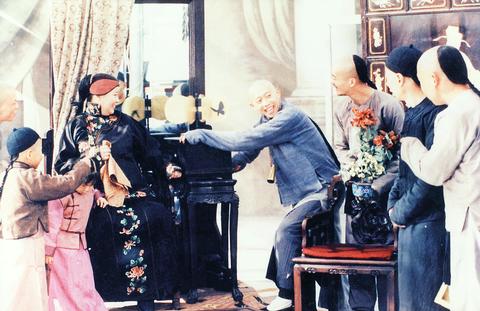
PHOTO COURTESY OF CMPC
The plot of Shadow Magic is based loosely on the life of Chinese filmmaking pioneer Liu Jinglun (劉京倫) and his production of the first silent film in China in 1902. Jared Harris (Happiness, I Shot Andy Warhol, Smoke) plays a threadbare entrepreneur, Raymond Wallace, who is in China hoping to sell the West's latest invention -- moving pictures. Wallace's show, called "Shadow Magic," enjoys little success until he meets Liu, a young photographer played by Xia Yu (夏雨).
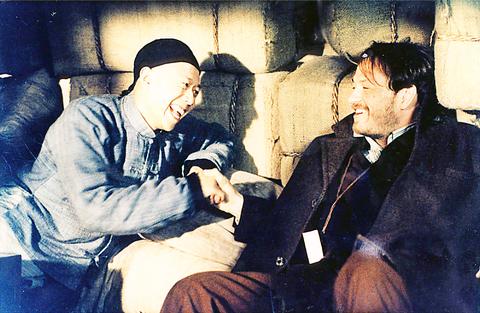
PHOTO COURTESY OF CMPC
Liu, a photographer at a Beijing photography shop, is fascinated by the much-maligned and "useless" foreign "gadgetry" of photos and film. His interests eventually connect him with Wallace, and he begins to help with the "Shadow Magic" show.
But Chinese society at the time felt intense animosity toward foreigners and was deeply suspicious of all elements of Western culture. Liu is then forced to hide his friendship with Raymond from his employer and his father. His desire to learn the "foreigner's tricks" also jeopardizes his relationship with Ling, the woman he loves, who is the daughter of a man named Lord Tan. Tan happens to be China's most celebrated Chinese opera star at that time, and he unsurprisingly was contemptuous of movies in comparison with thousand-year-old Chinese performance art.
The most intriguing parts of the film deal with the collision of these two cultures and the ultimate compromises reached between the two. With humor and detail, Hu brings out people's apprehensive contact with film by showing audiences' astonished faces when they see images projected on a screen, the openly voiced suspicion and afterward the excited chatter and visible enjoyment. Even the Empress Dowager Cixi (慈禧太后), featured in a climactic scene, is won over: "The foreigners indeed excel at this. They know how to have fun."
Using magic as a metaphor, Hu hints at the value of film as a possible bridge between cultures. Liu has to convince his neighbors not to worry. "The black box can make you into a film, and you'll look the same in the film even 100 years later." At the end of the movie, one of Liu's neighbors who has become an avid movie fan, says: "even if the machine blows up again, I'll still go to the movies."
And don't forget Shadow Magic also features a love story, as Liu takes the bold step to pursue Ling in a "Western way" as taught by Wallace. Liu and Ling -- played by rising starlet Xing Yufei (邢宇飛) -- indulge in slight flirtation when Ling asks Liu to take her photo.
The love story provides a refreshingly light-hearted backdrop for the documentary nature of the story of film's arrival in China, and as the Chinese audiences begin to appreciate movies and shake off their initial fears of the medium, we see film acting as a force for mutual understanding. This is Ann Hu's own magic.
Film Notes:
Shadow Magic
Written by: Ann Hu
Taiwan release: Feb. 24
Running time: 115 minutes
Rated: Not rated
Starring: Xia Yu, Jared Harris, Xing Yufei

Taiwan’s English education system is being pulled apart by three opposing forces. Bilingual Nation 2030 pulls students toward English and global communication. Artificial Intelligence (AI) readiness pulls them toward digital judgment, verification and AI-mediated work. But Taiwan’s old exam culture pulls them back toward memorization, grammar drills, timed reading and correct answers. If the education system keeps using old exams to define success, it risks producing graduates who are neither genuinely bilingual nor genuinely AI-ready, but trained for tasks machines can already perform. The first force is Bilingual Nation 2030. Launched in 2018, the policy aimed to “help Taiwan’s workforce connect
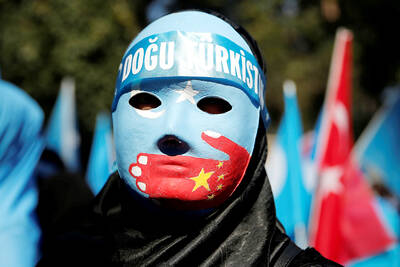
It seems every few days one bumps into one of those “real man” comments in which Taiwan is urged to “face reality” or similar, and “make a deal,” with the speaker implying that soon it will be too late. “Deal” advocates always present themselves as having a superior grip on reality, and the manly ability to make the “hard choice.” Their testosterone-laden language often echoes that of Taiwan sellout advocates. Note that such commentary always specifies a process (“make a deal, work with, make progress”), never the end state of what occupation by a violent authoritarian colonialist state will entail. In

There are shadowy cabals plotting to sell out Taiwan to be annexed by China, by invasion if necessary. Fortunately, they are buffoons. In 2019, former Bamboo Union gangster and founder of the China Unification Promotion Party (CUPP), Chang An-le (張安樂, colorfully known as “White Wolf”), led a protest at the Legislative Yuan against comments made by then-premier Su Tseng-chang (蘇貞昌) that in the event of an attack by China, he would never surrender, but would protect the nation by fighting to the end, even if he only had a broom. Chang had party members bring a wooden casket that they
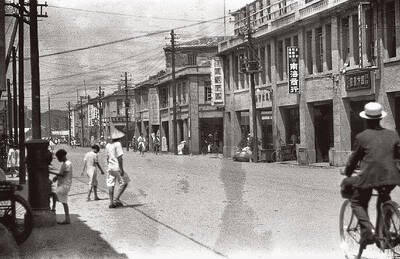
June 1 to June 7 "If all Taiwanese were as afraid of dying as you, then what would happen?” Physician Shih Chiang-nan (施江南) reportedly said this to his wife Chen Chiao-tung (陳焦桐) after she urged him to stop intervening on behalf of Taiwanese soldiers stranded overseas after serving in the Japanese Army during World War II. Shih had clashed with high-ranking officials over the issue, engaged in several heated arguments with Taiwan governor-general Chen Yi (陳儀) and allegedly shouted at general Ko Yuan-fen (柯遠芬), chief of staff of the Taiwan Garrison Command, over


 RSS
RSS