


Noble motives and the hope that they are riding the wave of the future has led a number of companies in Taiwan to develop and manufacture electrical motorcycles.
These vehicles, despite the endorsement of Taiwan's Environmental Protection Agency (EPA), still face an uphill battle for acceptance. Considerable outlay for small returns has seen the EPA backpedal on its original commitment to the electric motorcycle through a reduction in subsidies, but improvements in technology and reductions in production costs may still enable this "green" motorbike to establish itself on Taiwan.
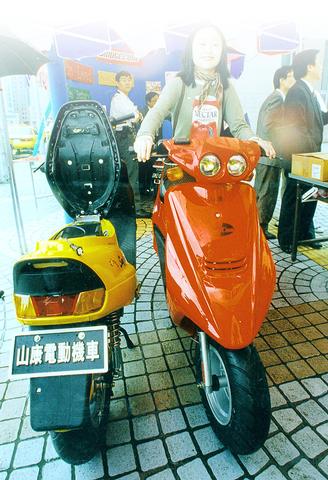
TAIPEI TIMES PHOTO FILE
Over the last few months, the Taiwan government's four-year-old electric motorcycles program seemed to be facing the chop. In the first weeks of December, however, the companies involved in this new industry got a reprieve. The industry had provided some nominal gains -- over 8,000 vehicles sold so far in 2000 -- so the government promised to continue the per vehicle subsidy program for another year, at the same time backpedaling slightly on more wide-ranging forms of assistance, like the structural necessity of charging stations.
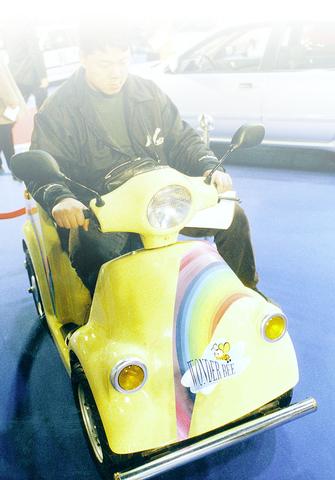
Clean technology
Moving into 2001, Taiwan's budding electric motorcycle industry can do nothing but hope for a good year.
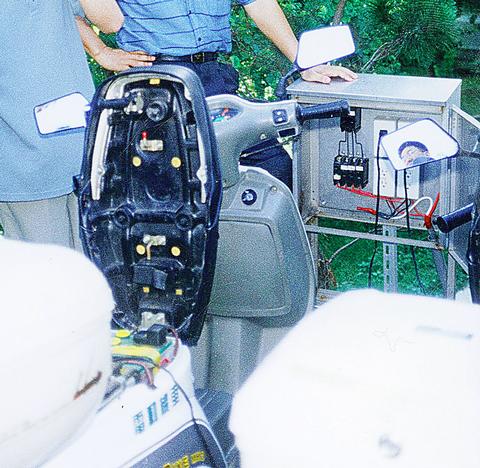
TAIPEI TIMES PHOTO FILE
"Taiwan could easily become the world leader in this industry," said Kung Tse-chi (
TAIPEI TIMES PHOTO FILE
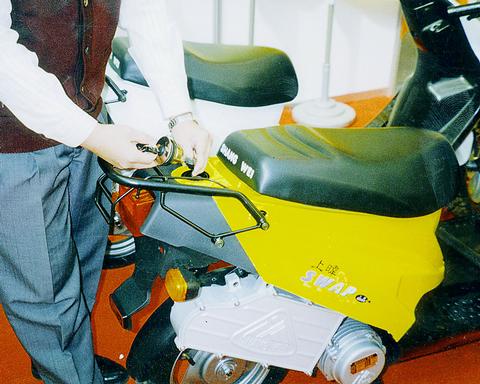
At a glance, Shang Wei's e-cycle, which goes by the name SWAP, looks very like one of the 50cc motor scooters that already flood Taiwan's roads. Instead of an exhaust pipe, however, it has a shiny and somewhat rectangular aluminum box, which is part of its power supply and control system. Power is supplied by four 12-volt batteries housed under the floorboard. When power starts to run low, the rider can simply pop up the license plate, roll out a power cord and plug into a wall socket.
Recharging takes between three and five hours, which is fairly typical for all of Taiwan's seven electric motorcycle makers. In other areas of performance, however, Shang Wei claims to rank at the top of the pack. Backing its assertion are its leading position in domestic sales for this year (1,971 through September) and its curious collection of patrons, including the President of Costa Rica and the chairman of the state congress of West Virginia.
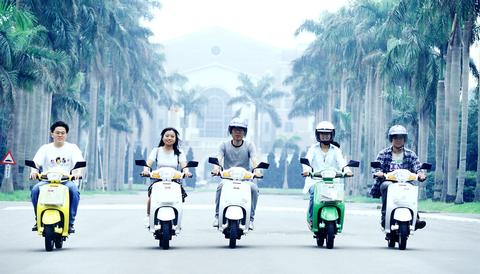
TAIPEI TIMES FILE PHOTO
Still, the key performance factor for any electric motorcycle is range, and the ever optimistic Kung claims the SWAP can now run for up to 92km without a recharge.
"For range, the magic number is one hundred, because that approaches the range of a gas-powered 50cc motorcycle, which is the electric motorcycle's natural competitor," said Lin Fu-ming (
Lin, however, takes more of a pragmatic view when it comes to performance, saying that if such long ranges are possible, they can only be achieved under "some sort of ideal conditions."
"We're all using the same kind of batteries," he said, "so the difference isn't going to be that great. In stop-and-go traffic, our electric motorcycle will only go a little over 30km. I think that's a more realistic number."
This realism is in marked contrast to the wild optimism that has continued to plague the electrical vehicle industry all over the world -- Taiwan and the EPA have been no exception.
Counting the cost
According to the EPA's original plan, Taiwan's manufacturers were to sell 40,000 e-cycles domestically this year, and the agency was to provide 20,000 recharging stations. The program was set out in 1997 when then Premier Vincent Siew (
The 8,000 or so e-cycles sold this year will fall far short of this goal, accounting for only half the 16,000 cycles necessary to meet the 2 percent requirement (total motorcycle sales in Taiwan should reach around 800,000 this year). As for charging stations, the EPA established only three as an experiment, and then closed them all last month.
Complicating the matter, when the new EPA administration came in with the Chen Shui-bian (
"They didn't know what was going on," said Hsu Chih-hsi (
The EPA's initial actions were drastic. In August, it announced it would cut next year's per-cycle subsidy to NT$6,000, down from last year's NT$22,000 to NT$31,000. It further stated that it would do away with all support by 2002. As per vehicle production costs range from NT$40,000 to NT$70,000, the move would effectively crippled the industry, not allowing the new e-cycles to compete with 50cc motorcycles, which generally fall in the NT$30,000 to NT$40,000 price range.
"If the subsidy went that low, we couldn't cover our costs," said Hsu, adding "We've [Taiwan] invested several hundred million so far. To pull out now would be a complete waste."
Batteries not included
Yet the poor performance, poor sales and an unacceptably sluggish rate of development cited by the EPA are all realities. Still, there was one even bigger problem at the root of all of them -- batteries. "Right now, almost everyone in the world is still using the same batteries," said Hsu, referring to the lead-acid batteries that are similar to those used to start automobiles since the 1930s. "There are other more efficient batteries out there right now, but they can't go on the market because the cost is too high. Hopefully, we'll have something new by the end of next year."
"Hope" is the word most e-motorcycle makers use when it comes to batteries. Their hopes are placed in a variety of products. EVT is looking at Ni-Zn (nickel-zinc) batteries, which Hsu says will offer twice the range, last twice as long, and weigh half as much as the lead-acid batteries EVT currently uses.
Lin, meanwhile, says that Sam Ever is looking at Lithium-ion batteries. One of the highest energy density batteries around, lithium ion batteries are widely used in cell phones and laptops. They will leave the planet next year on NASA's Mars 2001 lander. Fitted for motorcycles, they will offer similar performance improvements as Ni-Zn, but the problem remains of making the necessary adjustments so they can power something as large as a motorcycle. "It may be two or three years away," he said.
Ready for anything, Kung Zi-chi of Shang Wei's marketing department says simply, "Whatever battery works, we'll take it, whether it's nickel-metal-hydride, Ni-Zn, lithium, or zinc-air fuel cells," adding that an upgrade is "extremely possible" sometime next year.
Aside from improvements in performance standards, which are roughly similar for most batteries of the next generation, e-cycle makers cite the potential of cutting battery weight. "Lead acid batteries are very heavy," said Hsu, naming them as the reason electric motorcycles all weigh in between 100kg and 130kg, or 50 percent more than a typical 90cc scooter.
According to Hsu, Evercel, a US company, is looking to establish a factory producing Ni-Zn batteries in Xiamen, China, to supply electrical motorcycle manufacturers in Taiwan. "So something may not be too far off," Hsu said.
Three months ago, however, slow development with overseas battery development aggravated fears of an EPA pullout. When the EPA threatened to cut subsidies by three-quarters in August, the industry became seriously agitated and it was only after complaints from the industry that the agency reconsidered. A series of meetings was called, bringing together EPA officials, industry reps and a group of 15 scholars.
"We will not deviate from the original plan, which called for an NT$8,000 reduction in the subsidy for 2001," Chuang Shun-cheng (
The responsibilities turned over to the manufacturers will primarily include the creation of charging stations, a responsibility tentatively reserved for the EPA up until now.
POWERING UP
EVT's Hsu said that charging stations are necessary because: "The number one complaint of electric motorcycle riders is that the bikes are difficult to recharge. Sure you can plug them into your wall socket, but what if you live on the third or fourth floor?"
At present, EVT is taking the lead in charging services, constructing 20 charging stations in Kaohsiung where most of its sales have taken place. Hsu said the stations should be completed by the end of this month. "We're putting them at gas stations, and since the equipment uses a very high current, it will only take 15 minutes to recharge a motorcycle," he said.
Shang Wei, meanwhile, is taking a more rag-tag approach to the problem. Instead of shelling out NT$200,000 to NT$300,000 per charging station, it is offering individual service to each and every person that buys one of its motorcycles.
"We'll go into your basement and attach an extension chord to your power box," said Shang Wei's Kung. "That way if you live on an upper floor you can still recharge at home."
Though Shang Wei can't offer such personalized service internationally, Kung echoes the sentiments of most in the industry, expressing optimism about the market beyond Taiwan. This feeling is echoed by Evercel officials, who have called Taiwan's motorcycles "some of the best scooters in the world." Early last year, another US leader in electric vehicles, Zapworld.com, gave a further vote of confidence, agreeing to source all of its e-motorcycles from Taiwan producer Kang Yang.
Yet fundamentally, the issue for Kung still comes down to environmental protection. "Everyone wants to breathe fresh air," he said. "We love this planet. We love Taiwan."
Fortunately, the EPA agrees with him for the moment. "In a non-industrial urban center like Taipei, about 90 percent of the air pollution comes from vehicle exhaust," said Chuang. Yet he tempers any desire for easy solutions, adding, "environmental protection is no free lunch."

Taiwan’s English education system is being pulled apart by three opposing forces. Bilingual Nation 2030 pulls students toward English and global communication. Artificial Intelligence (AI) readiness pulls them toward digital judgment, verification and AI-mediated work. But Taiwan’s old exam culture pulls them back toward memorization, grammar drills, timed reading and correct answers. If the education system keeps using old exams to define success, it risks producing graduates who are neither genuinely bilingual nor genuinely AI-ready, but trained for tasks machines can already perform. The first force is Bilingual Nation 2030. Launched in 2018, the policy aimed to “help Taiwan’s workforce connect

It seems every few days one bumps into one of those “real man” comments in which Taiwan is urged to “face reality” or similar, and “make a deal,” with the speaker implying that soon it will be too late. “Deal” advocates always present themselves as having a superior grip on reality, and the manly ability to make the “hard choice.” Their testosterone-laden language often echoes that of Taiwan sellout advocates. Note that such commentary always specifies a process (“make a deal, work with, make progress”), never the end state of what occupation by a violent authoritarian colonialist state will entail. In
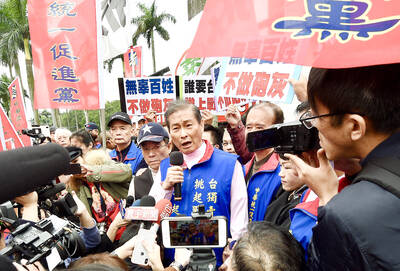
There are shadowy cabals plotting to sell out Taiwan to be annexed by China, by invasion if necessary. Fortunately, they are buffoons. In 2019, former Bamboo Union gangster and founder of the China Unification Promotion Party (CUPP), Chang An-le (張安樂, colorfully known as “White Wolf”), led a protest at the Legislative Yuan against comments made by then-premier Su Tseng-chang (蘇貞昌) that in the event of an attack by China, he would never surrender, but would protect the nation by fighting to the end, even if he only had a broom. Chang had party members bring a wooden casket that they
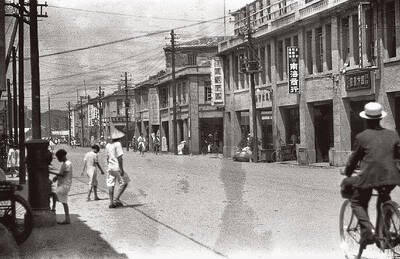
June 1 to June 7 "If all Taiwanese were as afraid of dying as you, then what would happen?” Physician Shih Chiang-nan (施江南) reportedly said this to his wife Chen Chiao-tung (陳焦桐) after she urged him to stop intervening on behalf of Taiwanese soldiers stranded overseas after serving in the Japanese Army during World War II. Shih had clashed with high-ranking officials over the issue, engaged in several heated arguments with Taiwan governor-general Chen Yi (陳儀) and allegedly shouted at general Ko Yuan-fen (柯遠芬), chief of staff of the Taiwan Garrison Command, over


 RSS
RSS