


The young artist Hou Chun-ming (
Trying to come to terms with a recent divorce, he reveals his emotional pain. His installation of deeply private thoughts and dream imagery is a way for Hou to exorcise his innermost demons, but this exhibition, instead of being a probing exploration into the human psyche, is more like a transitory passage. It lacks the universality of his ear-lier work.
In the main room, a large wooden spiral structure consists of vertical wooden strips attached firmly to the ground and ceiling. Affixed to the strips, slightly below eye-level, are book-sized boxes numbered in chronological order. Following the path of the spiral, the viewer reads the hand-written texts on the doors of the 83 boxes and opens them to peer inside at Hou's nightmarish dream imagery rendered in crayon, ink or watercolor on paper.
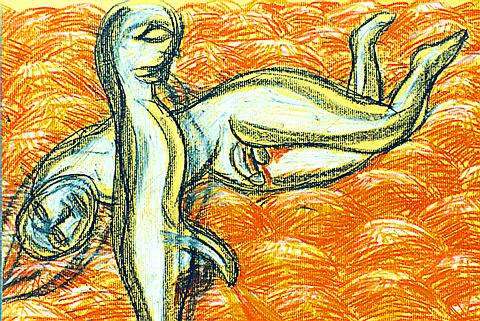
PHOTO COURTESY OF HANART GALLERY
Like walking a Buddhist mantra, the one-on-one meditative interaction with the art leads the viewer into the center of the spiral. The diary-like texts written in a stream-of-consciousness manner conjures up Hou's "inner child" and reflects his turmoil experienced as an adult.
Hou shares an affinity with the unnerving self-portraits of Antonin Artaud, the creator of "the theater of cruelty" (1930s). Razor-sharp tongues jut out of existential mouths, female talons grasp castrating scissors, Medusa-like heads coldly stare at their male prey, soaring eagles grasp decapitated, bleeding heads, men urinate fire, and landscapes ravished by war. These are some of the horrific images envisioned by Hou. Life on Earth is hell and Hou seems to say that sex is a battleground and one of life's most vicious forces.
One weak point of the show is a series of quick sketches and finger paintings completed during therapy, and displayed at the entrance to a smaller exhibition room. To treat all the marks made by an artist like a "holy relic" feeds into the notion of "artistic genius" and cheapens the overall vision of the show.
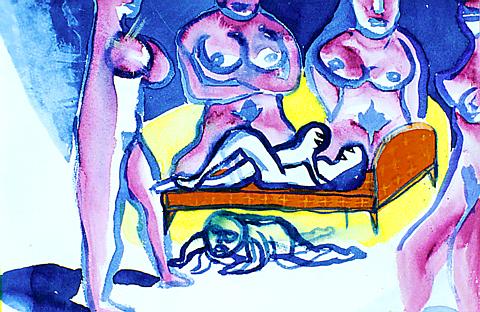
In a huge note pinned to the wall, Hou beseeches the viewer to help him by not criticizing him, but to see and share his work. Like the traditional Chinese artist, Hou has always tried to stimulate contemplative reflection in the viewer. He has also strove to help change Taiwanese society through his art. This time, he is asking for help.

Taiwan’s English education system is being pulled apart by three opposing forces. Bilingual Nation 2030 pulls students toward English and global communication. Artificial Intelligence (AI) readiness pulls them toward digital judgment, verification and AI-mediated work. But Taiwan’s old exam culture pulls them back toward memorization, grammar drills, timed reading and correct answers. If the education system keeps using old exams to define success, it risks producing graduates who are neither genuinely bilingual nor genuinely AI-ready, but trained for tasks machines can already perform. The first force is Bilingual Nation 2030. Launched in 2018, the policy aimed to “help Taiwan’s workforce connect

It seems every few days one bumps into one of those “real man” comments in which Taiwan is urged to “face reality” or similar, and “make a deal,” with the speaker implying that soon it will be too late. “Deal” advocates always present themselves as having a superior grip on reality, and the manly ability to make the “hard choice.” Their testosterone-laden language often echoes that of Taiwan sellout advocates. Note that such commentary always specifies a process (“make a deal, work with, make progress”), never the end state of what occupation by a violent authoritarian colonialist state will entail. In
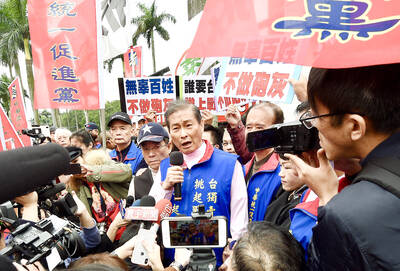
There are shadowy cabals plotting to sell out Taiwan to be annexed by China, by invasion if necessary. Fortunately, they are buffoons. In 2019, former Bamboo Union gangster and founder of the China Unification Promotion Party (CUPP), Chang An-le (張安樂, colorfully known as “White Wolf”), led a protest at the Legislative Yuan against comments made by then-premier Su Tseng-chang (蘇貞昌) that in the event of an attack by China, he would never surrender, but would protect the nation by fighting to the end, even if he only had a broom. Chang had party members bring a wooden casket that they
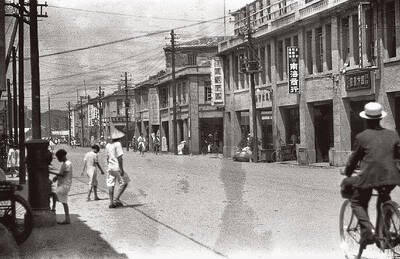
June 1 to June 7 "If all Taiwanese were as afraid of dying as you, then what would happen?” Physician Shih Chiang-nan (施江南) reportedly said this to his wife Chen Chiao-tung (陳焦桐) after she urged him to stop intervening on behalf of Taiwanese soldiers stranded overseas after serving in the Japanese Army during World War II. Shih had clashed with high-ranking officials over the issue, engaged in several heated arguments with Taiwan governor-general Chen Yi (陳儀) and allegedly shouted at general Ko Yuan-fen (柯遠芬), chief of staff of the Taiwan Garrison Command, over


 RSS
RSS