


Alot has changed in Taiwan's nuclear industry since 1980, the year when officials at state-owned Taipower proposed a fourth nuclear power plant, a project they envisioned wrapping up and coming on line by 1989.
At the time, it was a reasonable assumption. The island was power hungry and the process for approving nuclear plants was extremely streamlined.
"At the time of the first plants, residents cheered and celebrated a plant coming to their area," remembers Yu Sheng-hsiung, director of the utility's Nuclear Communications Center and an employee of Taipower since the late 70s.
No more. These days energy officials are more likely to get an egg in the face from an angry protester. Democratization and rapid industrialization have created no shortage of divisive issues in Taiwan, but few are as controversial as the use of nuclear energy.
And Nuclear Power Plant No. 4 -- dogged so much by indecision and public protest that it won't come on line till 2004 -- has become the symbol of far-reaching changes in Taiwan in relation to nuclear issues, such as safety, site selection, and public opinion.
One of the most obvious indicators of these changes is that having built three plants within 15 years, the fourth will take 24 years.
"Since the society has become more open and more critical, the government cannot use the same tactics like 20 or 40 years ago. They cannot twist the arm of the people as they wish," says Chang Kow-lung, a professor of physics at National Taiwan University and a former chairman of the Taiwan Environmental Protection Union. "The environmental groups will continue to fight to stop nuclear power plants, and the government will have to pay a greater price to develop them further."
Part of the reason for the shift in public attitudes is due to a history of mishaps and alleged mismanagement in the industry. Involved in the anti-nuclear lobby for more than 20 years and consulted by the government during environmental reviews for NPP No. 4, Chang harbors a basic skepticism of the competency of Taipower and government officials who develop and regulate nuclear power.
"There are many things that should not happen, but they happen here in Taiwan," he says, citing as an example a drunk driver who was transporting radioactive waste from NPP No.1 in September. His truck overturned and 31 barrels of waste spilled into Chienhwa Creek.
The government's development of the industry certainly has a checkered past, starting in the bad old days in Taiwan when nuclear power plants were built without vigorous public debate and safeguards like detailed Environmental Impact Assessments.
In 1988, an accidental explosion and radiation leakage at the Institute of Nuclear Energy Research capped a long struggle to deal with high-level waste from a research reactor and a secret nuclear weapons development program. That same year the government's Atomic Energy Council shut down NPP No.1 because of radiation leakage. In 1992, the AEC was besieged with criticism for allegedly covering up the discovered usage of radioactive rebar in the construction of at least 1,500 apartments.
Critics argue that this is compelling evidence that Taiwan should get out of the nuclear business. But AEC and Taipower officials, who are forthright in acknowledging past mistakes, say it's hardly that simple.
"It's easier to comment than to implement some real solution," says Yu. "I would really appreciate it if you can find a good alternative. In my opinion, there are not enough alternatives to supplant nuclear energy in this country; it is indispensable."
A lack of practical -- cheap, clean and abundant -- alternatives to meet the burgeoning demand is proponents' strongest argument in favor of nuclear power. In the last 20 years, energy demand on the island has increased by an average of 6 percent annually. To meet that demand, the energy sector has relied on using increasing amounts of coal and oil, which are less efficient energy producers than nuclear reactors and emit high concentrations of greenhouse gases. As a percentage of source materials used to produce energy, however, Taiwan's reliance on oil has dropped 25 percent since 1978 to 51 percent. The gap is made up by increased burning of coal and natural gas and by more usage of nuclear energy. (See graphs.)
Environmentalists say nuclear energy wouldn't be so necessary if the central government more aggressively promoted energy conservation and decreased its support of high energy-consuming industries like cement and steel that contribute a small share toward Taiwan's GDP.
"Many people talk about the energy supply and sources, but very few talk about energy management," says George Cheng, CEO of Taiwan Watch Institute, an environmental think-tank. "Most important in Taiwan is managing energy usage. There is a lot of waste here. When we compare the efficiency of energy in Taiwan to Japan, the US and Europe, it is very low."
Cheng believes that with the development and execution of effective energy conservation policies and the pursuit of renewable energy resources, Taiwan can slowly phase-out nuclear energy. "But you have to start right now -- look for ways to do it."
In the last decade, the use of renewable energy resources has been quite limited in Taiwan, with hydropower representing just 3 percent of the power supply in 1998. And the development of other renewables, such as solar and wind energy, may be difficult given that they require large tracts of land and are unpredictable. The government has pursued other alternative energy sources, such as biogas generators and geothermal energy, but has met with limited success.
Meanwhile, the central government's Energy Commission predicts that by the year 2020, Taiwan's energy consumption will double. And most of that energy will be imported.
These two things influence quite heavily the future use of nuclear energy in Taiwan and it is perhaps the main force behind the government's decision last year to fix nuclear energy as a source of between 20 percent and 30 percent of Taipower's electricity. (In 1998, that represented about 10 percent of the island's overall energy supply.)
With that decision, the completion of NPP No. 4 seems assured. And to maintain that percentage as energy demand increases each year through 2020, Taipower will need more than just the two additional reactors of NPP No. 4.
"There is a likelihood to add more units (reactors) in the existing nuclear power plants," says Wang Song-feng, secretary-general of the AEC. "But there will be no fifth nuclear power plant. We will only add more units to keep the percentage the same."
Wang believes that in Taiwan there is growing acceptance of nuclear energy, despite the mistakes of the past. He says the AEC and Taipower are working to build a reputation of "trust and transparency" in the industry in the hopes of winning over a sometimes skeptical public.
"It is already difficult enough for them to understand the technology, and if they get the impression that you are trying to hide something, then that will just make things more difficult. ... If I do something wrong, I correct it and I admit that we did something wrong. But we have the ability and the willingness to improve and to correct. I think that is the only way to gain confidence."
Chiang Hsiang-huei, dean of Tsinghua University's College of Nuclear Science and an expert on nuclear safety issues, is satisfied that Taiwan is improving its record. "Taipower has already established a very strict and a very good safety culture, especially in the last 5 to 10 years," he says. "I find that there is tremendous improvement in the safety measures taken and the safety standards increase day by day. I don't find any difficulty with the safe operation of nuclear power plants in Taiwan."
There remains, however, the issue of storage and disposal of nuclear waste. Chiang, for one, takes issue with Taipower's willingness to export its low-level nuclear waste to places like Russia, North Korea and the Marshall Islands. To do so violates the principle set forth by the International Atomic Energy Agency to deal with radioactive waste at home unless exportation increases its chances of being handled properly.
"Waste disposal actually isn't so difficult from an engineering point of view because the amount is so small," Chiang says. "The problem is a social problem or a political problem. But if you cannot solve this problem and find a site then I think it's not healthy to develop or use nuclear power. This problem should be and actually can be settled down in this country."
The waste issue has long plagued Taipower as a public relations headache. Soon after it started storing low-level waste on Orchid Island in 1982, it met resistance from the Aboriginal Tao native to the island. There has also been leakage from about 3,000 of the nearly 100,000 barrels in temporary storage there, increasing the criticism of Taipower and its ability to appropriately handle and dispose of waste.
Taipower is currently assessing an islet near Matsu as a permanent disposal site. An environmental impact assessment is due by the end of 2000 and if things proceed smoothly, officials hope to start moving waste from Orchid to a new site by 2002. If things don't go smoothly, it could take several years before a site is ready. With Orchid Island at maximum capacity, Taipower will put low-level waste in warehouses at two of its nuclear plants, where 60,000 barrels are already in temporary storage.
In the future, the perennial problem with storage will enliven the public debate in Taiwan, as will fallout from accidents such as the one at the Tokaimura Fuel Conversion Plant in Japan. But whether it will significantly affect the direction of national energy policy with what the government believes is an impending energy crisis approaching is hard to envision.
"The problem now is that the public pressure is not enough to push the government to make a decision -- the right decision -- to phase out nuclear energy," says Cheng, of the Taiwan Watch Institute.
And others, like Chang, think Taiwan won't learn until it is too late.
"It seems they only learn lessons when doing things wrong," he says.
But Taipower'sYu, who understands the fear people have because they don't trust nuclear safety, says it's easy to mislead the public. "From time to time, I remind our critics that this is a small island with 21 million people who want a high living standard. How do we do that?"

Taiwan’s English education system is being pulled apart by three opposing forces. Bilingual Nation 2030 pulls students toward English and global communication. Artificial Intelligence (AI) readiness pulls them toward digital judgment, verification and AI-mediated work. But Taiwan’s old exam culture pulls them back toward memorization, grammar drills, timed reading and correct answers. If the education system keeps using old exams to define success, it risks producing graduates who are neither genuinely bilingual nor genuinely AI-ready, but trained for tasks machines can already perform. The first force is Bilingual Nation 2030. Launched in 2018, the policy aimed to “help Taiwan’s workforce connect
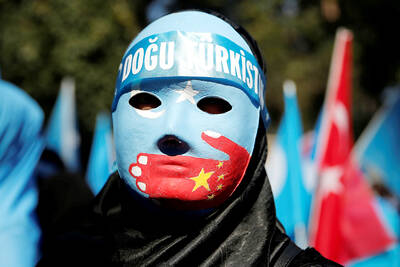
It seems every few days one bumps into one of those “real man” comments in which Taiwan is urged to “face reality” or similar, and “make a deal,” with the speaker implying that soon it will be too late. “Deal” advocates always present themselves as having a superior grip on reality, and the manly ability to make the “hard choice.” Their testosterone-laden language often echoes that of Taiwan sellout advocates. Note that such commentary always specifies a process (“make a deal, work with, make progress”), never the end state of what occupation by a violent authoritarian colonialist state will entail. In
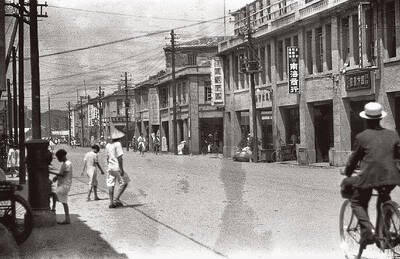
June 1 to June 7 "If all Taiwanese were as afraid of dying as you, then what would happen?” Physician Shih Chiang-nan (施江南) reportedly said this to his wife Chen Chiao-tung (陳焦桐) after she urged him to stop intervening on behalf of Taiwanese soldiers stranded overseas after serving in the Japanese Army during World War II. Shih had clashed with high-ranking officials over the issue, engaged in several heated arguments with Taiwan governor-general Chen Yi (陳儀) and allegedly shouted at general Ko Yuan-fen (柯遠芬), chief of staff of the Taiwan Garrison Command, over

“Taiwan’s Opposition Leader Comes to US With a Message Straight Out of Beijing” read a May 31 headline in the Wall Street Journal. Top US administration officials and members of Congress almost certainly read the WSJ, and if there was a bullet point takeaway that people in Washington should absorb ahead of Chinese Nationalist Party (KMT) Chair Cheng Li-wun’s (鄭麗文) arrival in DC on June 9, that headline is it. The last few columns have discussed this very topic, and the timing is not coincidental. While those top officials likely do not read the Taipei Times, judging by the number


 RSS
RSS