


A fisherman walked barefoot down a strip of seashore country road as we passed by, his fingers sunk into the gray, bulbous head of an octopus, its limp tentacles swaying against his calf.
No one else walked the road, which was lined with several homes that faced the Pacific. There was no sound or movement other than the surf harmlessly battering a saw-toothed barrier of volcanic rock and black coral. The fisherman glanced at us only long enough to show indifference as he strolled onward with his dinner.
For sure, we were a familiar sight -- mainlanders of a different sort that breeze in on weekends from Taiwan to ply ourselves with the beauty and slowness of Green Island -- the "gem of green in a sea of blue."
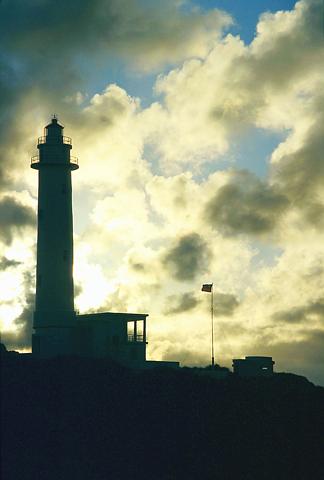
PHOTO: MIKE CLENDENIN, TAIPEI TIMES
Every weekend, the population of the 16 square-km island -- 3,300 -- doubles and sometimes triples with the influx of daytrippers. But it is an advancing tide of tourism that recedes on Monday as quickly as it washes in on Friday, leaving the island with the feel of a little-considered, lazy Filipino backwater.
Driving east out of Chungliao, one of the island's three villages, our guide Mr. Hong prompted us to look left at this and right at that. "On the left is a place where you can see the plum mountain deer," he said, speaking of the endangered Sika that are still available on a few local menus. "But they only come out at night. If you try to go up into the mountains during the day and see them there is only a .059 percent chance. We know this because we go up there a lot and measure it."
We passed a modern, whitewashed complex that could pass for the local library. "That is where the worst mental patients used to come from the army," he said. Now only a few soldiers remain, he noted quickly, and it is being converted to a retirement home for the rich.
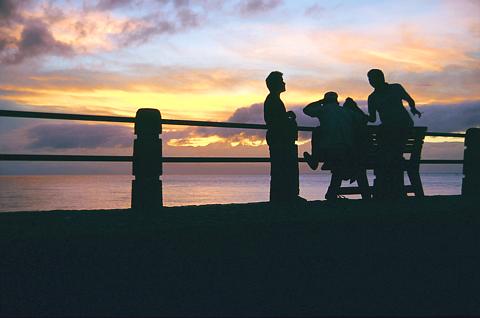
PHOTO MIKE CLENDENIN, TAIPEI TIMES
A few more sundry attractions came into view. Rock formations that pose as a Japanese general, a pregnant woman beckoning her general home from war, an ambiguous hulk of volcanic rock known as the "nose of Green Island."
They are sentries of the coast that signal the approach of the island's less beautiful, but more notorious landmark, euphemistically called "The Green Island Chalet." Once run by a now-defunct branch of the army, the former prison for political dissidents and gangsters lies in a purgatorial slumber. Plans to use it as a medium-security facility were scuttled by former inmates who want it reopened as a memorial to the nefarious rule of Chiang Kai-shek, a plan itself stalled by indecision over which government agency should pay for it.
The result is a weed-riven, slightly anonymous facade that passes by without much notice if it weren't for the memorial being built across the road, tentatively due to open in early December and a testament to the time when the island, also known as Lutao, held more than 1,000 prisoners, many of whom were the snuffed-out sparks of democracy. (Two other prisons, one maximum- and one minimum-security, still operate on the island.)
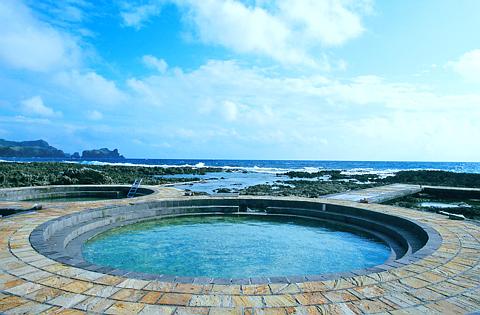
PHOTO: MIKE CLENDENIN, TAIPEI TIMES
But whether the monument opens on time is of little concern here. Green Island is in no rush. It seems too sleepy for speed; besides, the last decade has brought enough fast-paced changes to its shores. Taiwan's lurch toward democracy served as catalyst for a far-reaching transformation on Lutao, changing it from a place where no one wants to go to a place where no one wants to leave.
Instead of being feared as the "Alcatraz of Taiwan" it is now ironically touted as a destination resort, a relatively undeveloped foil to frenetic Taiwan. And that promotion of the island is making it increasingly schizophrenic. Like so many of Taiwan's beauty spots, it is awash with people on the weekends and lonely the rest of the time.
In these slower moments it is hard to believe that so many people visit the place (a record 50,000 people came in July).
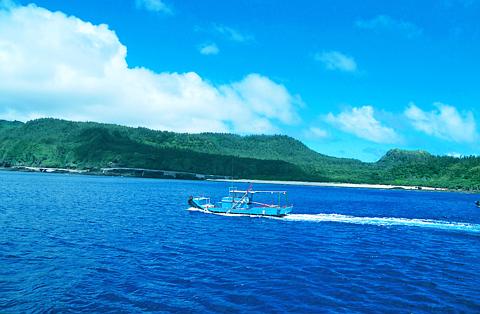
PHOTO: MIKE CLENDENIN, TAIPEI TIMES
"We have at least two people cleaning the coast each day," boasts Mr. Hong. "That's why it's so clean. And prisoners (on good behavior get to come out at least four times a month to pick up garbage."
This clean and nearly pristine coast is a collage of curling turquoise breakers that fall timelessly upon coral beaches; of sculpted bluffs, pockmarked and moistened by the wind and sea; of sparse villages that often seem empty during the week. A voyeuristic peek through the windows and doorways of Lutao reveals the drowsy mid-week pace of the place, most likely perceived as boredom by the locals. The same two men playing Pac Man on a Monday under the arcade's clinical whitewash of florescent lights are the same two men playing Tuesday, with a few extra geckos being the sole change in scenery. They sit in the same seats, beer bottles at their feet, twitching every few seconds, submerged in a virtual world and oblivious to the clinging couples and middle-aged men on the nearby boardwalk gathered to admire the pastel-tinged clouds of another sunset.
Down the road a ways two ladies bump into each other in the middle of the main street, then stand where they are, chatting. A few scooters drive around, slowly, in no hurry, it seems, to get anywhere. On the west side of the street, a group of diners wades through Taiwan beers and seagrass soup -- a local specialty. A few hours later the same group is still pushing through entrees and stacking up bottles, the conversation driven into a more animated and good-natured banter with every passing beer. In Nanliao, the island's port village, they pass for the rowdiest group around.
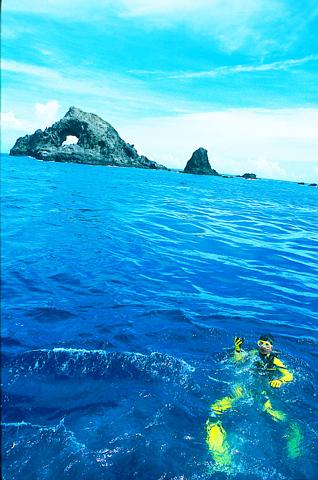
PHOTO: MIKE CLENDENIN, TAIPEI TIMES
There isn't much in the way of excitement on Lutao, unless a dog should try to chase your scooter down, so falling into the rhythm of life here is as uncomplicated as inhaling a breath of clean sea air. Daytime hours slip away with early morning hikes, beach reposes, snorkeling or scuba diving. Maybe two or three scooter rides along the perimeter road, up among the overgrown meadows staked out by water buffalo and egrets, past women in balaclavas stooped in tiny fields to gather vegetables, and along the snaking bends of the east coast where bluffs deny the sea any encroachment on the sheep-grazing terraces above.
At night, the slackness of the island winnows even further unless you visit the island's lone karaoke den, from which the melancholy drone of Taiwanese ballads corrupt the silence. The evening activity begins at sunset, with a few beers had quietly on the boardwalk, and extends slowly and uneventfully into the night with self-guided moonlight drives along curling roads, dappled with frogs and fringed with the sound of crickets bedded down in the undergrowth.
The anonymity of the darkness also makes late-night the best time for an intimate soak in the island's touted seaside saltwater hot springs, a geological attraction replicated only near Italy's Mt. Vesuvius and a reminder of the "burning island's" volcanic roots. There are two tiled warm pools, one tiled hot pool and a natural cold water pool just beyond reach of the breakers.
With a few friends, some wine, cheese and crackers, I eased into a pool and allowed the heat to draw me down. Shadows passed from sea to shore as storm clouds sped through the moonlight. Every so often a passing shower dulled the heat of the springs. Waves crashed all around. Above, a single star shone through a window in the thickening clouds. The moon drifted in and out; its light reflecting in bright silvery lines along the ripples in the pool.
I breathed in deeply and closed my eyes and my thoughts drifted to images from our day of scuba diving. In water almost clear enough to see someone wink from 15 meters away, we descended on a pinnacle just off the northeast shore, trailing bubbles through layers of deepening blue. The pinnacle sprouted from the sea floor, adorned like a Christmas tree with a crusty melange of decorous soft and hard corals. Tiny schools of fish flitted about in sharp angles while solitary predators patrolled ceaselessly, investigating the tunnels and nooks of the vast, rocky colony.
A handful of other divers darted among the pinnacle's smaller peaks and depressions, like mice in a maze, anxious to poke their heads into every hidden crevace in hopes of seeing an eel or a lionfish or some other prized sighting they could tell their friends about. After 20 minutes of frantic motion, they returned to the surface, low on air, leaving us alone for another 30 minutes to slowly cruise the area.
Later, we joked about their harried tour of the site and I thought of how much they had missed because of their speed. But then maybe they hadn't caught on yet to one of Lutao's unspoken rules -- there is no need to hurry.
For your information:
Transportation -- Green Island is accessible by ferry or plane from Taitung. The ferry takes roughly an hour, costs about NT$300, and is at times a rough, rolling journey into the swells of the Pacific, so be prepared to be among plenty of sea-sick tourists. Boats leave from the Fukang harbor. Times vary according to the company you choose but there are at least a couple departures early each morning.
The plane is NT$600 one-way and takes about 10 minutes from Taitung. Try Formosa Airlines at 672-830 or Taiwan Airlines at 672-526. There are several departures a day from both Taitung and Nanliao.
Scooters may be rented at the airport or near the harbor for about NT$400-NT$500 per day.
Accommodation -- There are several hotels on the island, with prices ranging from NT$500 for a dorm bed to NT$4,500. The average is about NT$2000 for a double. On the cheap and roughing it end, there are some attractive and well-located campsites -- near the hot springs and Tapaisha beach -- available for NT$200-NT$300. Two-man tents may be rented for NT$300. Reservations must be made through the tourist office across from the airport.
Recreation -- Scuba diving is by far one of the most attractive activities on the island, with visibility averaging 20 meters and underwater scenes reminiscent of the Philippines. Sanasai is the boat company of choice with its well-equipped cruiser kitted out to handle about a dozen people.
Guidance -- Contact the East Coast National Scenic Area tourism bureau at (089) 841-520 or www.tbrocecnsa.gov.tw. The website is in Chinese, Japanese and English and offers suggestions for self-guided sight-seeing tours.

Michael slides a sequin glove over the pop star’s tarnished legacy, shrouding Michael Jackson’s complications with a conventional biopic that, if you cover your ears, sounds great. Antoine Fuqua’s movie is sanctioned by Jackson’s estate and its producers include the estate’s executors. So it is, by its nature, a narrow, authorized perspective on Jackson. The film ends before the flood of allegations of sexual abuse of children, or Jackson’s own acknowledgment of sleeping alongside kids. Jackson and his estate have long maintained his innocence. In his only criminal trial, in 2005, Jackson was acquitted. Michael doesn’t even subtly nod to these facts.
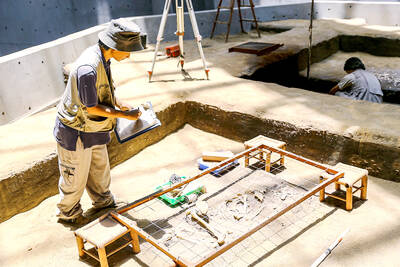
Writing of the finds at the ancient iron-working site of Shihsanhang (十 三行) in New Taipei City’s Bali District (八里), archaeologist Tsang Cheng-hwa (臧振華) of the Academia Sinica’s Institute of History and Philology observes: “One bronze bowl gilded with gold, together with copper coins and fragments of Tang and Song ceramics, were also found. These provide evidence for early contact between Taiwan aborigines and Chinese.” The Shihsanhang Web site from the Ministry of Culture says of the finds: “They were evidence that the residents of the area had a close trading relation with Chinese civilians, as the coins can be

The March/April volume of Foreign Affairs, long a purveyor of pro-China pablum, offered up another irksome Beijing-speak on the issues and solutions for the problems vexing the People’s Republic of China (PRC) and the US: “America and China at the Edge of Ruin: A Last Chance to Step Back From the Brink” rang the provocative title, by David M. Lampton and Wang Jisi (王緝思). If one ever wants to describe what went wrong with US-PRC relations, the career of Wang Jisi is a good place to start. Wang has extensive experience in the US and the West. He was a visiting

The January 2028 presidential election is already stirring to life. In seven or eight months, the primary season will kick into high gear following this November’s local elections. By this point next year, we will likely know the Democratic Progressive Party (DPP) candidate and whether the Taiwan People’s Party (TPP) will be fielding a candidate. Also around this time, the Chinese Nationalist Party (KMT) will either have already completed their primary, or it will be heading into the final stretch. By next summer, the presidential race will be in high gear. The big question is who will be the KMT’s


 RSS
RSS