


India’s youth have many reasons to feel wounded. From shrinking returns on college education to the disappearance of good jobs and fading hopes of a middle-class life, they are fighting one battle after another. In the end, though, what broke Gen Z’s dam of patience was an insult from the highest court in the land.
“There are youngsters like cockroaches, who don’t get any employment or have any place in the [legal] profession,” Surya Kant, the chief justice of India, said during a May 15 court hearing on a petition about delayed recognition of advocates’ seniority. “Some of them become media, some of them become social media … right-to-information activists and other activists, and they start attacking everyone.”
Although Kant quickly walked back his comments, insisting he was misquoted and that his words were meant only as a rebuke to unscrupulous lawyers entering the profession solely to cause mischief, the damage was done. Abhijeet Dipke, an Indian communications strategist in the US, responded to what he took as a generational slight with a social-media post announcing the birth of the Cockroach Janta Party (CJP) — Janta or Janata being the Hindi word for “people.”
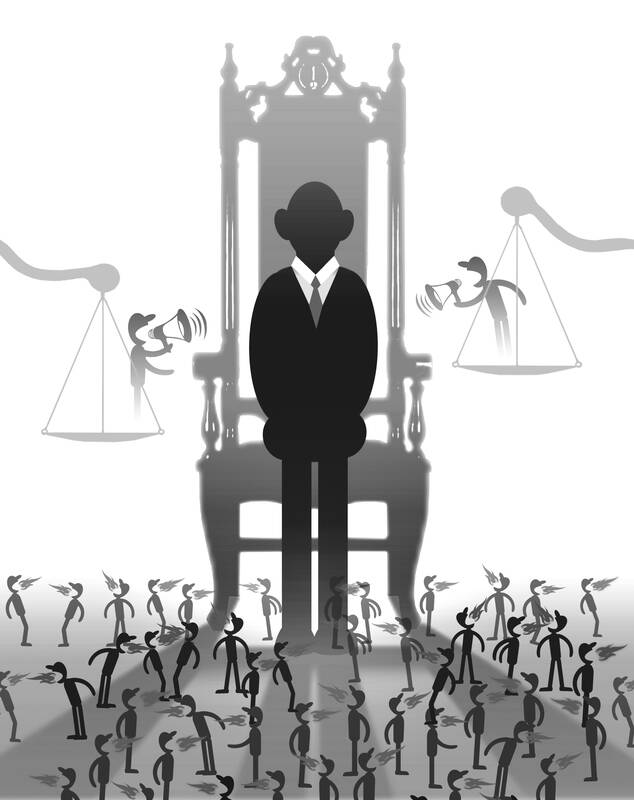
Illustration: Yusha
What began as satire, a fleeting Internet meme featuring AI-generated images and videos of anthropomorphic insects, has almost overnight emerged as a movement with viral mass appeal. The CJP has amassed 22 million followers on Instagram, more than double the numbers for Prime Minister Narendra Modi’s ruling Bharatiya Janata Party (BJP).
Even though the CJP is not a registered political party, it has released a charter. The self-described “Voice of the Lazy and Unemployed” has called for a cleanup of the electoral system, an end to the growing proximity between the political executive and the judiciary, more women in parliament and government and a domestic media free from the clutches of oligarchs.
However, the hot-button issue for the youth right now is their all-important high-school exam. Its integrity has been put under severe doubt by an ill-prepared switch to digitization, imperiling the fate of millions of future collegegoers. Dipke has pounced on the opportunity by announcing that he will return to India on Saturday and hold a peaceful protest in New Delhi to demand the education minister’s resignation. “Meet me at the airport,” he said in a video message to his followers.
The Modi government is not taking this new challenge lightly. The BJP has steadily extended its control on society by polarizing the majority Hindu community against minority Muslims. The opposition has become largely irrelevant in electoral contests that it says are neither free nor fair. While the government and the Election Commission dispute those claims, the net result is that India is beginning to resemble a single-party state with weakened institutional checks on executive authority and little scope for expressing dissent.
However, even an unassailable hold on power can come unstuck if a grassroots protest is allowed to snowball, something that has helped Modi tremendously in his own political career. The timing is also dangerous. The BJP’s promise to lead the country to a prosperous future has come under a cloud. Foreign investors are pulling money out, and the domestic capitalist class — including some of Modi’s most ardent supporters — is not investing either. The crisis in the Middle East is threatening India’s energy security and aggravating its balance-of-payment deficit. The “cockroach” challenge may prove to be one simultaneous shock too many for the prime minister’s personal brand of infallibility to absorb.
No wonder then that authorities have withheld local access to the CJP’s X handle. Since the 30-year-old Dipke holds a degree in public relations from Boston University and has prior experience in Indian political activism, the BJP alleges that his movement is a foreign-sponsored influence operation to destabilize India.
Still, the crevices through which youth anger is crawling out are all at home.
Elsewhere, several countries have switched to digital evaluation of exam papers, so that software can rule out human errors in adding totals. The shift is typically carefully planned and rigorously tested. China piloted digital marking for its Gaokao university-entrance exam in Guangxi province in 1999, rolling it out across most of the country by 2006.
India, however, rushed into the new technology with such haste that nearly a quarter of the 1.8 million students — far more than in previous years — are unhappy with their scores in the All India Senior School Certificate Examination. Some complained that the answer sheets on which they were graded were not even theirs. In one such high-profile case, the testing authority admitted its error, but not before pro-government social-media accounts labeled the young student a Pakistani — a common insult against those deemed anti-national — for questioning the botched implementation of the new system.
Although Education Minister Dharmendra Pradhan has acknowledged the crisis and promised to fix the errors in a re-evaluation exercise, test takers are being fed Instagram reels extolling the virtues of going digital. Still, with no sign that students were buying the “reform,” the government on Tuesday transferred the top two officials of the Central Board of Secondary Education and ordered a probe.
India’s institutional machinery is failing its youth long before they enter the workforce. A nationwide entrance exam for medical schools was canceled recently after a widespread paper leak, leaving more than two million aspirants months behind in their careers. The state has ordered a retest, announcing that this time the question papers will be transported via air force planes.
It does not get any easier after graduation. Even before the arrival of AI, the pathway to jobs was riddled with potholes. The wage bump graduates historically enjoyed over school-leavers peaked in 2011 and has stagnated ever since. The world’s most populous nation churns out 5 million graduates a year, yet only a third find salaried positions. The job market is so bleak that the financial return on an additional year of schooling is now lower than in sub-Saharan Africa.
Every few decades, youth frustration in India becomes a consequential force that compels the political class to crush or co-opt it. In 1974, engineering students in Gujarat launched the Navnirman, or “reconstruction,” movement, burning buses over hostel food bills and ultimately bringing down a state government. That movement provided a fragmented opposition with a blueprint to challenge then-prime minister Indira Gandhi’s rising autocratic tendencies. More importantly, it birthed the careers of several future political titans, including a then-23-year-old student organizer named Narendra Modi. Decades later, he would resort to the successful playbook once again, capitalizing on public outrage over corruption, high fuel prices and the brutal gang-rape and murder of a young woman on a New Delhi bus in 2012. The successive waves of anger played a big part in the then-Gujarat chief minister’s ascendance to national power in 2014.
Now the shoe is on the other foot. The Cockroach Janta Party says anyone can be a member if they are online for at least 11 hours a day. It is a joke with a kernel of seriousness. The same smartphone that is keeping millions of young Indians trapped in “timepass” — the Indian English phrase that describes a state of perpetual ennui — was exploited for rapid political mobilization by the popular film star Vijay. A fresh entrant to politics, he caused a surprise electoral upset last month in the better educated, more industrialized southern state of Tamil Nadu. Vijay, who uses only one name, relied on Gen Z to persuade their parents to vote for him.
He also showed how the influence of youth over politics may play out differently from other South Asian nations, where violent Gen-Z protests have led to three regime changes in recent years — in Sri Lanka, Bangladesh and Nepal. However, occupying a public square in contemporary India can lead to swift imprisonment under anti-terror laws.
Gen Z has adapted. Using consumer AI tools, the swarm has discovered that while the police can clear a street corner, enter university libraries to beat up students, or put their leaders in jail for years without trial, it has no idea how to suppress an abstract, decentralized meme.
Still, that protest is not costless. The 19-year-old ethical hacker who flagged major security loopholes in the test-marking portal in February (the board of education rejected the claim last week) is taking a big risk. As the New Delhi-based advocacy group Internet Freedom Foundation has noted, good-faith security research in India is not protected from legal prosecution.
“To be too conscious is an illness,” Fyodor Dostoevsky’s protagonist said in Notes From Underground, the satirical novella he wrote in response to 19th-century Russian nihilism. “I have many times tried to become an insect. But I was not equal even to that,” he said.
However, in 21st-century India, the cockroach is not a metaphor for running away from problems. Instead, it is a symbol of survival — in the swamps of communalized politics, corruption and staggering bureaucratic callousness.
Andy Mukherjee is a Bloomberg Opinion columnist covering industrial companies and financial services in Asia. Previously, he worked for Reuters, the Straits Times and Bloomberg News. This column reflects the personal views of the author and does not necessarily reflect the opinion of the editorial board or Bloomberg LP and its owners.
Singaporean former Prime Minister and current senior minister Lee Hsien- Loong(李顯龍) last month stood on Chinese soil and told Beijing that Singapore cooperates because of “shared interests”, not because of common “ethnic descent,” a significant statement that has upended China’s cognitive warfare tactics of “ethnic nationalism.” Along with using its military buildup and economic growth to expand its international dominance, China has long deployed ethnic politics to promote the idea that all ethnic Chinese around the world, regardless of citizenship, share a tight bond with the Chinese motherland, by which it means the regime of the People’s Republic of China (PRC)
A recent report concerning a student who is suing his teacher posed the question in its headline: Does failing a student in two subjects constitute bullying? The college student in Chiayi County apparently sought NT$2 million (US$63,603) in state compensation, but a court dismissed the case. The first reaction of many might have been to ask: What has happened to students nowadays? Some say that teachers have lost their authority, while others say students are overindulged. Some even start reminiscing over the days when “whatever the teacher says goes.” However, the real issue might be overlooked if emotional reactions like that are the
When I visited Taiwan last summer, I called on the nation to use its status as a technology superpower to build superweapons. It is obvious to me as I return a year later that Taiwan is now answering that call. By 2030, Taiwan envisions a domestic drone hub, capable of producing large quantities of drones per year. The nation continues to tighten cooperation across the private sector, scientific researchers and the elected government, on creating new and innovative production avenues for defense, while efforts to become central to the “democratic supply chain” are only increasing. Anduril is seeing all of these positive
Chinese Nationalist Party (KMT) Chairwoman Cheng Li-wun (鄭麗文) in San Francisco on Tuesday last week said if she had not met with Chinese President Xi Jinping (習近平), she would have been “just a plain” and “even negligible” KMT chairperson, bluntly signaling the role she is playing in her visit to the US — Beijing’s messenger from Taiwan. Cheng and her delegation arrived in the US on Monday last week for a two-week visit across five major cities. Her party said the group is scheduled to meet with US lawmakers, officials, policy experts and businesspeople. Before departing, Cheng said her trip


 RSS
RSS