


When I visited Taiwan last summer, I called on the nation to use its status as a technology superpower to build superweapons. It is obvious to me as I return a year later that Taiwan is now answering that call.
By 2030, Taiwan envisions a domestic drone hub, capable of producing large quantities of drones per year. The nation continues to tighten cooperation across the private sector, scientific researchers and the elected government, on creating new and innovative production avenues for defense, while efforts to become central to the “democratic supply chain” are only increasing.
Anduril is seeing all of these positive trends firsthand in our own work in Taiwan. Since we opened our Taiwan office early last year, we have deepened our partnership with the Taiwanese military and industry alike.
Anduril has many projects — some of which include our continuous support for the Altius fleet which we delivered rapidly to the army, critical commercial missions with our Dive-LD autonomous underwater vehicle, and Lattice command-and-control technology we have integrated with Taiwanese systems.
We have brought more than 15 new Taiwanese companies into our global supply chain in the past year, spanning precision machining, electronics, batteries, motors and optics. Our spending with local suppliers is on track to grow 15-fold this year versus 2024. We have also hired Taiwanese talent to support our expansion, focusing on engineers, supply chain specialists and operators, and are poised to further grow our footprint in the years ahead.
However, it is not enough for us to just build and deliver this technology. Taiwan needs proven capability. Anduril will provide it. We conduct rigorous, regular and ambitious testing of our hardware. This enables us to build trust and confidence in our technology with those who use it. It also allows us to push our kit to its limits so that we can constantly update and improve our technology.
This is only possible because of the strong partnerships we have built with Taiwanese. The willingness to expand industrial capacity and defense production is palpable. We see unshakable resolve from across Taiwanese society when it comes to resisting Chinese intimidation.
Taiwan has also steadily invested in expanding its own self-defense capability: This year’s budget would be the largest in the nation’s history, and medium-term visions to implement even more advanced technology into the military are impressive. At Anduril, we will continue to support the development of a vibrant dual-use industry, encouraging the incredible commercial companies in Taiwan to participate in the defense of their nation.
Over the past year, China has made significant progress across a range of military capabilities — including autonomous weapons — that demand our close attention. Continuing conflicts across the globe demonstrate the changing future of war, where the combination of mass production volume and technological agility determine battlefield success. Taiwan must sustain its pursuit of a military that can perform at the highest levels and at remarkable speeds across domains.
Despite these challenges, I remain optimistic about Taiwan and its future. History shows that open societies and proud democracies can outbuild and out-innovate autocrats and dictators. Anduril is making a series of investments in our operations in Taiwan that we would only make if we were confident about Taiwan’s growing dynamism and strength, and the military’s ability to wield technology in the nation’s defense. We will continue to be a steady and growing presence to enhance deterrence.
I closed out my remarks at National Taiwan University last summer with a simple challenge: “Put your technological talents to work for the mission of protecting your country.”
I am thrilled to see the rising generation of Taiwanese do exactly this, and I hope many of them will become future Anduril employees while they do it. My hope is that in another year’s time, Taiwan will become the high-tech fortress of freedom that it aspires to become.
Palmer Luckey is the founder of Anduril Industries.
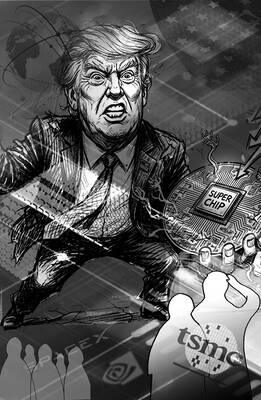
The White House’s decision to take a 9.9 percent stake in Intel Corp is looking like very shrewd business indeed. Since the government bought in at US$20.47 a share last August, the US chipmaker’s surging stock price has delivered the US a US$43 billion return. One of the reasons the investment has so far proved so sound is that the White House has made sure of it. According to The Wall Street Journal, Howard personally pushed deals on Intel’s behalf with some of the most lucrative clients imaginable. They include Nvidia Corp, the company at the heart of the AI
A single photograph can cut through a lot of noise, but it can also be used to misrepresent the truth. At the very least, it can concentrate the mind on something that requires further investigation. On Monday last week, Ma Ying-jeou Foundation CEO Tai Hsia-ling (戴遐齡) and former National Security Council secretary-general King Pu-tsung (金溥聰) held a news conference in which they showed a photograph of former foundation CEO Hsiao Hsu-tsen (蕭旭岑), now Chinese Nationalist Party (KMT) deputy chairman. In the image Hsiao is seated next to Xiamen Taiwan Businessmen Association chairman Han Ying-huan (韓螢煥). The two men were holding
I first met Professor Ray Jiing (井迎瑞) as a film and documentary student at Shih Hsin University’s (SHU) Department of Radio Television and Film in 1988. The following year, he went on to become the director of the Chinese Taipei Film Archive — forerunner of the Taiwan Film and Audiovisual Institute (TFAI). Over his eight-year tenure, Jiing rescued and restored over 200 classic Taiwanese films. In 1997, he established the Graduate Institute of Studies in Documentary and Film Archiving at Tainan National University of the Arts (TNNUA), and I joined the program in his third cohort of students. Beyond a
A recent report concerning a student who is suing his teacher posed the question in its headline: Does failing a student in two subjects constitute bullying? The college student in Chiayi County apparently sought NT$2 million (US$63,603) in state compensation, but a court dismissed the case. The first reaction of many might have been to ask: What has happened to students nowadays? Some say that teachers have lost their authority, while others say students are overindulged. Some even start reminiscing over the days when “whatever the teacher says goes.” However, the real issue might be overlooked if emotional reactions like that are the


 RSS
RSS