


A recent report concerning a student who is suing his teacher posed the question in its headline: Does failing a student in two subjects constitute bullying?
The college student in Chiayi County apparently sought NT$2 million (US$63,603) in state compensation, but a court dismissed the case.
The first reaction of many might have been to ask: What has happened to students nowadays? Some say that teachers have lost their authority, while others say students are overindulged. Some even start reminiscing over the days when “whatever the teacher says goes.”
However, the real issue might be overlooked if emotional reactions like that are the focus. What happened was not solely about education. Rather, it was a sign that society is undergoing a transformation and Taiwanese are not prepared for it.
After the marketization of education, the “learning relationship” has been transformed into a “consumption relationship.” Over the past two or three decades, a similar phenomenon has emerged in many other parts of the world: Education has become increasingly a service industry. Under such marketization, students become clients and parents consumers, while schools worry about enrollment rates and teachers worry about customer complaints.
Previously, teachers made demands on students. Now, students evaluate teachers. In the past, the core of education was growth.
Now, education is increasingly expected to be a “comfortable experience.”
The problem is that growth is not always comfortable. It demands effort, challenges the mind, and involves mistakes and setbacks. When the system begins to fear conflict, what education loses might be the courage to demand growth.
Education used to be effective because teachers held a monopoly on knowledge. The traditional education system was quite reasonable in the era of information scarcity. The greatest value of teachers was “I know something, but you do not.”
From historical knowledge to English grammar, expert knowledge and geographical data, students could only rely on teachers, textbooks and libraries. So teachers lectured while students memorized. The approach was effective because “explicit knowledge” was previously in the hands of the teachers.
However, in the artificial intelligence (AI) era, explicit knowledge has already been overwhelmed. Students can quickly check ChatGPT, YouTube, Google, online courses and overseas academics for information via their smartphones. Oftentimes, such tools find information faster than their teachers can provide.
Sometimes, they even explain things more clearly. If teachers stick to the old-fashioned method of “I lecture, you listen,” students will naturally ask: “Why should I listen?” That is also one of the reasons behind the widespread phenomenon of students scrolling on their phones in class. The problem is not just about laziness on the part of students, but rather their perception that AI is better.
What is valuable in education is “tacit knowledge.” No matter how powerful AI is, it has limitations. AI excels in teaching explicit knowledge — like facts, definitions, formulas and vocabulary, but real challenges lie in tacit knowledge — such as how to judge, make decisions, interact with others, handle stress, solve problems, read the room, respond on the spot and learn how to deal with failure.
AI can explain these things, but explanations cannot replace real-life practice.
Watching 100 instructional videos on how to drive a car does not mean you will actually be able to take the wheel on the road and memorizing geographical and historical facts does not guarantee you could be a tour guide.
True expertise always involves a significant amount of “learning by doing.” That is the irreplaceable value of real professionals.
Unfortunately, many schools still operate under the traditional education model. Many education providers in Taiwan remain stuck in the cycle of “memorization, exams and grades,” instead of “doing, refining and enabling.” However, high scores do not necessarily lead to ability and being good at tests does not necessarily mean being good at doing things.
Many teachers feel trapped within the system. Faced with 18-week courses, large class sizes, pressure from grading students and demands for fair assessment, teachers are forced to adopt the most efficient methods, focusing on lectures, exams and assignments.
That exhausts and numbs teachers and students, as they form tacit agreements on low effort, low conflict and low growth.
More worryingly, there is an increasing number of teachers who rely on sales pitches. As competence has become more difficult to detect, another social phenomenon has emerged: Those who talk the talk are replacing those who walk the walk. Nowadays, everybody is a teacher, mentor, expert or consultant. Some possess skills, while others are simply good at self-branding. Although they are good at managing their image, they are not good at solving problems, while taking advantage of their “teacher” status to build influence, set trends and gain trust.
In the AI era, the role of teachers needs to be redefined. In the future, it will be risky if teachers only teach knowledge, because AI can do that faster and cheaper. So the truly valuable teachers will resemble coaches, mentors, trainers and curators. Their value will shift to helping students judge what matters, guiding them through practice, creating real-world scenarios and providing feedback. They will pass on tacit knowledge, transforming students from “knowing” to “doing.”
The greatest value of teachers was “knowing the answers.” In the AI era, their greatest value is “doing tasks with students, guiding them through practice and teaching them how to face the real world.”
The real crisis is not AI; it is that education is still stuck in an era without AI.
Dennis Ma is president of the Tourist Guide Association and an assistant professor at a university.
Translated by Eddy Chang
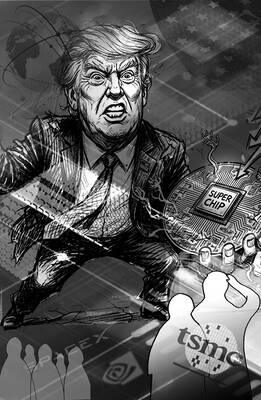
The White House’s decision to take a 9.9 percent stake in Intel Corp is looking like very shrewd business indeed. Since the government bought in at US$20.47 a share last August, the US chipmaker’s surging stock price has delivered the US a US$43 billion return. One of the reasons the investment has so far proved so sound is that the White House has made sure of it. According to The Wall Street Journal, Howard personally pushed deals on Intel’s behalf with some of the most lucrative clients imaginable. They include Nvidia Corp, the company at the heart of the AI
The Ministry of the Interior, working with the navy and coast guard, is organizing Taiwan’s first joint exercise simulating escort tankers carrying liquefied natural gas (LNG) and oil through a Chinese blockade. The drills simulate fuel transport along three maritime corridors leading toward Japan, the Philippines and the US. Deputy Minister of the Interior Sawyer Mars (馬士元) said that a blockade of the Taiwan Strait would amount to “almost a 100 percent blockade of the regional energy supply.” Minister of National Defense Wellington Koo said planning to counter a blockade is standard practice in Taipei. While the exercise is limited in
A single photograph can cut through a lot of noise, but it can also be used to misrepresent the truth. At the very least, it can concentrate the mind on something that requires further investigation. On Monday last week, Ma Ying-jeou Foundation CEO Tai Hsia-ling (戴遐齡) and former National Security Council secretary-general King Pu-tsung (金溥聰) held a news conference in which they showed a photograph of former foundation CEO Hsiao Hsu-tsen (蕭旭岑), now Chinese Nationalist Party (KMT) deputy chairman. In the image Hsiao is seated next to Xiamen Taiwan Businessmen Association chairman Han Ying-huan (韓螢煥). The two men were holding
I first met Professor Ray Jiing (井迎瑞) as a film and documentary student at Shih Hsin University’s (SHU) Department of Radio Television and Film in 1988. The following year, he went on to become the director of the Chinese Taipei Film Archive — forerunner of the Taiwan Film and Audiovisual Institute (TFAI). Over his eight-year tenure, Jiing rescued and restored over 200 classic Taiwanese films. In 1997, he established the Graduate Institute of Studies in Documentary and Film Archiving at Tainan National University of the Arts (TNNUA), and I joined the program in his third cohort of students. Beyond a


 RSS
RSS