


Singaporean former Prime Minister and current senior minister Lee Hsien- Loong(李顯龍) last month stood on Chinese soil and told Beijing that Singapore cooperates because of “shared interests”, not because of common “ethnic descent,” a significant statement that has upended China’s cognitive warfare tactics of “ethnic nationalism.”
Along with using its military buildup and economic growth to expand its international dominance, China has long deployed ethnic politics to promote the idea that all ethnic Chinese around the world, regardless of citizenship, share a tight bond with the Chinese motherland, by which it means the regime of the People’s Republic of China (PRC) ruled by the Chinese Communist Party (CCP).
The concept of “same ancestry, same roots” has been embedded in Chinese state rhetoric, aiming to cultivate affinity, influence and loyalty among overseas Chinese populations around the world, especially in Taiwan and Singapore.
Singapore has 6.11 million people, 75 percent of whom are ethnic Chinese. During his May 18 to 22 visit to China to seek more high-tech and economic cooperation, Lee addressed Singapore’s relationship with China at a news conference, saying: “We are a Chinese-majority country, but we are a multiracial society. We are a separate country with separate sovereignty from China.”
“Singapore must keep engaging China, but on its own terms,” Lee said, adding that “Singapore and China cooperate as friends and in order to have mutual benefits, but it’s because we both share common interests, not because we are both [of] the same ethnic descent.”
Reviewing Singapore’s national development history, the city-state has long asserted that it is an independent and multiracial sovereign country, rejecting the “third China” label.
Lee Kuan Yew (李光耀), Singapore’s first prime minister, who was born to a family of Peranakan Chinese descent, and his son Lee Hsien Loong have done their utmost to establish a Singaporean national identity, instead of an extension of Beijing’s “Chinese nation.”
In essence, the two Singaporean leaders proved that ethnic identity and national identity can overlap or interplay, but are not necessarily the same.
Loong’s remarks, deliberately delivered on Chinese territory, clearly refuted China’s “united front” narrative of ethnicity, while defending Singapore’s national sovereignty and civic identity.
The comments should be a wake-up call for some Taiwanese, and break the Chinese ethnic myth that some hold.
Taiwan Thinktank researcher Wu Se-chih (吳瑟致) said that “Singapore is countering China’s cognitive warfare of ethnic nationalism with civic nationalism, which emphasizes the loyalty of the people to the country stemming from a shared constitutional system, legal values and national identity, rather than from bloodlines or ethnicity.”
China’s “ethnic nationality” rhetoric targeting Taiwan, which Beijing has long sought to conquer as part of its dream of a “great rejuvenation of the Chinese nation,” is more extensive than what Singapore faces. An even greater challenge is that there are voices in Taiwan echoing China’s “united front” efforts, including statements such as: “same culture, same origins,” “both sides of the Taiwan Strait are one family” and “blood is thicker than water.” These agents promote so-called “cross-strait unification” and disguise the push to eliminate the sovereignty of the Republic of China (ROC)in Taiwan.
Chinese Nationalist Party (KMT) Chairwoman Cheng Li-wun (鄭麗文) in April visited China and met with Chinese President Xi Jinping (習近平). While Loong highlighted Singapore’s sovereignty, Cheng parroted Xi’s “same origin” and “one China” narratives, undermining Taiwan’s sovereignty.
The Wall Street Journal reported that Beijing is grooming Cheng to represent the KMT in the 2028 presidential election. Cheng, now in the US to meet with expatriate groups, is praising Xi and parroting the same rhetoric that “both sides of the Taiwan Strait belong to the Chinese nation” and that “we are one family.”
Cultural closeness and ethnic ties do not mean political obedience is required, let alone the surrender of sovereignty.
Taiwan is a mature democracy, entirely different from the one-party authoritarian China, and neither is subordinate to the other. Polls clearly show that the majority of people in Taiwan identify as “Taiwanese,” not “Chinese,” and also object to Beijing’s “one-country, two systems” or “unification” proposals.
From government actions and anti-infiltration legislation to social awareness and defense, Taiwan and the public should redouble their efforts to counter China’s ethnic politics.
Most importantly, the nation’s identity, democracy, freedom and the right to determine its own future must be prioritized.
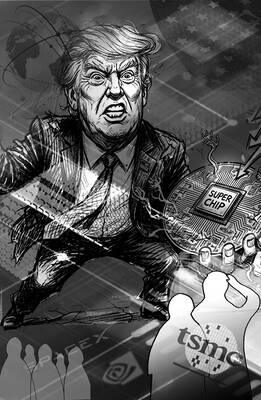
The White House’s decision to take a 9.9 percent stake in Intel Corp is looking like very shrewd business indeed. Since the government bought in at US$20.47 a share last August, the US chipmaker’s surging stock price has delivered the US a US$43 billion return. One of the reasons the investment has so far proved so sound is that the White House has made sure of it. According to The Wall Street Journal, Howard personally pushed deals on Intel’s behalf with some of the most lucrative clients imaginable. They include Nvidia Corp, the company at the heart of the AI
A single photograph can cut through a lot of noise, but it can also be used to misrepresent the truth. At the very least, it can concentrate the mind on something that requires further investigation. On Monday last week, Ma Ying-jeou Foundation CEO Tai Hsia-ling (戴遐齡) and former National Security Council secretary-general King Pu-tsung (金溥聰) held a news conference in which they showed a photograph of former foundation CEO Hsiao Hsu-tsen (蕭旭岑), now Chinese Nationalist Party (KMT) deputy chairman. In the image Hsiao is seated next to Xiamen Taiwan Businessmen Association chairman Han Ying-huan (韓螢煥). The two men were holding
I first met Professor Ray Jiing (井迎瑞) as a film and documentary student at Shih Hsin University’s (SHU) Department of Radio Television and Film in 1988. The following year, he went on to become the director of the Chinese Taipei Film Archive — forerunner of the Taiwan Film and Audiovisual Institute (TFAI). Over his eight-year tenure, Jiing rescued and restored over 200 classic Taiwanese films. In 1997, he established the Graduate Institute of Studies in Documentary and Film Archiving at Tainan National University of the Arts (TNNUA), and I joined the program in his third cohort of students. Beyond a
A recent report concerning a student who is suing his teacher posed the question in its headline: Does failing a student in two subjects constitute bullying? The college student in Chiayi County apparently sought NT$2 million (US$63,603) in state compensation, but a court dismissed the case. The first reaction of many might have been to ask: What has happened to students nowadays? Some say that teachers have lost their authority, while others say students are overindulged. Some even start reminiscing over the days when “whatever the teacher says goes.” However, the real issue might be overlooked if emotional reactions like that are the


 RSS
RSS