


The US-Israeli war with Iran has shown how instability can become a powerful political instrument. Leaders can exploit crises to maintain supporters’ loyalty, even while imposing costs on them, and extract concessions from domestic and foreign adversaries through coercion and manufactured unpredictability. In a forthcoming paper, Canadian economist Ronald Wintrobe calls this dynamic “thugocracy”: a form of rule grounded in coercion, intimidation and unpredictability.
Over the past three months, the conflict has swung repeatedly — sometimes within hours — from escalation to de-escalation, with threats, strikes, sanctions, tolls and ceasefire announcements following one another at breakneck speed. For example, on April 7, only hours after saying that “a whole civilization will die tonight,” US President Donald Trump abruptly changed tack and announced a ceasefire, claiming that America’s military objectives had already been achieved.
Conventional frameworks for diplomacy and deterrence are poorly suited to a conflict of this kind. Wintrobe’s thugocracy concept is especially valuable because it highlights how coercion, instability and political loyalty can interact in ways that redistribute the costs and benefits of conflict unevenly across society. Political and economic insiders have the financial resources and privileged information to benefit from instability, while all others absorb the costs. Convinced that the sacrifices imposed by war, sanctions and economic coercion serve a larger purpose, the leader’s supporters are willing to endure substantial hardship.
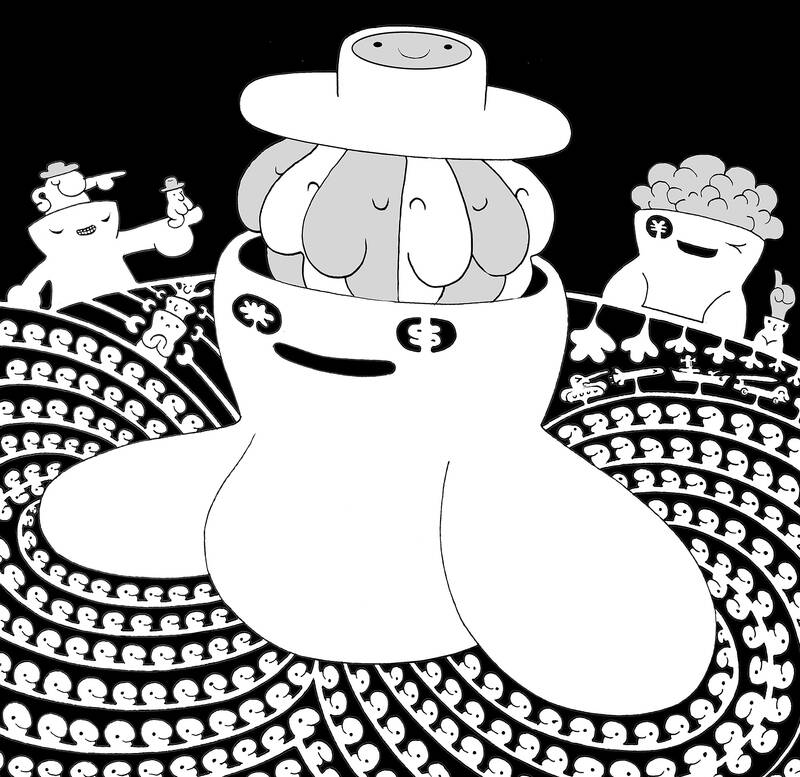
Illustration: Mountain People
The Trump administration illustrates how war and profit are becoming increasingly intertwined. In March, for example, the Financial Times reported that a broker associated with Secretary of Defense Pete Hegseth attempted to acquire a defense-focused investment fund just before the start of the Iran war. While that allegation remains disputed, the broader dynamic is clear: Those closest to power are uniquely positioned to anticipate shocks, hedge against them and profit from the instability that follows. Prediction markets such as Polymarket have pushed that logic even further, turning geopolitical escalation itself into a speculative asset.
The pattern extends beyond financial markets. Trump has repeatedly threatened to “take” Iran’s oil and target key oil-export infrastructure, including facilities on Kharg Island, underscoring how deeply material interests are embedded in his strategic calculus.
Trade policy has likewise become an instrument of coercion, with Trump threatening to impose sweeping tariffs on countries that continue trading with Iran. Together with sanctions and military pressure, trade restrictions have become part of a unified bargaining strategy aimed not only at weakening Iran but at maximizing US leverage over other countries.
Viewed against the backdrop of Iran’s economy before the war began, the effects of these measures become much clearer. After decades of Western sanctions, many households were already grappling with falling living standards, while domestic industries struggled to stay afloat.
Nader Habibi of Brandeis University and I said in a study that international sanctions were associated with a significant contraction of Iran’s middle class between 2012 and 2019. This was not simply a temporary shock, but the result of sustained declines in real incomes, persistent inflation and severe labor-market disruptions. As purchasing power eroded, many households experienced downward mobility.
The consequences were not limited to lost income. Studies have shown that sanctions have made essential drugs far more expensive and harder to obtain. For many patients, this meant missing or delaying treatment and heightened health risks. These economic and social pressures helped fuel the mass protests that swept Iran early this year.
The war is devastating an economy already weakened by years of cumulative shocks. And because ordinary Iranian households bear most of these costs, external actors remain insulated from many of the immediate political costs of escalation.
This helps explain why coercive policies can retain support among a leader’s core constituency despite imposing significant economic costs. Drawing on the concept of “Giffen goods,” Wintrobe said that some policies can continue to command support even when they leave supporters materially worse off. That does not mean that the Iran war is popular among US voters, or that Iran’s government enjoys majority support. Rather, the mechanism operates within particular constituencies. In the US, it works through partisan loyalty, narratives of strength and selective information flows. In Iran, external attacks and sanctions can reinforce nationalist solidarity, even among citizens who remain critical of the regime.
Information is central to this process, especially among Trump’s core supporters. The issue is not formal censorship, but a fragmented and polarized media environment in which the costs of the Iran war can be reframed as the price of strength, deterrence and national renewal. In such a setting, economic strain can more easily be attributed to Iran, foreign rivals or domestic opponents rather than to the administration’s own decisions. At the same time, Trump’s rapid shift from threatening Iran with catastrophic destruction to announcing a ceasefire can be cast as tactical success, reinforcing the perception that the president is acting decisively and strategically.
Identity also plays a powerful role. When policies are framed as vital to national security, they can create a strong sense of collective purpose even as they impose severe economic costs. That is because public attitudes are shaped as much by status, identity and fear of external threats as they are by material interests.
In times of war, the connection between policy choices and economic hardship becomes obscured, making alternative explanations easier to accept. The result is a political equilibrium that perpetuates costly and destabilizing policies. The persistence of sufficient public support for such measures reflects the interplay between economic incentives, weak political accountability, restricted information and identity politics, rather than simple voter irrationality.
When war generates economic gains for certain groups, it can create powerful incentives to prolong it. While not every beneficiary seeks escalation, some people are structurally positioned to profit from it.
The fallout does not stop at national borders. Rising prices, supply-chain disruptions and heightened uncertainty ripple through the global economy, affecting households and firms far beyond the immediate conflict zone and reshaping political incentives worldwide.
The fragile ceasefire with Iran might pause the violence, but it does not alter the underlying incentives driving the conflict. As long as volatility enriches the powerful while ordinary people pay the price, escalation remains politically useful. The real challenge is to sever the link between geopolitical instability and private gain.
Mohammad Reza Farzanegan, professor of the economics of the Middle East at the Center for Near and Middle Eastern Studies and the School of Business and Economics at Marburg University, is a visiting fellow at the Hamburg Institute for Advanced Study and a research fellow at CESifo and the Economic Research Forum.
Copyright: Project Syndicate
Taiwan’s higher education system is facing an existential crisis. As the demographic drop-off continues to empty classrooms, universities across the island are locked in a desperate battle for survival, international student recruitment and crucial Ministry of Education funding. To win this battle, institutions have turned to what seems like an objective measure of quality: global university rankings. Unfortunately, this chase is a costly illusion, and taxpayers are footing the bill. In the past few years, the goalposts have shifted from pure research output to “sustainability” and “societal impact,” largely driven by commercial metrics such as the UK-based Times Higher Education (THE) Impact
History might remember 2026, not 2022, as the year artificial intelligence (AI) truly changed everything. ChatGPT’s launch was a product moment. What is happening now is an anthropological moment: AI is no longer merely answering questions. It is now taking initiative and learning from others to get things done, behaving less like software and more like a colleague. The economic consequence is the rise of the one-person company — a structure anticipated in the 2024 book The Choices Amid Great Changes, which I coauthored. The real target of AI is not labor. It is hierarchy. When AI sharply reduces the cost
The inter-Korean relationship, long defined by national division, offers the clearest mirror within East Asia for cross-strait relations. Yet even there, reunification language is breaking down. The South Korean government disclosed on Wednesday last week that North Korea’s constitutional revision in March had deleted references to reunification and added a territorial clause defining its border with South Korea. South Korea is also seriously debating whether national reunification with North Korea is still necessary. On April 27, South Korean President Lee Jae-myung marked the eighth anniversary of the Panmunjom Declaration, the 2018 inter-Korean agreement in which the two Koreas pledged to
I wrote this before US President Donald Trump embarked on his uneventful state visit to China on Thursday. So, I shall confine my observations to the joint US-Philippine military exercise of April 20 through May 8, known collectively as “Balikatan 2026.” This year’s Balikatan was notable for its “firsts.” First, it was conducted primarily with Taiwan in mind, not the Philippines or even the South China Sea. It also showed that in the Pacific, America’s alliance network is still robust. Allies are enthusiastic about America’s renewed leadership in the region. Nine decades ago, in 1936, America had neither military strength


 RSS
RSS