


The lead-up to US President Donald Trump’s two-day summit with Chinese President Xi Jinping (習近平) reflected the prevailing assumption within his administration that China can be treated as another rising power willing to negotiate pragmatic deals with the incumbent global hegemon.
However, Xi’s China represents something else entirely: a near-totalitarian country with a clear and ambitious strategy to surpass the US and remake the global order. Guided by Xi’s “China Dream” of national rejuvenation, the People’s Republic of China is not seeking merely to create a bipolar world or step into the US’ shoes. Nor does it aspire to inherit the burdens and obligations that accompanied US primacy.
Instead, as Olivia Cheung and I write in our forthcoming book China’s Global Strategy Under Xi Jinping, China is seeking global pre-eminence on its own terms, reshaping the international order in ways that reflect its own political system, values and interests. While China recognizes the importance of its bilateral relationship with the US, its global strategy is not centered on it. Rather, it is guided by “Xi Jinping Thought” and implemented under the direction of the Chinese Communist Party (CCP).
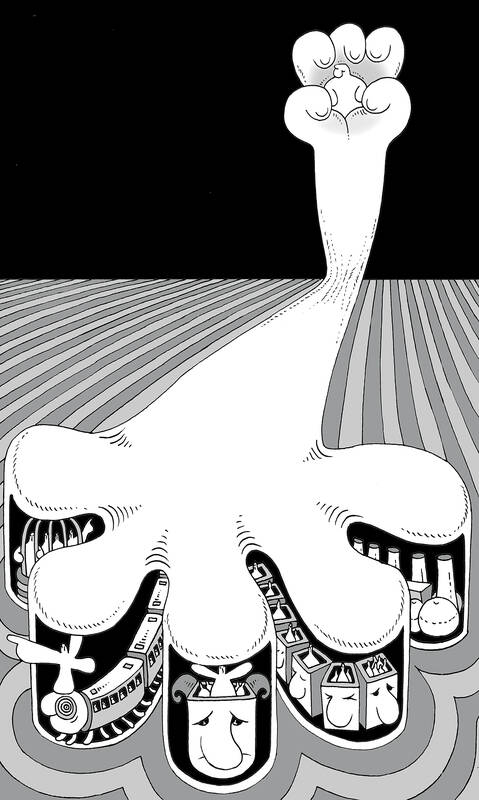
Illustration: Mountain People
The nature of China’s political system — and the way it is fused with state ideology — profoundly shapes its approach to international affairs. If China were merely another authoritarian power with expansive regional ambitions, it might be inclined to join Trump’s US in dividing the world into spheres of influence. However, its foreign policy is not reactive; first and foremost, it is driven by the pursuit of totalitarian rule.
For the US, this means that competition with China cannot be understood solely through the traditional lens of great-power politics. To engage with China effectively, US policymakers must recognize that Xi’s geopolitical ambitions are inseparable from his broader totalitarian project.
Two major new books by prominent US-based academics offer a deeper understanding of the ideological and institutional forces shaping China’s rise. They say that China’s gradual return to totalitarianism is not a historical accident brought about by Xi’s rise to power, but rather a structural feature of the Chinese political system that has far-reaching implications beyond China itself.
In Institutional Genes: Origins of China’s Institutions and Totalitarianism, Stanford University’s Xu Chenggang (許成鋼) draws on Chinese, Russian and Western history to explain why China remains trapped in institutional patterns that reproduce totalitarian rule.
Pei Minxin’s (裴敏欣) The Broken China Dream: How Reform Revived Totalitarianism focuses more narrowly on the post-Mao Zedong (毛澤東) era, tracing the roots of China’s increasingly authoritarian trajectory to Deng Xiaoping’s (鄧小平) approach to “reform and opening up.”
Although Xu and Pei approach the issue from different angles, they arrive at strikingly similar conclusions. Whereas Xu says that China’s return to totalitarianism was written into the regime’s DNA, Pei argues that the decisive factor was Deng’s decision to preserve the Leninist one-party state while pursuing economic reform. By maintaining the CCP’s political monopoly, Deng blocked democratization and set the stage for the eventual emergence of a Xi-like leader, Pei writes.
At the center of both books lies a fundamental question: What exactly is totalitarianism?
Xu defines it as “an extreme type of modern autocracy characterized by total control over society through a totalitarian party” that relies on “ideology, secret police, armed force, the media and organizations (including businesses) throughout society” to dominate resources and social life. That distinguished it from authoritarianism, which does not depend on an all-encompassing ideology or seek tight control over society and the economy.
As Xu points out, modern totalitarianism emerged in the wake of the 1917 Bolshevik Revolution. In his view, communist totalitarianism took root in China not only because of Soviet support for the fledgling CCP and Mao, but also because China’s own institutional traditions made Chinese society more receptive to it.
However, I am not convinced that contemporary China merits the label “totalitarian.” Whereas Xu unequivocally classifies it as such, Pei adopts a more nuanced view, writing that Xi has moved China closer to totalitarianism than authoritarianism. I would instead describe China today as aspiring to totalitarianism, although it has not yet reached that point.
To be sure, Xi’s “one country, one ideology, one people, one party and one leader” agenda — central to his “China Dream of national rejuvenation” — leaves little doubt about his intentions, but the project remains incomplete. Despite the CCP’s massive state apparatus, sophisticated digital surveillance systems and requirement that Chinese citizens study “Xi Jinping Thought,” the regime does not exercise total control over the economy, nor has it eliminated individual freedom outside the political realm.
Information access is a case in point. China might not have a free and open Internet, but the vast intranet constructed by the CCP still gives citizens remarkable latitude to browse, shop, communicate and consume entertainment online. Nothing comparable existed in Mao’s China.
Xu is more pessimistic than Pei. If totalitarianism is embedded in China’s institutional genes, as he writes, democratization would require replacing those deeply entrenched patterns with pro-democratic ones — a prospect bordering on fantasy.
Pei’s conclusions are more conditional. His analysis implies that dismantling China’s Leninist political structure could open a path to democratization, however arduous. Yet Pei himself considers such a shift exceedingly unlikely.
While Xu and Pei are right that the near-term outlook for freedom and rights in China remains bleak, all is not lost. Indeed, their books’ value lies not in presenting China’s future as predetermined, but in offering more grounds for cautious optimism than the authors themselves acknowledge.
The common thread running through both books is the resilience of China’s Leninist political system, which has remained in place since 1949. As both note, Deng’s insistence on upholding the “four cardinal principles” — the socialist road, the people’s democratic dictatorship, the CCP’s leadership, and the ideological supremacy of Marxism-Leninism and “Mao Zedong Thought” — ensured the survival of the institutional framework necessary for the eventual restoration of totalitarian rule.
By the start of the reform era, China resembled today’s North Korea far more than the prosperous, industrialized and technologically advanced power it is today. By any measure, China has proven more successful than its communist-totalitarian counterparts, building a more dynamic, innovative and efficient economy than the Soviet Union ever achieved — all while remaining quintessentially Leninist.
Much of the study on China has understandably focused on the sweeping transformations unleashed by four decades of rapid economic growth. That emphasis has obscured how little the political system itself has changed over the same period.
In this respect, Xu and Pei implicitly challenge earlier interpretations of China’s political evolution.
For example, in his 2010 book China’s New Confucianism: Politics and Everyday Life in a Changing Society, political theorist Daniel A. Bell suggested that the CCP had changed to such an extent that it might as well be called the Confucian Party of China. Xu and Pei’s analyses are difficult to reconcile with interpretations of this kind.
Whether China is best understood as totalitarian, near-totalitarian, or merely authoritarian has profound implications for democratic governments engaged in strategic competition with it, as well as businesses, universities and non-governmental institutions. To understand China, it is essential to focus on the political structures underpinning the regime, rather than how the regime may appear at a particular moment in history.
Consider China’s integration into the global economy. If democratic governments had recognized that Deng’s “reform and opening up” was designed not to dismantle China’s Leninist system, but to strengthen and modernize it, would they still have assumed that China’s accession to the WTO would nudge it toward Western-style liberalism? Would they have worked so hard to facilitate China’s economic modernization, thereby enabling it to become a world power capable of challenging and potentially eclipsing their own democratic-capitalist model?
Xu’s “institutional genes” concept accounts for why China’s economic transformation has failed to produce political liberalization. Rather than simply reviving the kind of civilizational argument that often underpins claims of Chinese exceptionalism, he writes that democratization ultimately depends on the “fundamental and stable mechanisms of incentives and constraints that shape the behavior of key actors in major social interactions.” Although these institutional genes are inherited, Xu acknowledges that they can evolve, mutate or be replaced.
Xu traces China’s institutional genes to its Marxist-Leninist legacy and its much longer history of centralized imperial rule — two traditions he sees as mutually reinforcing. He identifies three especially important features inherited from dynastic China: a centralized, hierarchical administrative system; an examination-based bureaucracy overseeing a continent-scale state; and concentrated land ownership.
These institutional arrangements fostered a political culture hostile to constitutionalism and democracy, Xu writes. The centralized state apparatus, the adoption of Confucianism as a form of premodern state ideology that shaped the thinking of government officials, and the absence of property rights all helped pre-empt challenges to imperial authority, whether from aristocratic elites or grassroots movements.
China is not alone in possessing institutional genes conducive to totalitarian rule, Xu writes. Russia, too, developed institutional traditions that, while distinct from China’s, proved equally fertile ground for communist dictatorship.
Whether Xu’s sweeping historical argument ultimately proves his case is open to debate, but it raises a question that cannot easily be dismissed: Can some societies become trapped in totalitarianism because of deeply embedded institutional structures and political traditions? There is no need to embrace his theory of institutional genes to recognize the pivotal role China’s political structures have played in shaping its post-Mao trajectory.
Pei reaches a similar conclusion without resorting to institutional genetics. Instead, he offers a damning indictment of Deng’s legacy. Through a meticulous decade-by-decade dissection of the post-Mao era, he chronicles China’s extraordinary economic and social transformation while demonstrating how its political system, buttressed by Deng’s four cardinal principles, has remained fundamentally unchanged.
Pei’s argument is in many ways more empirically compelling. By confining himself to the post-Mao era, he is able to draw on a more focused body of evidence while avoiding the controversies inherent in Xu’s panoramic historical survey, which spans civilizations and millennia. His central thesis — that the survival of the Leninist system foreclosed any possibility of democratization — makes Xi’s rule appear all but inevitable in retrospect, reinforcing the argument that China remains caught in a totalitarian trap.
Pei’s analysis — particularly his interpretation of the CCP’s crucial 17th Congress in 2007, which elevated Xi as then-Chinese president Hu Jintao’s (胡錦濤) heir apparent ahead of the 2012 leadership transition — is formidable. Even so, he might overestimate the extent to which the Leninist system facilitated Xi’s totalitarian ambitions. My own assessment of China’s long-term trajectory is less pessimistic.
In 2007, when Xi emerged as Hu’s successor, Hu himself preferred his protege Li Keqiang (李克強), but his Communist Youth League faction lost out to the Shanghai faction headed by Hu’s predecessor, former Chinese president Jiang Zemin (江澤民), Pei writes. Xi ultimately prevailed because Jiang’s faction lacked a strong candidate of its own and preferred backing him to allowing the Youth League to dominate the leadership for another decade.
Once in power, he capitalized on widespread alarm within the CCP leadership over corruption and institutional decay to outmaneuver and neutralize both factions.
Pei also writes that Xi was not the only senior leader pushing for totalitarianism. The other prominent figure was Bo Xilai (薄熙來), the politburo member who oversaw Chongqing before his expulsion and arrest in 2012. In Pei’s telling, broad support among CCP leaders for Bo’s “Chongqing model,” which concentrated economic power in the hands of regional leaders and state-owned enterprises, revealed how receptive the Leninist system was to a revival of totalitarian politics.
What remains less convincing is Pei’s suggestion that Xi’s rise reflected the structural logic of the Leninist system rather than contingent political maneuvering. As Pei himself acknowledges, Jiang and the Shanghai faction backed Xi precisely because he lacked a strong factional base and advanced through the system without raising red flags.
Unlike Bo, whose flamboyant neo-Maoist politics unnerved much of the party leadership, Xi carefully concealed his ambitions and ideological preferences before coming to power. In other words, Jiang’s faction supported Xi not because they wanted a return to totalitarianism, but because they believed they could control him.
The elite consensus that first sidelined Bo and later brought about his downfall further suggests that the CCP’s top echelon did not want to see China steered back toward totalitarianism. Bo’s revival of practices associated with the Cultural Revolution triggered great unease — and likely fear — among many of his peers, which is why they ultimately turned against him. Xi, by contrast, played a far more disciplined and calculated game. For that reason, the Leninist system alone cannot fully account for his rise.
While Deng’s decision to preserve the Leninist order undoubtedly created the institutional conditions that made the emergence of a new totalitarian ruler possible, it did not make the rise of someone like Xi inevitable. His ascent is therefore better understood as the result of elite maneuvering, rather than as a predetermined outcome of China’s political system.
Moreover, party leaders’ distaste for Bo’s totalitarian tendencies seems to have lingered. Despite their unwillingness to challenge Xi openly, many within the political elite appear uncomfortable with the direction in which he is taking China.
For example, Chinese Minister of Foreign Affairs Wang Yi (王毅) initially appeared uneasy with Xi’s push for “wolf warrior” diplomacy before ultimately falling into line. Should Xi preside over a prolonged national crisis, it is far from clear how many would remain loyal.
None of this is to suggest that Deng should be absolved. Had he not preserved the Leninist system, Xi would have found it vastly more difficult, if not impossible, to begin restoring totalitarianism within five years of taking power. Still, possibility should not be confused with inevitability. That distinction might seem subtle, but it suggests that China’s future is far from preordained.
Xi’s commitment to totalitarianism is unmistakable. For him, centralized authority and ideological discipline are the foundations of China’s greatness. National greatness, of course, can also be understood differently: not as the concentration of power in the hands of the state, but as the ability of citizens to be protected by the law, develop their talents freely, and prosper without fear of repression and discrimination.
However, even by Xi’s own standards it is far from clear that totalitarianism can deliver long-term prosperity. On this point, Xu’s skepticism appears well-founded. His survey of modern history suggests that communist-totalitarian systems consistently succumb to economic mismanagement, policy rigidity and declining dynamism. As he writes, no communist-totalitarian state has escaped the middle-income trap.
Whether China will be an exception remains to be seen. Totalitarianism can achieve impressive short-term results, particularly when it comes to mobilizing resources, building infrastructure and advancing strategic industries. However, centralized control and ideological rigidity tend to distort economic decisionmaking, suppress entrepreneurship and domestic innovation, and generate distrust abroad. The further Xi pushes China down the totalitarian path, the more pronounced these problems are likely to become.
China’s history since 1949 illustrates the point starkly. Under Mao, totalitarian rule produced repeated economic disasters, most catastrophically during the Great Leap Forward, which caused one of the deadliest famines in human history, killing an estimated 30 million people between 1959 and 1961. By the end of the Mao era, China was among the world’s poorest countries, in sharp contrast to Taiwan’s rapid industrialization under Chiang Kai-shek (蔣介石).
Deng’s reforms succeeded largely because the CCP retreated from the most extreme forms of totalitarianism. China opened itself to foreign trade, investment, technology and managerial expertise, convincing much of the outside world that it was moving toward a more pragmatic and less ideological system.
Under collective leadership, China experienced decades of extraordinary growth, aided significantly by the Chinese diaspora’s capital and expertise. The end of that era of breakneck expansion coincided with Xi’s rise to power and his renewed push toward totalitarianism.
Of course, China’s economic slowdown cannot be attributed solely to Xi. Structural pressures associated with the middle-income trap, such as rising labor costs and demographic decline, have played a significant role — but Xi’s governing style has clearly compounded these problems.
In particular, his replacement of collective leadership with authoritarian rule has increased both the frequency and scale of major policy mistakes, from the escalation of the trade war with the US during Trump’s first term to the abrupt abandonment of the “zero COVID-19” policy, which triggered a massive spike in deaths among an inadequately vaccinated population.
At the same time, Xi’s increasingly aggressive approach has led many external partners to rethink economic and technological cooperation with China. The shift in public mood has been equally significant. For much of the reform era, most Chinese believed their lives would continue to improve, but that confidence has weakened under Xi.
Rather than participating enthusiastically in his project of national rejuvenation, many younger people have opted out of China’s hypercompetitive work culture altogether, embracing the ethos of tangping (躺平, “lying flat”).
Admittedly, Xi’s restoration of centralized control has significantly increased the CCP’s capacity to direct development in strategic sectors, particularly advanced technologies, but these gains come at considerable cost. By abandoning the pragmatism that defined the reform era in favor of totalitarianism, Xi risks undermining the very foundations of the economic miracle that made China’s rise possible, thereby weakening its ability to achieve the “China Dream.”
Moreover, Xi has planted a political time bomb by effectively making himself leader for life. By dismantling the norms of orderly succession established after Mao, he has increased the likelihood that his eventual departure would trigger an intense power struggle that could shape China’s future.
As Pei writes, the prospects for democratization remain dim, but even a partial retreat from totalitarianism would be better for China and the world.
For now, China’s direction under Xi appears fixed. Whether he can ultimately realize his “China Dream” will depend not only on the competence of his leadership, but also on how the rest of the world responds to a regime that increasingly defines itself in opposition to the democratic world.
This is where Pei’s and Xu’s books prove especially valuable. Anyone interested in China would benefit enormously from Pei’s insights and his lucid, well-structured analysis of its post-Mao evolution. Policymakers, in particular, stand to gain a significantly clearer understanding of the country they are dealing with.
Xu’s ambitious and sprawling work also deserves serious attention, although at more than 700 pages, it is likely to be read primarily by academic specialists.
Together, Pei and Xu provide indispensable insights into the nature of Xi’s China. By forcing readers to look beyond the reassuring assumptions that have long shaped Western policies and confront the deeper structural forces driving the Chinese political system, they lay bare the stakes of China’s return to totalitarianism.
Steve Tsang is director of the SOAS China Institute at the University of London’s School of Oriental and African Studies. He is the author of The Political Thought of Xi Jinping and the coauthor of the forthcoming China’s Global Strategy Under Xi Jinping.
Copyright: Project Syndicate
Taiwan’s higher education system is facing an existential crisis. As the demographic drop-off continues to empty classrooms, universities across the island are locked in a desperate battle for survival, international student recruitment and crucial Ministry of Education funding. To win this battle, institutions have turned to what seems like an objective measure of quality: global university rankings. Unfortunately, this chase is a costly illusion, and taxpayers are footing the bill. In the past few years, the goalposts have shifted from pure research output to “sustainability” and “societal impact,” largely driven by commercial metrics such as the UK-based Times Higher Education (THE) Impact
History might remember 2026, not 2022, as the year artificial intelligence (AI) truly changed everything. ChatGPT’s launch was a product moment. What is happening now is an anthropological moment: AI is no longer merely answering questions. It is now taking initiative and learning from others to get things done, behaving less like software and more like a colleague. The economic consequence is the rise of the one-person company — a structure anticipated in the 2024 book The Choices Amid Great Changes, which I coauthored. The real target of AI is not labor. It is hierarchy. When AI sharply reduces the cost
The inter-Korean relationship, long defined by national division, offers the clearest mirror within East Asia for cross-strait relations. Yet even there, reunification language is breaking down. The South Korean government disclosed on Wednesday last week that North Korea’s constitutional revision in March had deleted references to reunification and added a territorial clause defining its border with South Korea. South Korea is also seriously debating whether national reunification with North Korea is still necessary. On April 27, South Korean President Lee Jae-myung marked the eighth anniversary of the Panmunjom Declaration, the 2018 inter-Korean agreement in which the two Koreas pledged to
I wrote this before US President Donald Trump embarked on his uneventful state visit to China on Thursday. So, I shall confine my observations to the joint US-Philippine military exercise of April 20 through May 8, known collectively as “Balikatan 2026.” This year’s Balikatan was notable for its “firsts.” First, it was conducted primarily with Taiwan in mind, not the Philippines or even the South China Sea. It also showed that in the Pacific, America’s alliance network is still robust. Allies are enthusiastic about America’s renewed leadership in the region. Nine decades ago, in 1936, America had neither military strength


 RSS
RSS